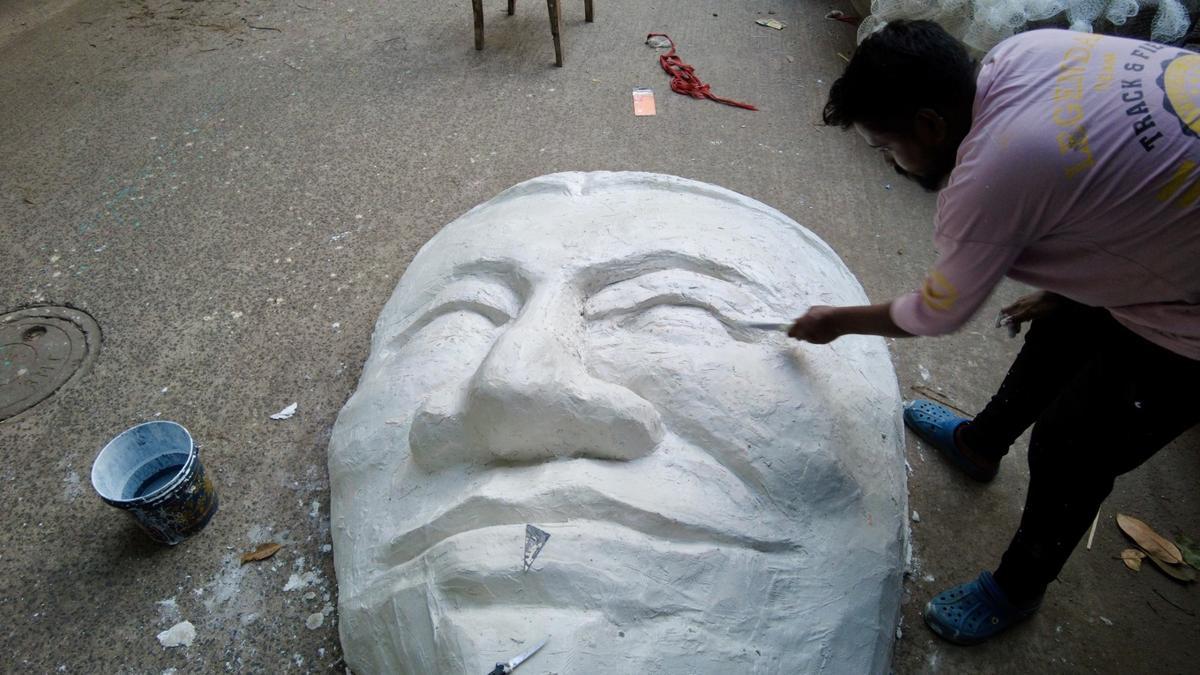
Kolkata’s Behala Art Fest aims to connect aesthetics with the ordinary
The Hindu
Behala Art Fest brings art to the streets, making it accessible to all, featuring artists from around the world.
This is a show that aims to drag art out of galleries onto the streets to make it accessible to people who would otherwise never imagine stepping into the hallowed halls where it is usually displayed. The Behala Art Fest — perhaps the only event in Kolkata named after a neighbourhood — begins on Friday (December 20, 2024), completing five years with this edition and more popular than ever.
“Artists are encouraged to engage in any artistic discipline, including installation, photography, performance, and graffiti, among others. This year, artists from several countries, including Japan, the Netherlands, Bangladesh, and Denmark, are participating,” Panchali Banerjee, director of Behala Art Fest Foundation, said.
Since the show is for the public, in the real sense of the word, displays are located in places such as buildings, garages, shops. streets, parking lots, and rickshaw stands. “The idea is to make art as much accessible to a vegetable vendor as to a vegetable buyer, as much accessible to a rickshaw puller as to a commuter. We wanted to free art from the confines of galleries, we wanted to rid it of the elitist tag, we wanted to bridge the gap between art and ordinary people,” Abhishek Bhattacharjee, one of the organisers, said.
The show will go on for three days, December 20-22, open to the public from 3 p.m. to 10 p.m. As many as 25 artists are participating and round-the-clock security and CCTV cameras will protect their exhibits. This year’s show is being curated by Anuradha Pathak and Ayan Mukherjee.
“Apart from Durga Puja, this is the only art festival that happens in the public realm, bringing together visual artists, performance artists filmmakers, photographers and social art practitioners on the same platform. This year many artists interacted with the people of Behala and that excited the locals because they saw themselves as part of the fest and not just providers of space. When people from the locality become part of the process and act as collaborators, the event automatically becomes inclusive and the excitement increases,” Ms. Pathak said.
The festival is usually held in February but this year had to be shifted from February to December because board exams were advanced due to the general elections and exam-related restrictions were in place. The inaugural edition was held shortly before the COVID-19 lockdown was imposed and luckily for the organisers, subsequent Februarys saw the relaxation of pandemic-related restrictions.


Telangana MP urges Centre to expedite ₹1,270 crore dues transfer from Andhra Pradesh for financial fairness and development.

A Karnataka man was detained with ₹62.5 lakh in cash during election checks on NH 544, claiming it was from a property sale.

Telangana Government issued 16 notifications to fill 31,798 vacancies, with 67,763 total recruitments since Congress took power.

Supreme Court directs Tarun Butolia's family to seek safety assessment from Delhi Police after fatal Uttam Nagar clash.

CM Stalin asserts unity in the DMK-led alliance, dismissing division attempts and emphasizing collaborative efforts for the upcoming elections.

Rahul Gandhi to skip Kerala rally due to Sonia Gandhi’s ill health; Kharge to attend Kozhikode event
Rahul Gandhi will miss the Kerala rally due to Sonia Gandhi's health; Congress president Kharge to attend instead.

Thunderstorms with lightning and gusty winds forecasted for 20 Telangana districts on March 26

TGSRTC reduces Metro AC and Deluxe bus fares by 30% in Hyderabad to encourage public transport amid the fuel crisis.

Supreme Court criticises Haryana Police for mishandling a four-year-old rape case, mandates swift action and oversight with a Special Investigation Team.

On World Theatre Day 2026, artists in Hyderabad call for affordable venues as rising costs and infrastructure gaps challenge the city’s theatre ecosystem.

Madhapur police seize 31 illegally transported commercial gas cylinders, ensuring public safety and compliance with regulatory norms.

Punjab AAP MLA Harmeet Singh Pathanmajra arrested in Gwalior after evading police in a rape case for over six months.

Bose Krishnamachari resigned from the Kochi Biennale Foundation amid sexual harassment allegations, confirmed by the foundation's chairperson.