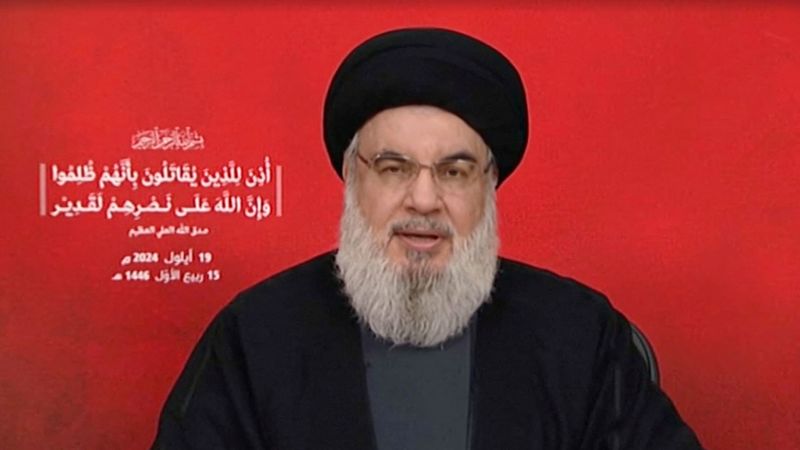
Killing of Nasrallah is a key prize for Israel, but it’s too early to write off Hezbollah
CNN
On Saturday, Hezbollah confirmed that its leader, Hassan Nasrallah, is dead after Israel announced he was killed in an airstrike in Beirut on Friday.
On Saturday, Hezbollah confirmed that its leader, Hassan Nasrallah, is dead after Israel announced he was killed in an airstrike in Beirut on Friday. His death marks a major moment in recent Middle East history, but the long-term consequences are uncertain. It raises a key question: Do “decapitation strikes” killing the leaders of terrorist groups cripple them? The short answer is not really. Israel should know from its own history that such strikes don’t always succeed in crippling a militant group. In 2008, Israel killed Hezbollah’s military leader, Imad Mughniyeh, in Damascus, Syria, yet the group only gathered strength in the years that followed. Four years earlier, Israel killed a founder of Hamas, Sheikh Ahmed Yassin, in an airstrike. Yet, the group did not collapse, and almost two decades later it still carried out the October 7 attacks in Israel, killing some 1,200 Israelis in a single day. More recently, in July, Israel said it killed one of the October 7 masterminds, Mohammed Deif, a key Hamas military commander, yet the militant group fights on in Gaza. The US has its own history of killing terrorist leaders in the hope that it will cripple its foes. When Abu Musab al-Zarqawi, the leader of al Qaeda in Iraq, was killed in a US bombing raid in 2006, it was treated as a major breakthrough because al Qaeda in Iraq was significantly contributing to the civil war that was then tearing the country apart.


More than a month into the Department of Homeland Security shutdown, lawmakers on Capitol Hill are reckoning with their own travel privileges amid anxieties the funding crunch could exacerbate issues at already understaffed airports around the country.

TV host and comedian Bill Maher has been chosen to receive the prestigious Mark Twain Prize for American Humor, two sources close to the Kennedy Center told CNN.

Conventional wisdom has set in that President Donald Trump’s base is sticking with him on the Iran war, but he has alienated significant portions of his voters — and risks alienating more.

US officials are furiously trying to avert a potential monthslong closure of the Strait of Hormuz, privately acknowledging that reopening the key waterway is a problem without a clear solution and dependent at least in part on what lengths President Donald Trump is willing to go to force the Iranian regime’s hand, multiple administration and intelligence officials tell CNN.

The chief executive of Live Nation testified Thursday that it was “disgusting” that a top ticketing employee talked about “robbing fans blind” in internal messages.

Supreme Court revives First Amendment lawsuit from street preacher who called concertgoers ‘sissies’
The Supreme Court on Friday revived a First Amendment lawsuit from a street preacher who used a loudspeaker to call people “whores,” “Jezebels” and “sissies” as they tried to enter an amphitheater to attend concerts in a suburban Mississippi community.

As millions of Americans braced for a series of brutal storms this winter, the senior official in charge of the federal government’s disaster response had been on the job only a few weeks — and had previously claimed on podcasts that he once teleported to a Waffle House.

Air travelers across the US continue to face travel headaches as Transportation Security Administration workers go without full pay. Find the latest live updates here.

Veterans’ advocates are raising concerns that a new agreement between the departments of Veterans Affairs and Justice could take away veterans’ autonomy over their health care decisions and deter them from seeking care, particularly those facing homelessness.

Admirers of Cesar Chavez and public officials are scrambling to respond to claims about the man who has been honored with holidays, statues and school names in communities around the country.

The co-founder of Super Micro Computer and two others were charged with diverting $2.5 billion worth of servers with Nvidia’s artificial intelligence chips to China, in violation of US laws barring exports to that country without a license.

The Treasury Department will begin to manage federal student loans in default, taking on a key function of the Education Department as the Trump administration further pushes to dismantle it.

The Justice Department on Thursday seized several websites it says were used by Iran as part of “psychological operations” targeting perceived advisories and spreading terrorist propaganda.