Kerala University’s archaeological excavation unearths 5,300-year-old Early Harappan settlement in Gujarat
The Hindu
University of Kerala archaeologists uncover 5,300-year-old Early Harappan settlement near Lakhapar village in Gujarat, revealing unique cultural insights.
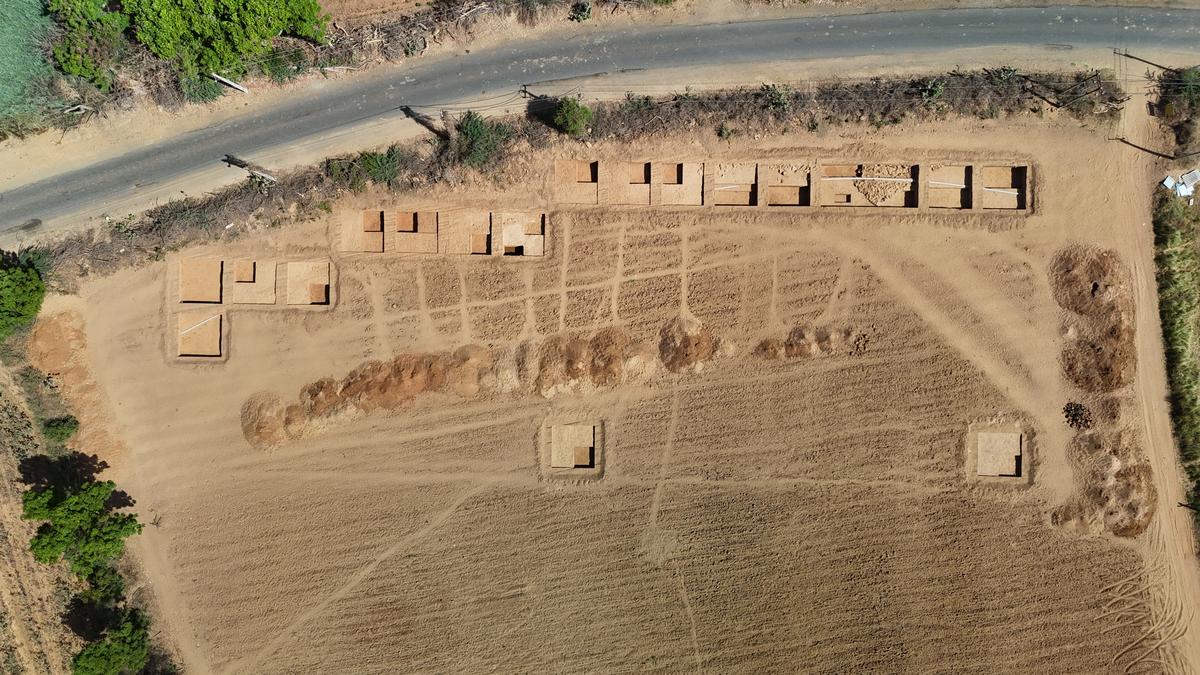
Archaeologists from the University of Kerala have unearthed a 5,300-year-old settlement near Lakhapar village in western Kachchh, Gujarat.
The excavation has revealed an Early Harappan habitation site, located near the now-quiet Gandi river, once a perennial water source, spanning nearly three hectares on either side of the Gaduli-Lakhapar road. The site was first identified in 2022 by a team led by Abhayan G.S. and Rajesh S.V. from the Department of Archaeology, Kerala University.
The collaborative project, involving both international and national institutions, builds upon the team’s earlier work at the nearby Early Harappan necropolis of Juna Khatiya, just 1.5 km away, where they had documented 197 burials over three field seasons since 2019.
The Lakhapar discoveries now provide critical habitation context to those burials, suggesting a dynamic, interconnected cultural landscape in the arid Kachchh desert.
The excavation uncovered structural remnants, walls made of local sandstone and shale, indicating well-planned construction activities.
Particularly striking is the presence of pottery from both Early and Classical Harappan phases, dating back to around 3300 BC. Among these finds is the extremely rare Pre-Prabhas Ware, previously known from only three sites across Gujarat. The presence of this distinct ceramic tradition at Lakhapar points to a culturally unique group within the larger Harappan civilization.
Even more intriguing is the discovery of a human burial in the vicinity of the settlement. The skeleton, though poorly preserved, was interred directly in a pit with no visible architecture or markers and accompanied by Pre-Prabhas Ware pottery. This is the first known burial to include this rare ware, hinting at a previously undocumented ritual practice or subgroup within the Early Harappan population, the researchers point out.


76-year-old Kurian Jacob from Kerala triumphs with seven medals, including five golds, at the Open Masters Games in Abu Dhabi.

Explore the nature of the human mind as an emergent property of brain activity and complex neural interactions.

CERN's Large Hadron Collider discovers the Xi-cc-plus particle, enhancing understanding of quantum mechanics and baryon behavior.

Vibha Batra’s latest book, Spotless (Hachette India) is a novel in verse for young adults

In its first edition, the Madras Art Salon spotlights the works of journalist and artist Narayan Lakshman at The Botanical Club, a social space in the British Deputy High Commission, Chennai

Cholesterol enhances melanoma cell invasion by making nuclei squishier, revealing a potential treatment target in cancer progression.

The designers reinterpret the Swedish artist’s symbolic forms and colour energy through contemporary resortwear silhouettes

Discover the inspiring legacy of Bibha Chowdhuri, a pioneering woman in physics and a trailblazer in STEM history.

Discover the inspiring legacy of Bibha Chowdhuri, a pioneering woman in physics and a trailblazer in STEM history.

Ashdeen’s Spring 2026 collection features saris inspired by the designer’s Parsi gara archive

Red ochre burials, ritual markings and myths across cultures show that red repeatedly marks liminal thresholds such as puberty, sacrifice and death; anthropologists argue that the colour functions as a technology of collective ritual and value, binding communities through shared symbolic acts

India approves 23 institutions for quantum labs under the National Quantum Mission, aiming to advance quantum technology and research.

India approves 23 institutions for quantum labs under the National Quantum Mission, aiming to advance quantum technology and research.