Kenyan police deployed to Haiti haven’t received full promised salary in two months
CNN
Hundreds of Kenyan officers are leading an international force in Haiti, but have not received full pay amid a rocky start in the gang-plagued Caribbean nation.
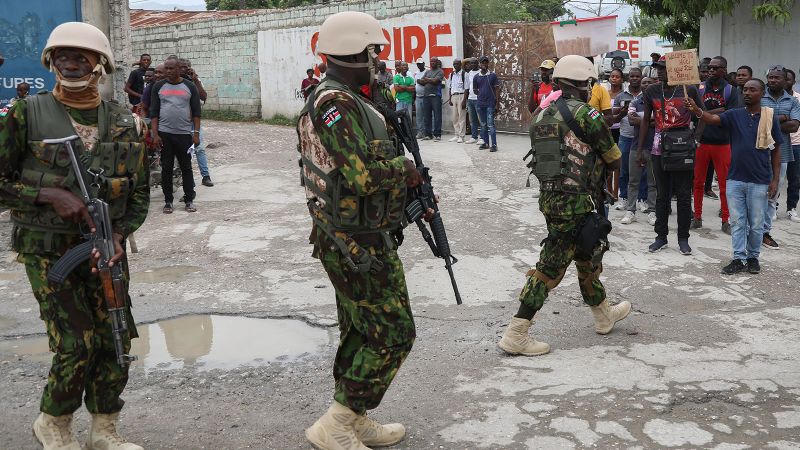
Hundreds of Kenyan police officers leading an international policing force in Haiti have not received their full pay for two months, the latest complication in what has been a rocky start to the security mission in the gang-plagued Caribbean nation. The first Kenyan officers deployed to Haiti arrived in June, the vanguard of a multinational security support mission (MSS) that is being funded largely by the United States. There are now around 400 Kenyan police in the country, many from specialized units. In an August 25 statement acknowledging delays to payments, the MSS announced that officers could expect the missing funds to hit their bank accounts this week. “Therefore, there is nothing to worry about (regarding) welfare issues of the MSS officers, since mainstream processes have been finalized,” the MSS added. In a “progress report” released Monday, Kenya’s National Police Service (NPS) said that the officers were continuing “to draw their NPS salaries” while waiting for the supplemental pay for their MSS duties. Kenyan officers had expected to be paid a significant supplement for their Haiti deployment – a grueling assignment more typical of a military than of a police force. Officers are not allowed to leave their base in the Haitian capital Port-au-Prince during non-working hours.


Earlier this month, US Immigration and Customs Enforcement announced a Cuban migrant had died at a Texas detention camp after experiencing “medical distress,” giving little detail of what led up to his final moments.

A judge on Wednesday threw out the boundaries of the only congressional seat in New York City represented by a Republican, ordering the state to redraw the district on the grounds that its current composition unconstitutionally diluted the votes of Black and Hispanic residents.

Lawmakers have taken the next step toward holding Bill and Hillary Clinton in contempt of Congress for refusing to comply with a subpoena to testify in the congressional Jeffrey Epstein investigation.

Jack Smith is “not afraid” of Donald Trump, whom he unsuccessfully tried to take to trial during the 2024 campaign, his legal team told CNN Wednesday.

The Supreme Court signaled deep skepticism Wednesday that President Donald Trump had the authority to remove Lisa Cook from the Federal Reserve, with several conservative justices joining their liberal colleagues in posing pointed questions of the lawyer defending the president.

President Donald Trump’s winding, antagonistic speech to business moguls and government officials in the Swiss Alps on Wednesday was hardly a salve to concerns the Western Alliance is at its breaking point.

President Donald Trump’s quest for control of Greenland took a significant turn on Wednesday, when he backed off on using d military force — an option he and This team had previously reserved.

California Gov. Gavin Newsom, long one of President Donald Trump’s chief trolls, took the routine this week to the World Economic Forum in Davos, Switzerland – and got a globally televised rise out of the president.

Former first lady Michelle Obama said in a new interview that the country is moving toward the direction of having a woman president — taking a softer approach after previously saying the country is not ready for one.

Treasury Secretary Scott Bessent on Wednesday offered some biting words about Denmark, which maintains territorial control over Greenland, after the European country’s pension fund announced it would unwind its investment in US government bonds.

State and the Twin Cities officials face subpoenas as the feds probe whether they obstructed immigration enforcement efforts that have drawn strong backlash. Follow for live updates

President Donald Trump’s suggestion Tuesday that his Board of Peace “might” replace the United Nations is likely to compound concerns that the body meant to oversee the reconstruction of Gaza – and that he will indefinitely chair – will instead become a vehicle for him to attempt to supersede the body established 80 years ago to maintain global peace.

Michele Tafoya, a longtime sportscaster and conservative commentator, has officially announced she will run for US Senate in Minnesota, giving the Republican Party a well-known candidate in a state that’s being roiled by the ongoing federal immigration crackdown.