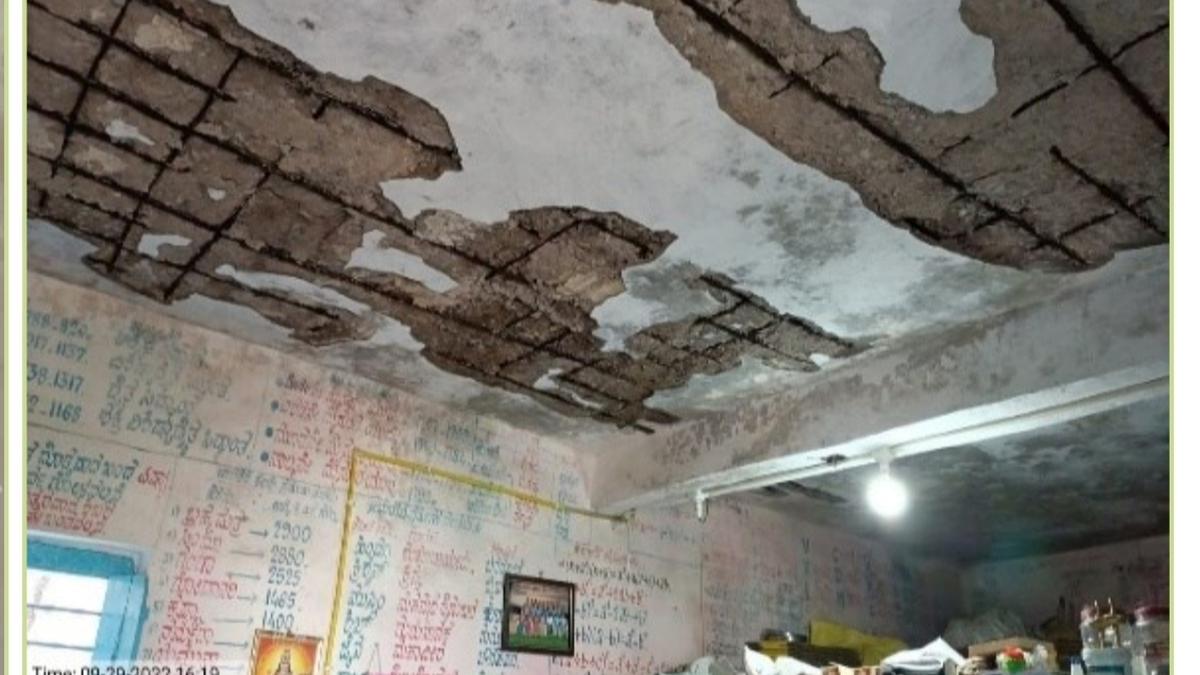
Keeping govt. schools out of assessment, a reason for bad condition of schools: CAG
The Hindu
The Comptroller and Auditor General (CAG) report on the functioning of primary educational institutions, tabled in the ongoing legislature session, has said that keeping schools run by government departments outside the process of renewal and recognition procedures, is a reason for bad condition of such schools.
The Comptroller and Auditor General (CAG) report on the functioning of primary educational institutions, tabled in the ongoing legislature session, has said that keeping schools run by government departments outside the process of renewal and recognition procedures, is a reason for bad condition of such schools.
In the report for 2021-22, it has been mentioned that as schools run by government departments are not subjected to mandatory assessment, a systematic audit of the condition of buildings, sufficiency of staff, and availability of teaching aids etc., has not been undertaken at regular intervals.
While the State government stated (in May 2023) that regulatory assessment was not mandatory for government schools, it is yet to evolve a system for periodically verifying the availability of educational facilities, compliance to safety norms etc., for enabling the departments to rectify deficiencies, if any, in a time-bound manner.
The CAG report said that including the government schools in the periodic assessment would facilitate better compliance towards infrastructure and safety norms.
The report also mentioned that the departments had not analysed the grades of schools after 2019-20 and as a result the comparative position of schools in terms of availability of infrastructure couldn’t be ascertained. Consequently non-continuation of the grading of schools after 2019-20 impaired the ability of the departments to identify and communicate the progress in improving the infrastructure facilities in the schools.
Although the government stated that student achievement tracking system (SATS) collected data related to infrastructure, the fact remained that though data was collected, it was not analysed for grading and reporting.
According to the grading done in 2019-20 during which schools were categorised as A,B, C, and D, based on the infrastructure available, out of the 22,341 lower primary schools only 86 (less than 1%) were graded A and out of the 22,083 upper primary schools, 3,017 (13.66%) were graded A.


Anuradha Jonnalagadda took over as in-charge Vice-Chancellor of the University of Hyderabad, focusing on continuity during the transition.

Telangana government awaits committee report on TGSRTC staff absorption, with decisions to be made at an appropriate time.

Telangana's revised pay scale implementation for employees will take timer. The tenure of Pay Revision Commission extended. Govt likely to take decision on reccomendation based on its report.

Vizianagaram's SP A.R. Damodar highlights 20 accident-prone areas and urges drivers to prioritize safety with helmets and seat belts.

Kerala HC stays disqualification of SNDP Yogam leaders, reversing a single judge's order regarding financial and regulatory compliance issues.

Karnataka announces daily supply of 10,000 LPG cylinders to hotels, easing the commercial shortage for the hospitality industry.

Malayalam superstar Mohanlal will be reuniting with filmmaker Priyadarshan, it was announced recently. It will mark the 100th film of Priyadarshan and is backed by Mohanlal’s longtime collaborator, Antony Perumbavoor

Gautham Vasudev Menon loses Madras High Court appeal, ordered to pay ₹4.25 crore to R.S. Infotainment with interest.

AIADMK faces its toughest challenge in 53 years as it prepares for the crucial 2026 T.N. Assembly elections.

Lakmé Fashion Week x FDCI 2026 in Mumbai: What worked and what didn’t

Telangana CM announces underpass beneath Begumpet Airport runway to alleviate traffic congestion in Hyderabad.

Congress leader Ramesh Chennithala claims an alliance between Pinarayi Vijayan, Modi, and Shah aims to undermine UDF in Kerala elections.

CCB arrests Bengaluru couple for running a fake government job scam, cheating over 100 victims out of crores.