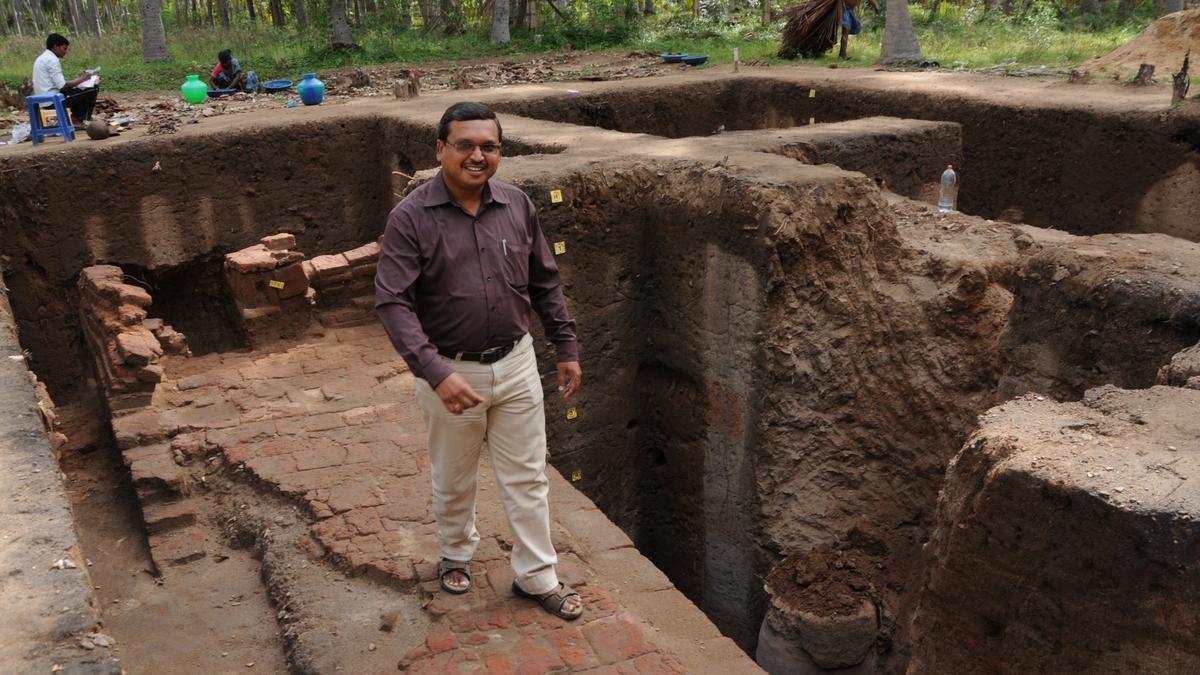
Keeladi excavation report of archaeologist Amarnath Ramakrishna: Why are Centre and T.N. government at loggerheads?
The Hindu
Archaeologist K. Amarnath Ramakrishna's transfer sparks controversy over Keeladi excavation findings, highlighting clash of narratives in Tamil Nadu.
The story so far: On June 17, 2025, archaeologist K. Amarnath Ramakrishna, twhose excavation at Keeladi (also spelt Keezhadi) in Tamil Nadu drew the nation’s attention, was transferred yet again, this time from New Delhi to Greater Noida. Mr. Ramakrishna, who was serving as the Director (Antiquity) and as Director of the National Mission on Monuments and Antiquities (NMMA), will now be the director of only the NMMA. The NMMA unit set up in 2007, according to sources, almost remains defunct. This move drew criticism from political circles in the State.
Over two years after Mr. Ramakrishna submitted his 982-page report on the first two phases of excavations carried out at Keeladi under his leadership between 2014 and 2016, a fresh controversy erupted last month. The Archaeological Survey of India (ASI) mandated him to revise his report but Mr. Ramakrishna refused to do it. This disagreement sparked a political clash between the Centre and Tamil Nadu. The State’s Minister for Archaeology Thangam Thennarasu even accused the BJP-led Union government of treating Tamils as second class citizens.
Keeladi, located about 12 km southeast of Madurai in Sivaganga district has become a symbol of pride for many in Tamil Nadu. Over a decade ago, Amarnath Ramakrishna who was then the ASI’s Superintending Archaeologist had initiated excavations at a site known as the Pallichanthai Tidal in Keeladi, a place that was originally a coconut grove spanning 100 acres. He had identified over 100 sites for excavation along the Vaigai River but Keeladi stood out.
It was in Keeladi that they unearthed over 7,500 ancient artifacts including wall structures, drainage systems and wells - all evidence of a sophisticated urban society that thrived. What was even more compelling was the carbon dating which revealed that these elements are over 2,160 years old dating back to the 2nd century BCE which is the time of the Sangam period in Tamil history.
Archaeologists were stunned by a few findings. Most importantly, there was no evidence of religious symbols at the excavation site which hinted at the secular nature of the civilization.
The finds also showed:
So, naturally the excitement around Keeladi’s discoveries was palpable. Tamil historians and enthusiasts saw it as proof of an advanced ancient Tamil civilization but soon after things took a sharp turn.


Residents of Chettichavadi express concerns over deteriorating groundwater quality due to long-standing garbage dumping issues in Salem West.

Community Health Officers in Vijayawada protest for reduced workload and continued incentives amid growing dissatisfaction over salary changes.

Telangana faces 13,929 healthcare vacancies, primarily in doctors and nurses, as recruitment efforts aim to address the shortage.

For most patients with TB who are severely underweight, nutritional support is an essential and not optional part of treatment

Family of custodial death victims demands harsh punishment for nine convicted policemen to prevent future abuses of power.

Rajinikanth refutes TVK leader's claims about DMK threats preventing his political entry, expressing gratitude to supportive political figures.

CM announces Cabinet Sub-Committee on Musi rejuvenation; rehabilitation for all displaced

Ramanathapuram identifies 145 polling stations as sensitive, ensuring security with paramilitary forces ahead of assembly elections, says DEO.

BJP Puducherry president V. P Ramalingam files nomination for Raj Bhavan, joined by Union Minister Mandaviya and Khushbu Sundar.

History-sheeter 'Thoppai' Ganesh shot dead by police in Chennai after attacking officers during attempted escape.

The government plans to amend the FCRA, introducing new regulations for NGO asset management and accountability for key functionaries.

The draft policy for “Responsible Digital Use Among Students”, released on Monday by the Department of Health and Family Welfare, has recommended that parents set structured routines with clear screen-time rules and prioritise privacy, safety, and open conversation with children on digital well-being.

Police Observer Sushant Kumar Saxena conducts surprise inspection at Shencottai police station, reviewing warrants and security arrangements ahead of elections.