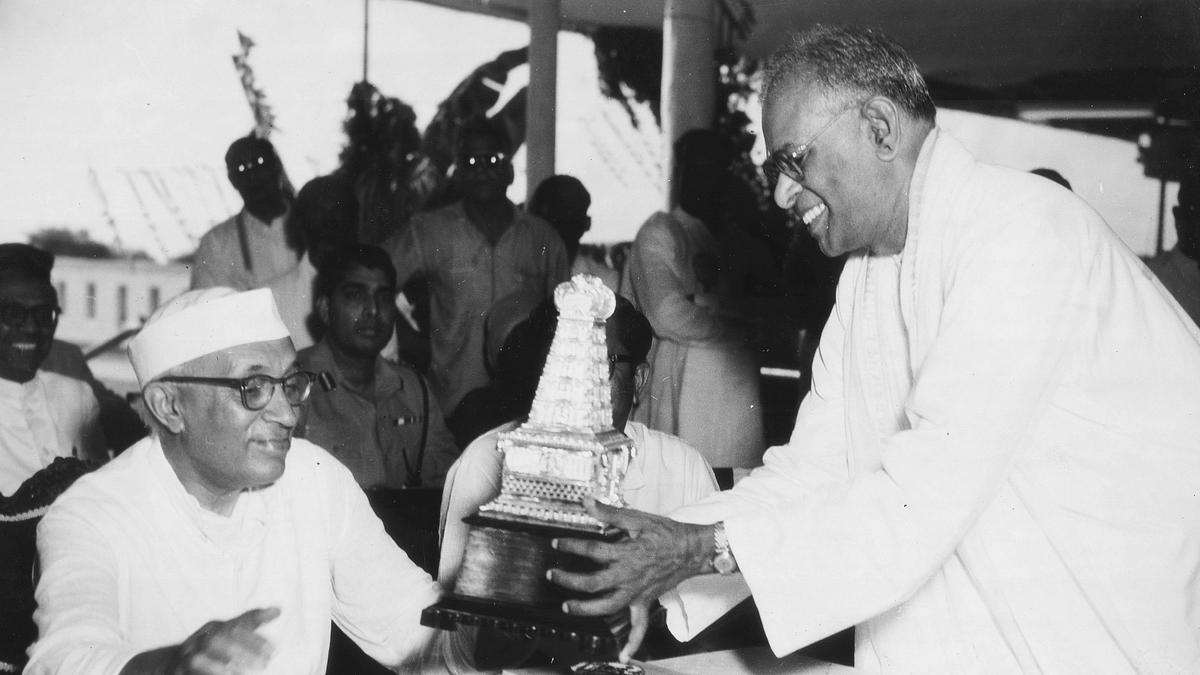
‘Kalaithanthai’ Karumuttu Thiagaraja Chettiar, an entrepreneur with the Midas touch who made a mark across domains
The Hindu
Textile Baron Thiagarajan Chettiar's legacy in textiles, education, journalism, and activism, remembered for his perseverance and values.
On April 15, 1959, then Prime Minister Pandit Jawaharlal Nehru came down to A. Thekkur, a village in Tirupattur, near Sivaganga to inaugurate a high school building. That the Prime Minister deemed it fit to grace the occasion, perhaps had to do with the man who ran the school -- ‘Kalaithanthai’ Karumuttu Thiagarajan Chettiar. In a life, which spanned eight decades, he forayed into several domains and tasted success like none other. He is primarily remembered for his reign over the textile space in south India, which earned him the moniker of ‘Textile Baron’ and contributions to education, launching a slew of colleges and institutes under the brand name of Thiagarajar.
Born on June 16, 1893 in the affluent Karumuttu family, Thiagarajan was the youngest son of the second wife of Muthukaruppan Chettiar -- who broke the trend of Chettiars taking up the money-lending profession, and forayed into the textile space instead, in 1866. The Karumuttu family imported different types of clothes and sold them in India and Ceylon, Radha Thiagarajan, wife of Thiagarajan, points out in his biography Karumuttu Thiagaraja Chettiar, The Textile King.
At the age of nine, after his father’s demise, Thiagarajan moved to Ceylon and was under the care of his elder brother, who was taking care of the family business. His tryst with textiles originated here. “The Karumuttus imported saris and dress fabrics from European countries, and had special dhotis manufactured in Lancashire and Manchester. The Karumuttu trademark would be imprinted on dhotis…,” the late author recalls in the book.
In 1916, during the First World War, the business in Colombo (which was run on a partnership by three of the Karumuttu brothers) dissolved, post which Thiagarajan returned to India. It was only after the 1921 strike at Harvey Mills, which led to massive layoffs, did a path open up for him in the textile domain. The laid-off workers appealed to Indian industrialists and businessmen for help, and thus brewed the idea of Sree Meenakshi Mills, his first own venture.
The idea to start the mills was proposed by Gujarati businessman Kalyanji Ramji, and Thiagarajan was on board. However, when the directors backed out owing to financial constraints, Thiagarajan took charge in 1923. Throughout 1924, he travelled to collect capital for the mills. Subsequently, he scouted for a location and drew up a plan for the structure. The operations finally began on May 4, 1927, recalls Radha.
“Throughout the decade, he built his empire and acquired financially and functionally defunct mills. He was financially prudent, served on the boards of other mills, helped entrepreneurs and set the benchmark for yardstick…,” Hari Thiagarajan, chairman of Thiagarajar College of Engineering (TCE) and the grandson of the late baron, says.
However, the challenges were aplenty. Two years after the mill’s operations commenced, the Great Depression hit countries across the globe. The effects trickled down to south India, and Thiagarajan faced challenges in raising money and clearing loans. He needed half a million rupees. However, he took the unorthodox way to resolve the problem by seeking help from his competitor, Harvey Mills.


The ‘Swastha Mysuru’ initiative aims to promote healthy living and preventive healthcare in Mysuru through community engagement and awareness.

Farmers in Ongole protest against BJP's policies, citing dangers to their livelihoods and demanding support for local agriculture.

From March 24, paneer queserotta, prawn tostadas, beef birria and more feature on MadCo's special Mexican pop up menu by Chef Mathangi Kumar alongside experimental cocktails, including a marigold highball

Revenue Minister Krishna Byre Gowda defends subsidies as crucial for economic growth, emphasising their role in boosting consumer demand during recessions.

Three doctors were arrested by the Mico Layout traffic police on Monday (March 23) after a video allegedly showing them triple-riding without helmets with one of the pillion riders seen drinking from a bottle went viral on social media.

Assembly protest ends in arrests as BJP targets Government over guarantees

Andhra Pradesh accelerates city gas distribution with streamlined approvals, enhancing access to cleaner energy and supporting sustainable urban development.

Sattankulam father-son custodial deaths case: Trial court convicts all nine accused police personnel
Nine police personnel convicted in Sattankulam custodial deaths; sentencing to be announced on March 30.

Minister Laxmi Hebbalkar supports local protests against a solid waste management plant in Turmuri, addressing residents' concerns.

Sattankulam father-son custodial deaths case: Trial court convicts all nine accused police personnel
Nine police personnel convicted in Sattankulam custodial deaths; sentencing to be announced on March 30.

Erode district conducts first EVM randomisation for April 23 Assembly elections, ensuring transparency and fairness in allocation.

TNCC conducts public consultation in Erode to gather community input for its upcoming election manifesto.

CID to investigate sexual assault allegations against suspended Moodbidri Police Inspector P.G. Sandesh, reveals Home Minister Parameshwara.