Judges may soon have to run for election in Mexico. Critics say that’s bad news for its democracy
CNN
Mexican President Andrés Manuel López Obrador has long been critical of his country’s Supreme Court as it stood in the way of some of his signature policy proposals. This month, as he closes out his six-year term in office, he appears poised to remake the entire judiciary in his mold.
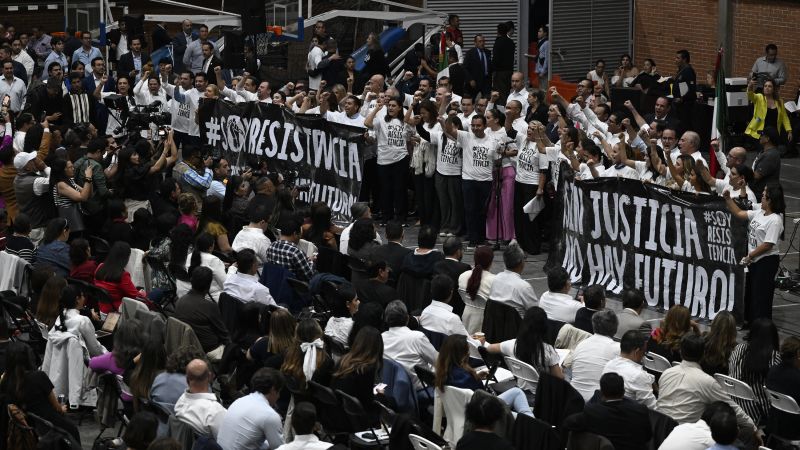
Mexican President Andrés Manuel López Obrador has long been critical of his country’s Supreme Court as it stood in the way of some of his signature policy proposals. This month, as he closes out his six-year term in office, he appears poised to remake the entire judiciary in his mold. Lawmakers in Mexico City this week began to push through a sweeping constitutional reform that would see Mexicans select judges at all levels of government through elections, a procedure that legal experts say would turn Mexico into an international outlier. The controversial measure passed the lower chamber of Congress on Wednesday with overwhelming support. The reform will next be voted on in the Senate, where its approval is likely due to López Obrador’s ruling coalition being one senator short of a supermajority. López Obrador, a popular leftist, says the overhaul is necessary to rid the judiciary of corruption and ensure its responsive to the popular will. Critics of the reform call it a power grab that will expose one of the last remaining checks on presidential power to political influence. “I see this as a constitutional crisis,” said Mariana Campos, the general director of México Evalúa, a civil society organization. “The judiciary has been a counterweight for the executive and the legislative branches, and the president and his political group believe that they can’t advance their objectives with this type of counterweight.” Opposition to the reform has quickly manifested into monumental schisms, with the country’s Supreme Court justices voting this week to join a nationwide protest of judicial workers grinding most legal proceedings to a halt.


Why do people “pledge allegiance” to a “state” that is no longer a state? And what spurs someone to not just attack innocent people, but to then make a statement of loyalty while doing so?

A Supreme Court case examining state deadlines for election ballots sent in the mail is just the tip of the spear in President Donald Trump’s war on mail-in voting.

As a shrinking number of Transportation Security Administration agents work to keep hourslong security lines moving despite not being paid, President Donald Trump stepped into the fray Saturday, announcing he will send Immigration and Customs Enforcement officers to airports by Monday if Congress doesn’t agree to a plan to end the partial government shutdown.

Donald Trump wants us to believe that a deal with Cuba is close at hand. After this past week, I am not so sure.

The search for missing 84-year-old Nancy Guthrie, mother of “Today” show host Savannah Guthrie, has stretched into another anguished week, with mounting pressure on investigators and a family grappling with uncertainty.

Cuba’s Ministry of Energy announced Saturday evening that entire island has suffered another electrical blackout, leaving more than 10 million people without power.

Iran’s attempt to strike a US-UK base over 2,000 miles (over 3,000 kilometers) off its coast has renewed questions about Tehran’s military capabilities and how far its missiles can reach.

For years, President Donald Trump has offered crass and insensitive comments about people who died – especially his foes. That reached a new level on Saturday.

Robert Mueller, the former FBI director who led the historic probe into alleged collusion between Donald Trump’s 2016 campaign and the Russian government, has died. He was 81.

Marlon Batres is not OK. The assistant principal says he is in constant fear for his students, staff and even himself after federal agents swarmed the streets.

To hear some prominent MAGA voices tell it, the marathon Senate debate over the “SAVE America Act” is an existential one for the Republican Party. But the urgency to pass the legislation is not felt by Americans more widely.

In the days after winning the Democratic nomination for Senate, Illinois Lt. Gov. Juliana Stratton spoke to the two women with whom she could make history next year.

This month, terrorist suspects in the alleged bomb-throwing in New York City and the synagogue attack in Michigan visited Phantom Fireworks stores shortly beforehand.