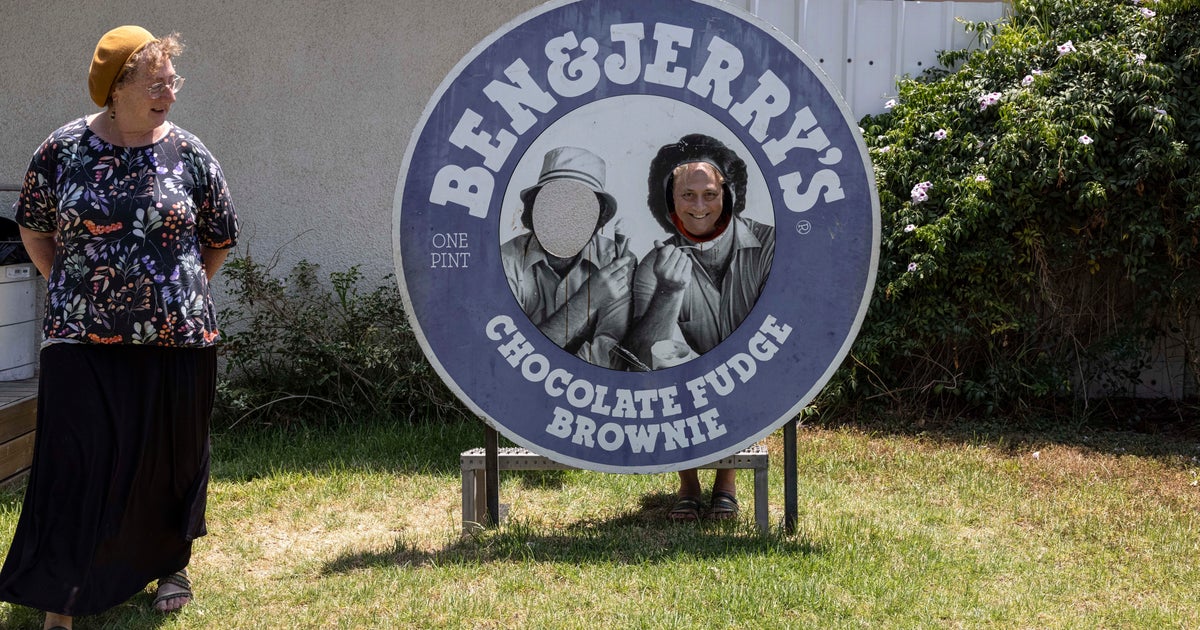
Judge rejects Ben & Jerry's bid to block ice cream sales in east Jerusalem and Israeli-occupied West Bank
CBSN
A federal judge on Monday rejected a request by Ben & Jerry's to block a plan by its corporate parent to allow its products to be sold in east Jerusalem and the occupied West Bank against the wishes of the Vermont ice cream maker's independent board of directors. U.S. District Court Judge Andrew Carter said Ben & Jerry's failed to show that the decision by London-based consumer goods conglomerate Unilever would hurt Ben and Jerry's social mission or confuse its customers. In his three-page decision, Carter said that the harm Ben & Jerry's was claiming was "too speculative." "The products sold in Israel and the West Bank will use no English trademarks, instead displaying new Hebrew and Arabic language Ben & Jerry's trademarks," the decision said. "Thus, the products sold in Israel and the West Bank will be dissimilar from other Ben & Jerry's products, mitigating, if not eliminating, the possibility of reputational harm."
Ben & Jerry's spokesman Sean Greenwood said Monday that the company had "no new position for us to share at this time."
Ben & Jerry's complaint in the case filed last month outlined the company's tradition of social activism over its 44-year history, including opposition to U.S. nuclear weapons spending in the 1980s, and in the 1990s, supporting LGBTQ+ rights and farmers. That activism continued after it was purchased by Unilever in 2000 with the focus on, among other issues, migrant justice and climate change. In the aftermath of the 2020 death of George Floyd, Ben & Jerry's became an advocate for Black Lives Matter.


The Taliban in Afghanistan claim that a Pakistani military airstrike on a drug rehabilitation hospital in Kabul has killed over 400 people and injured 250 others.

Washington — President Trump said Monday that he's requested to delay his trip to China because of the war with Iran, now in its third week. Joe Walsh contributed to this report. In:

Officials in Cuba reported an island-wide blackout Monday in the country of some 11 million people as its energy and economic crises deepen. Cuba has blamed its woes on a U.S. energy blockade after President Trump in January warned of tariffs on any country that sells or provides oil to it. In:

Two boats carrying 21 people capsized Monday off Henoko, a controversial relocation site for a U.S. military base off Japan's southern island of Okinawa, throwing all into the water and leaving two of them dead, officials said. In:

Ecuador on Sunday began two weeks of operations against drug traffickers with support from the United States, the latest joint show of force against drug cartels in the South American country. In:

Right after Vladimir Putin's invasion of Ukraine, Karabash Elementary, like schools across Russia, was ordered to indoctrinate young minds with a so-called "patriotic curriculum." Pasha Talankin, the school's videographer, was assigned to shoot it all, to prove to Russia's government that the school was toeing the line. In:

Six U.S. service members who were killed in a military refueling aircraft crash over Iraq last week have been identified as members of the Ohio Air National Guard and Florida-based crew members. Tucker Reals contributed to this report. In:

Ten months after taking office, Pope Leo XIV on Saturday finally moved into his apartments in the Vatican's Apostolic Palace, a historic papal residence that his predecessor had eschewed. In:

President Trump said the U.S. military "totally obliterated" every military target on Kharg Island during large-scale precision strikes Friday, thrusting the strategic small isle into the global spotlight. In:

Hamas on Saturday called on Iran to refrain from targeting neighboring countries, while affirming Tehran's right to defend itself against Israel and the United States. In:

A Jewish school in Amsterdam was damaged after an overnight explosion against its exterior wall, Mayor Femke Halsema said in a statement Saturday, denouncing the blast as a "cowardly act of aggression." In:

A growing number of social media users, including foreigners, are facing charges in the United Arab Emirates under the Gulf state's broad cybercrime laws for sharing or possessing digital content that depicts or comments on the impact of ongoing Iranian attacks, the advocacy group Detained in Dubai has warned. In:

CBS News asked its reporters and editors to gauge the local mood in foreign capital cities as the U.S.-Israeli war with Iran, now nearing the two-week mark, leaves energy and stock markets in turmoil. In: