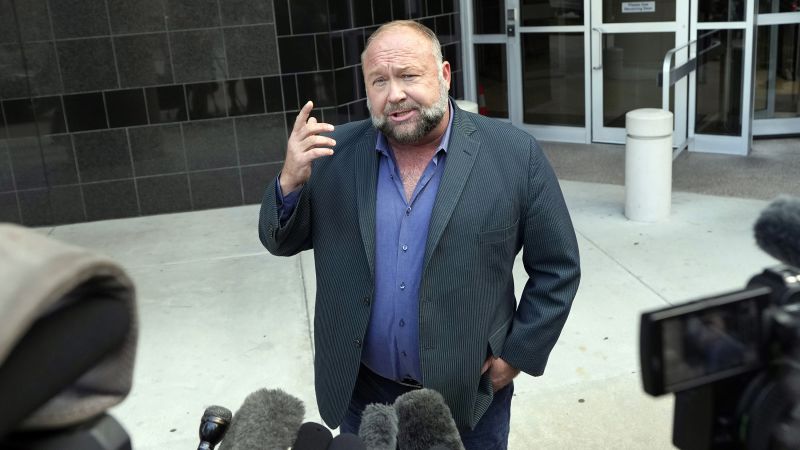
Judge approves liquidation of Alex Jones’ personal assets to pay Sandy Hook victims’ families
CNN
A Texas bankruptcy court judge has approved the liquidation of conspiracy theorist Alex Jones’ personal assets, setting the stage for repayment to the families of Sandy Hook shooting victims.
A Texas bankruptcy court judge has approved the liquidation of conspiracy theorist Alex Jones’ personal assets, setting the stage for repayment to the families of Sandy Hook shooting victims. Last week, Jones agreed to convert his personal bankruptcy into a Chapter 7 liquidation. The judge on Friday agreed to that move. Jones’ decision to seek Chapter 7 bankruptcy protection comes after he agreed to demands from the families of Sandy Hook victims, whom he owes more than $1 billion in damages over his lies about the 2012 school massacre. The seismic move paves the way for Jones to no longer own Infowars, the influential conspiracy empire he founded in the late 1990s. Over the years, Jones has not only used the media company to poison the public discourse with lies and conspiracy theories, but also to enrich himself to the tune of millions of dollars. Texas Judge Christopher Lopez will also on Friday consider liquidating Jones’ company Free Speech Systems, the parent company of Infowars, to pay the judgments to the Sandy Hook families. Right-wing conspiracy theorist Alex Jones acknowledged Friday that his most famous media property is likely to go away as part of his ongoing bankruptcy case.


If you only watched Fox News over the weekend, you didn’t hear about President Donald Trump’s widely condemned reaction to Robert Mueller’s death.

Oil prices rose Sunday after President Donald Trump threatened to “obliterate” Iran’s power plants if the Strait of Hormuz is not reopened by Monday evening.

Defense Secretary Pete Hegseth has been taking steps to thwart news coverage of the Pentagon for more than a year. Now he has finally met some resistance.

Defense Secretary Pete Hegseth has been taking steps to thwart news coverage of the Pentagon for more than a year. Now he has finally met some resistance.

Gerald Rodriguez, the general manager of an NPR affiliate in rural Colorado, expected federal funding for public media to shrink. He didn’t expect it to disappear almost overnight.

The much-touted new tax breaks for tips, overtime, seniors and car loan interest have a lot of income tax filers expecting a big bump in their refunds this year – or a big cut in their tax bill.

Looking out his shop window, across the street, just to the right, Paloma Clothing co-owner Mike Roach sees one of Portland, Oregon’s, most expensive gas stations.

Oil and liquefied natural gas tankers moving through the Strait of Hormuz carry around 20% of the world’s supply. But for countries on the Persian Gulf, the waterway is more than just an energy route – it’s a lifeline for more than 100 million people.

A California jury has largely sided with Twitter shareholders who accused billionaire Elon Musk of defrauding them by intentionally driving down the social media company’s stock ahead of his $44 billion acquisition in 2022.

The war with Iran is disrupting global oil flows, damaging energy infrastructure and raising fears of prolonged conflict. But gold, usually considered a safe haven during periods of economic uncertainty, has slumped.

US stocks and bonds fell, oil prices rose and gold had its worst week in four decades as the Iran war continues to ripple through financial markets.

The White House on Friday released its long-awaited national artificial intelligence legislative framework, a move to prevent states from enacting their own laws and enforce the Trump administration’s light-touch approach to AI regulation.

“Today is a difficult day,” CBS executives wrote to staff, explaining the cuts as a tough but necessary reallocation of newsroom resources.