Joint exit poll shows liberal candidate Lee forecast to win South Korean presidential election
The Hindu
Lee Jae-myung forecasted to win South Korea's presidential election, facing challenges including economic slowdown and North Korea's threats.
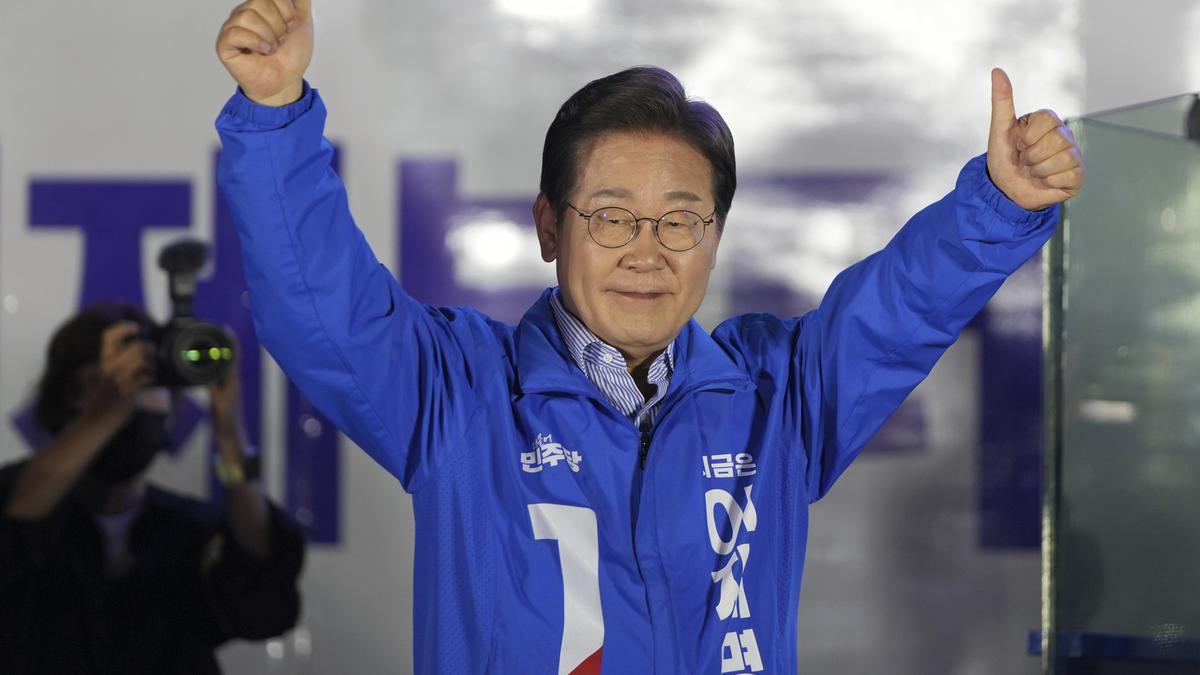
Liberal candidate Lee Jae-myung is forecast to win South Korea’s snap presidential election, a joint exit poll on Tuesday (June 3, 2025) showed, two months after his arch-rival and then conservative President Yoon Suk Yeol was removed from office over his short-lived imposition of martial law.
The exit poll by South Korea’s three major TV stations — KBS, MBC and SBS — showed Lee projected to obtain 51.7% of the total votes cast, beating main conservative candidate Kim Moon Soo on 39.3%.
Pre-election surveys also suggested Mr Lee, the Democratic Party candidate, appeared headed for an easy win, riding on deep public frustration over the conservatives in the wake of Yoon’s martial law debacle. Mr Kim has struggled to win over moderate, swing voters as his People Power Party remains in a quagmire of internal feuding over how to view Mr Yoon’s actions.
As the exit poll was announced, Democratic Party members cheered and applauded in jubilant scenes at a party hall, chanting Mr Lee’s name. At Mr Kim’s party headquarters, lawmakers sat in silence.
Voting began at 6 a.m. local time at 14,295 polling stations nationwide and closed at 8 p.m. Nearly 80% of the country’s 44.4 million eligible voter cast ballots, according to an ongoing tally. That’s one of the highest turnouts for a presidential election in South Korea and reflected public eagerness to move past the political turmoil.
The election serves as another defining moment in the country’s resilient democracy but observers worry a domestic divide worsened after Yoon’s martial law stunt is far from over and could pose a big political burden on the new president.
The past six months saw large crowds of people rallying in the streets to either denounce or support Mr Yoon, while a leadership vacuum caused by Yoon’s impeachment and ensuing formal dismissal rattled the country’s high-level diplomatic activities and financial markets.


A large explosion at Valero refinery in Port Arthur, Texas, prompts shelter-in-place order for nearby residents, no injuries reported.

Kim Jong Un vows to solidify North Korea's nuclear status and labels South Korea as its "most hostile" adversary.

U.S.-Israel war on Iran LIVE: Follow The Hindu for updates on the West Asia conflict on March 24, 2026

Trump claims “very good” talks with Iran, despite Tehran’s denial, as U.S. negotiators plan potential meetings in Pakistan.

Netanyahu discusses U.S.-Israeli military gains with Trump, emphasizing commitment to protect Israel's interests amid ongoing conflicts.

Pakistan reaffirms commitment to combat terrorism as Afghan ceasefire approaches end amid rising tensions and recent casualties.

Trump postpones military strikes on Iranian power plants for five days amid escalating tensions and ongoing diplomatic discussions.

Shorts News:Watch: NATO chief: 22-nation group forming to secure Strait of Hormuz

Saudi Aramco reduces crude supply to Asia for April, citing disruptions from the Iran-Israel conflict affecting trade routes.

Tencent launched a tool on Sunday to integrate its WeChat messaging platform with the OpenClaw agent

An Air Canada flight collided with a Port Authority vehicle at LaGuardia Airport, causing significant damage and police response.

Saudi Arabia and the UAE face missile attacks, with casualties reported and air defenses engaged amid escalating regional tensions.

Slovenia's parliamentary election results show a tight race between liberals and populists, signaling potential political instability ahead.