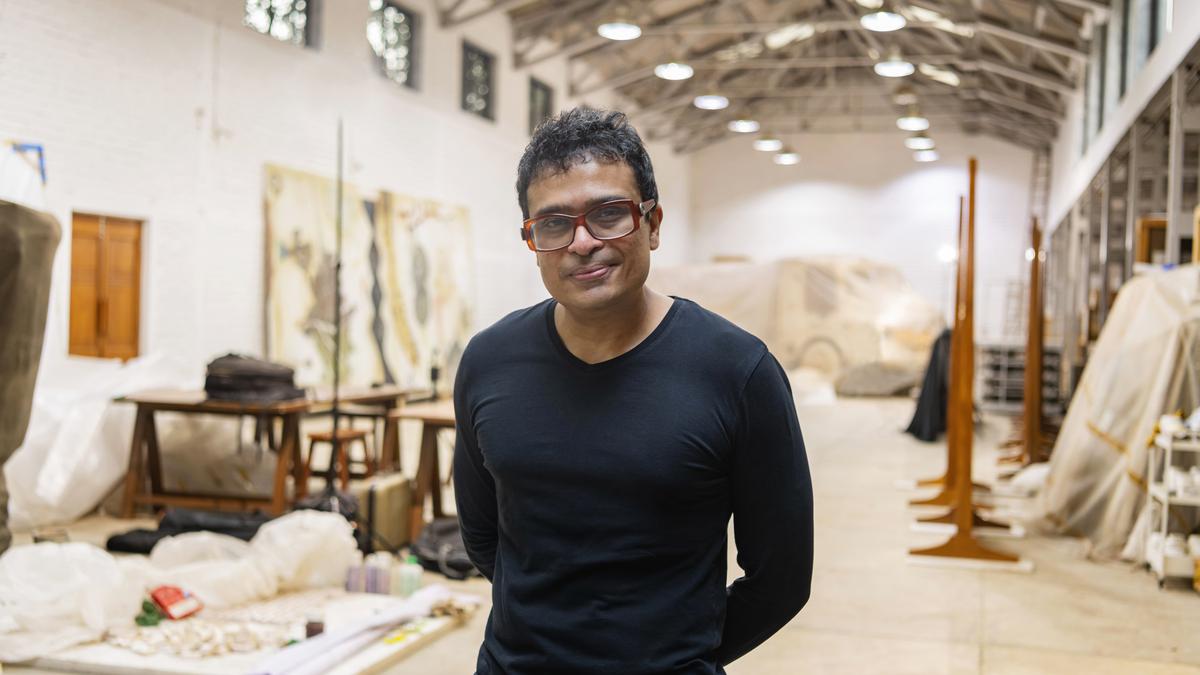
Jitish Kallat’s show, ‘Otherwhile’, on in Mumbai, is a fundamental study of life
The Hindu
Jitish Kallat’s ongoing show in Mumbai is emblematic of his constant preoccupation with birth and death
The themes that keep drawing Jitish Kallat have, in his words, “persisted or continued to grow in different ways.” These include, “themes of birth, death, time, evolution and decay.”
In the 25 years since, Jitish has shown across the world, art that interrogates the fundamentals of life and how humans try and make sense those themes. In ‘Otherwhile,’ his ongoing show at Chemould Prescott Road, the largest work, Integer Study (drawing from life), is emblematic of his inquiry, and the open-ended concepts that let him explore concentric themes. In this case, he explains, he is “counting up our species, moment to moment.” Each study logs the population of the world that day, along with the number of births that day and corresponding number of deaths. The works were made daily throughout 2021, on Bienfang gridded paper.
This sustained, daily engagement with the three numbers almost anchors every drawing. It also produced a set of intuitions every time he drew, says Kallat. The numbers though, become abstractions, divested of context.
Yet for Kallat, the daily tradition led to questions like, “Where did these ever-growing numbers come from? Every four days there is a million more in that number. Every drawing as a negative integer — where did these numbers go?” Later in the interview, Kallat seems to answer his own question when he says, “Drawing and painting are hardly the tools with which those fundamental answers can be entirely grasped, except by producing certain conditions within imagery that might point to those questions.”
These conditions mean that sometimes the work has no expected outcome. He explains, “For me to experience at some level, the periphery and outer limits of my own perception, I might want to produce conditions in the studio.” In the past, he’s done works titled ‘Wind Study’ and ‘Rain Study’, both of which make use of the elements to record a particular moment in time, in this case using nature and the elements.
In ‘Echo Verse’, an eight-park work that is shaped like the Waterman butterfly, the grid that underlines the work is painted with water colours. He explains: “The graph itself will produce a kind of nebulous form, you know, that would become the starting point for the first image, and often the first image would almost produce the condition for the next image.” These are overlaid onto each other to make a work, that seems to map geological spectacles, through the controlled use of air and water to shape the pigments.
Kallat says, “In the studio, there’s a peculiar sensation that one is witness to the same movement of matter that might happen on planet Earth.” Later, Kallat returns to this theme, saying, “I want to paint in a way that the painting meets you halfway with imagery that was just a moment before unforeseen,” mentioning how the way paint dries can mirror geological effects. He explains, “Something dries up in a certain way, it could become ferrous, iron-like, it dries up another way and it could become like earth, dries up in yet another way and it becomes completely fluid like silt, you know, and these are very subtle things.”


The government plans to amend the FCRA, introducing new regulations for NGO asset management and accountability for key functionaries.

The draft policy for “Responsible Digital Use Among Students”, released on Monday by the Department of Health and Family Welfare, has recommended that parents set structured routines with clear screen-time rules and prioritise privacy, safety, and open conversation with children on digital well-being.

Police Observer Sushant Kumar Saxena conducts surprise inspection at Shencottai police station, reviewing warrants and security arrangements ahead of elections.

Andhra Pradesh government to launch key projects in April, focusing on industrial growth and infrastructure development, says Nara Lokesh.

Lok Sabha refers the Corporate Laws (Amendment) Bill to a JPC amid opposition concerns over CSR provisions dilution.

SHG members in Kanniyakumari use snakes and ladders to raise election awareness and boost voter turnout.

Government accelerates consultations for early implementation of the Women’s Reservation Act to ensure women’s representation in 2029 elections.

CM A. Revanth Reddy distributes ₹1 crore insurance cheques to families of deceased Electricity department employees, enhancing financial security for workers.

The Bengaluru Traffic Police (BTP) registered 634 cases of drunk driving during a week-long special enforcement drive conducted across the city between March 16 and March 22.

GHMC intensifies action against property tax defaulters, seizing properties and offering a One Time Settlement scheme for payments.

CCB arrests three drug peddlers in Mangaluru, seizing ₹2.5 lakh worth of MDMA and other valuables.

TVK's 28 candidates in Puducherry include former BJP MLAs, a sitting Independent, and a retired police IG.

BRS submits notice on private member bill to Speaker