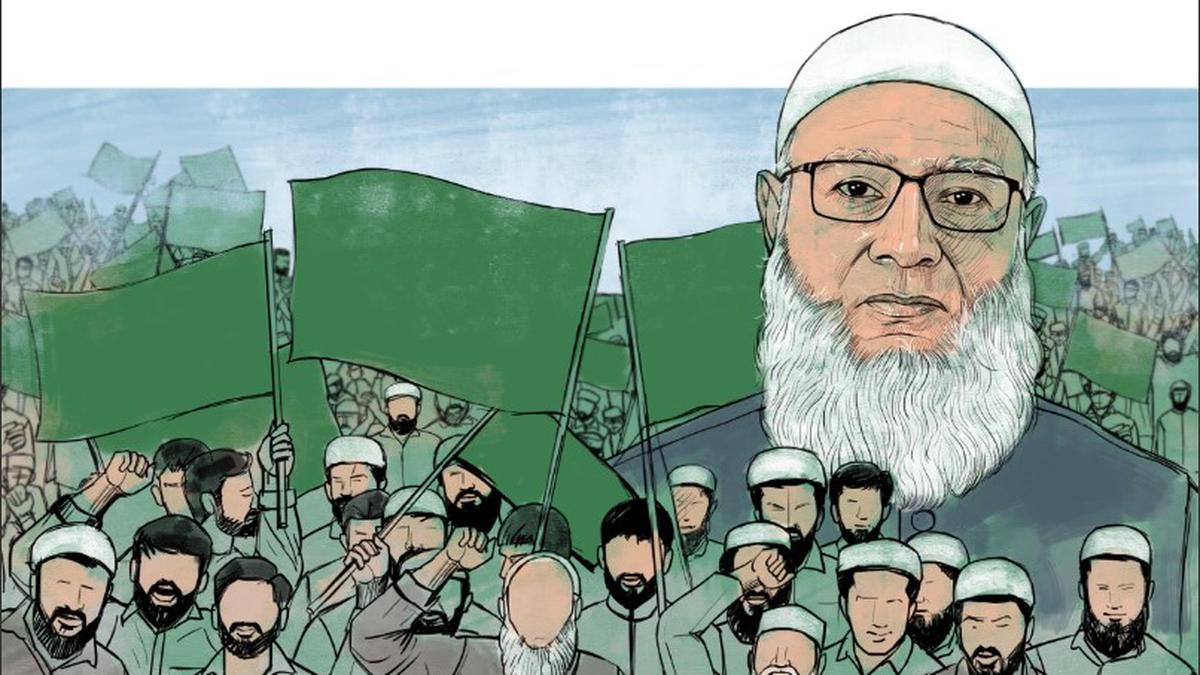
Jamaat-e-Islami | Old party, new brand Premium
The Hindu
The Opposition party, discredited by the war crimes trial and weakened by a state crackdown, is trying to rebrand itself as a ‘soft’ Islamist group that’s opposed to the Hasina government
In the backdrop of the protests led by the main Opposition Bangladesh Nationalist Party (BNP), authorities in Dhaka arrested Jamaat-e-Islami’s ameer Shafiqur Rahman and his son Rafat Sadik Saifullah last week. The arrests were interpreted as a move to pre-empt Jamaat, the largest Islamist party in Bangladesh, from infusing critical mass to the protest rally set to be launched by BNP leader Mirza Fakhrul Islam Alamgir.
The government of Prime Minister Sheikh Hasina arrested Mr. Alamgir a day before the BNP’s ‘Grand Rally’, and more arrests followed. Reports suggested that the rally failed to trigger a public movement against the government that the BNP had hoped for, but there were hints that unleashing of Jamaat’s foot soldiers could have triggered a larger challenge for Ms. Hasina.
The relationship between Jamaat and Ms. Hasina has been hostile for most of her last three tenures. The Hasina government has championed a trial for the genocide of 1971 during the Liberation War. Mir Quasem Ali, one of the biggest leaders of Jamaat, was convicted by the war crimes tribunal, set up in 2009 to investigate the crimes committed by the Pakistani Army and its local collaborators, and hanged in 2016. The hanging drew criticism from several quarters, but the Awami League government did not back off. Several other figures of Jamaat were hanged during 2013-16.
Jamaat in Bangladesh is one of the major offshoots of the main branch of Jamaat-e-Islami, founded by Islamic theologian Abu Ala Maududi in British India in 1941. Maududi developed a political ideology based on Islam and Jamaat was the party organisation to meet its objectives — establishing an Islamic state. The group split into different organisations after Partition.
It took strong roots in East Pakistan (now Bangladesh), and subsequently, its cadre were accused of supporting other organisations such as Al-Badr, who wanted continuation of the Pakistani rule over Bangladesh. After the end of Pakistani rule in 1971, Jamaat established itself as an entity of Bangladesh and continued to play a prominent role in the country’s politics.
Both the BNP and the Awami League had joined hands with Jamaat in the past against their common rivals. But after the war crimes trial and the subsequent state crack down, Jamaat adopted different tactics to stay relevant in Bangladesh’s politics. The party is now banned from contesting elections. But it remains a powerful radical force on the streets of Bangladesh.
Jamaat today marks December 16 — the day when Indian forces defeated Pakistan and the new nation of Bangladesh was born against the will of the Pakistani Army and its supporters such as Jamaat in 1971 — as Vijay Divas. This was unthinkable till a few years ago, but the organisation has come around to acknowledge that the Pakistani military was defeated in the war of 1971, though it is yet to concede to the truth of genocide of that time because of the obvious self-humiliation that it might cause.


Iran strikes near Israeli nuclear research center as Trump threatens attacks on Iranian power plants
Iran's missile strikes near Israel's nuclear site escalate tensions as Trump threatens retaliation against Iranian power plants.

Saudi Arabia intercepts one of three ballistic missiles targeting Riyadh amid ongoing regional tensions and threats from Iran.

Iran's death toll exceeds 1,500 amid escalating war, with heavy airstrikes and shifting U.S. and Israel strategies reported.

Iran's military threatens to target U.S. energy and desalination infrastructure in response to American threats over the Strait of Hormuz.

Iran-Israel war: Follow the latest updates from The Hindu on the West Asia war, on March 22, 2026

Robert Mueller, former FBI chief and special counsel, dies at 81, known for investigating Russian election interference.

Bangladesh seeks $2 billion in loans to address energy security amid rising global fuel prices and ongoing crisis measures.

The U.S. military strikes an Iranian base threatening the Strait of Hormuz, prompting international condemnation and escalating tensions.

UAE assures India that the safety of its citizens is a top priority amid ongoing regional conflicts and tensions.

Explore Trump's Cuba policies and their impact on the island's energy crisis amid U.S. sanctions and Russian support.

Israel threatens increased attacks on Iran as Britain condemns Tehran's attempted strike on Diego Garcia air base.

The Id-ul-Fitr festival in 2026 is unfolding across the world in contrasting circumstances, shaped by both celebrations and conflicts.

U.S. and Israel strike Iran's Natanz nuclear facility, with no reported radioactive leakage, says Iran's atomic energy organization.