Italian winemakers look to new technologies with old grape varieties to adapt to a changing climate
CBC
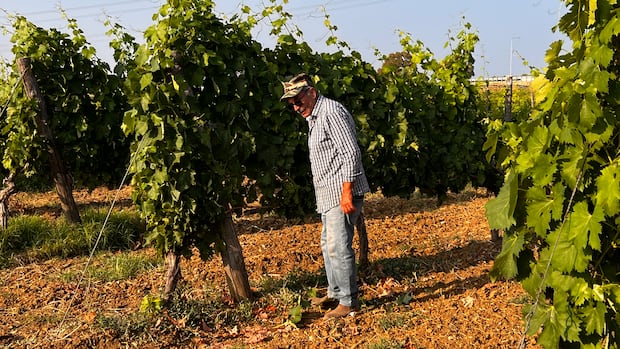
Massimo Tosoni paces through his vineyards, the rows stretching like ribbons of green under a relentless sun. In the distance, the town of Tarquinia sits on a hilltop once ruled by the ancient Etruscans.
“Look at the rows of vineyards there,” he said, gesturing past a local red grape, Ciliegiolo, known for its cherry-like aroma. “The earth is as dry and hard as stone.”
The 73-year-old shakes his head. It’s the result of soil unwatered for too long, where the sun has sucked out every last drop of life, blocking reabsorption of water.
Italy’s vineyards, like much of the world’s, are grappling with summers that are hotter and longer, erratic weather and dwindling water.
These shifts are forcing winemakers to rethink one of the oldest assumptions in their craft: terroir, the delicate interplay of soil, sun, wind, rain and human touch that gives each wine its specific taste, some might say, soul.
If global temperatures rise more than 2 C by century’s end, studies suggest up to 90 per cent of Italy’s lowland and coastal wine regions — about one-third of the country’s wine growing territory — could become unsuitable for viticulture, with similar risks for most of the world’s vineyards.
Italy is a top global wine producer, with its industry worth $20.7 billion Cdn and representing 10 per cent of the country’s agri-food economy. Before U.S. President Donald Trump’s tariffs on the European Union, exports totalled a record $12 billion Cdn in 2024, driven by premium and certified wines, even as producers faced climate extremes: drought in the south and hail and torrential downpours in the north.
In northern Lazio, the region around Rome that produces about three per cent of Italian wine, Tosoni, and his daughter, Martina Tosoni, 42, who returned to the farm after working in tourism in Spain, are among the thousands of producers already adapting.
Their white grapes, Trebbiano, Malvasia, Vermentino and Vioner, once harvested in October, now ripen by late August.
“Last year we waited too long and because of climate change lost a third of our harvest,” said Massimo.
Nearby producers have begun swapping the local Sangiovese and Montepulciano reds with the heat-tolerant Syrah, which was once grown mostly on the southern island of Sicily.
Martina said the lack of water, more than heat, is now the greatest threat.
“There’s a huge generational leap in awareness about efficient use of water,” she said.
She and other producers have introduced irrigation rotations to prevent shortages and upgraded their systems to minimize waste. Younger growers like her may also be tech-savvy and better equipped to access government grants for irrigation and other climate challenges.


Electricity demand is set to boom in Canada by 2050, according to new modelling from the national energy regulator released on Tuesday.

WARNING: This story contains details about self-harm and suicide.

The federal government is putting $200 million toward a Canadian-owned launch pad to send satellites into orbit.

Paige Eaton wanted to stay open-minded about the birth plan for her first baby, so when she ended up needing an emergency C-section, the Kitchener, Ont., resident felt somewhat prepared.

This story is part of CBC Health's Second Opinion, a weekly analysis of health and medical science news emailed to subscribers on Saturday mornings. If you haven't subscribed yet, you can do that by clicking here.

Lac La Ronge Indian Band's Woodland Wellness Centre has received funding to start a mobile addictions outreach program to address the opioid and mental health crisis.

Adriana Avelina Ruíz Márquez uses fake eyelash glue to attach a tiny transmitter to the thorax, just behind the head, of the monarch butterfly.

After several delays to the mission that will take four astronauts around the moon, NASA held a press conference today announcing that Artemis II is on track to launch as early as April 1.

Snuneymuxw First Nation is calling for a temporary closure and environmental investigation of a hazardous waste services company following a January oil spill on Duke Point near Nanaimo, B.C.

In February, five people were killed in separate avalanches across B.C. and Alberta. That same month, more than a dozen people were killed in California and Utah, including a particularly deadly avalanche that claimed the lives of nine. In Europe, from Andorra to Slovakia, the season has recorded 125 deaths from avalanches so far.

Getting a proper vehicle to transport people for urgent medical care is an ongoing challenge in fly-in First Nations in northwestern Ontario.

A new supergroup of musicians from Six Nations of the Grand River and Mississaugas of the Credit First Nation have collaborated on a Robbie Robertson-inspired song they will perform at the Junos Honouring Ceremony later this month in Hamilton.

People as young as 45 should be invited to provincial and territorial programs to screen for colorectal cancer, the Canadian Cancer Society urged on Wednesday.