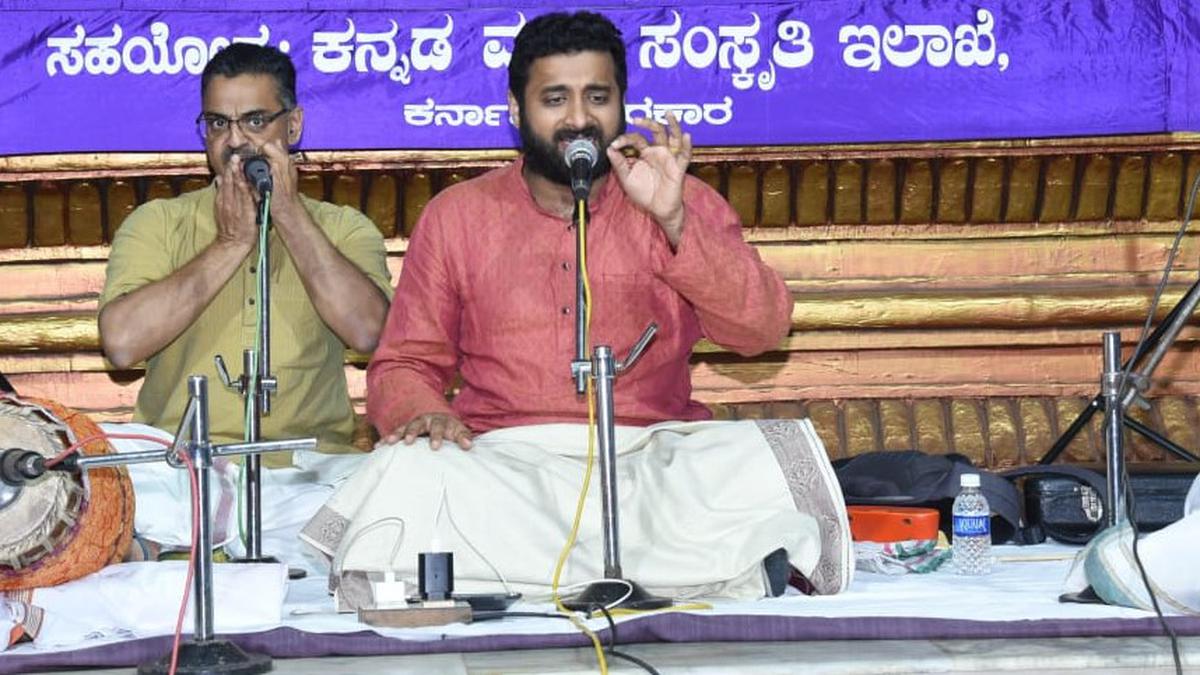
It was a display of technique and talent at Sangeetha Parishad, Mangaluru
The Hindu
Vivke Moozhikulam pays musical homage to Saint Tyagaraja in Mangaluru
Vivek Moozhikulam presented a spirited Carnatic vocal concert under the auspices of Mangaluru’s Sangeetha Parishad, in association with Karnataka Government’s Department of Kannada and Culture and Bharatiya Vidya Bhavan, Mangaluru. This is the Parishad’s 30th anniversary (Thrimshath Sambhrama) and it has been organising monthly concerts featuring both up-and-coming and established artistes.
Endowed with a majestic voice, Vivek began with the Saveri Varnam ‘Sarasooda ninne’ by Patnam Subramania Iyer, and quickly moved on to ‘Swaminatha paripaalaya aashu maam’ in Nattai by Muthuswami Dikshithar. He presented Papanasam Sivan’s masterpiece ‘Kaa vaa vaa’ in Varali with impeccable diction. Saint Tyagaraja’s compositions monopolised his concert. His delineation of Saramathi was full of fresh phrases, and, as expected, he presented ‘Mokshamu galadaa’. As a contrast, ‘Shobillu saptaswara’, in praise of the seven notes, followed briskly in Jaganmohini.
The central piece was ‘Raksha pettarae doraku’ in Bhairavi. After an elaborate and bhava-laden delineation of the raga, Vivek rendered the kriti with due dignity and appropriate ornamentation. In this Utsava Sampradaya kriti, Tyagaraja sings about placing an auspicious mark (raksha) on the forehead of Rama to ward off evil eyes. (In many houses, this used to be a regular ritual during twilight. That is why this time is referred to as ‘sayaraksha’). Tyagaraja takes the liberty to treat Rama as a small child who needs to be protected. In the same kriti, he enumerates the greatness of the Lord, too. The niraval for ‘Sangeetha priya tyagaraja’ had flashes of briga-laden sangathis, delivered with effortless ease.
Keshava Mohan Kumar followed the vocalist faithfully through his soulful repartess on the violin. Mridangam by Sunaada Krishna Amai spread sunaadham (pleasant sound), and he supported the artiste with sensitivity. During the thani, along with Balakrishna Hosamane (morsing), Sunaada wove enjoyable rhythmic patterns.
The lighter session comprised Purandaradasa’s padas, ‘Mandha mathiyu naanu’ and ‘Rama nama payasake’. While both of them were lyrically rich, the latter delighted the listeners with its metaphorical beauty, describing the process of preparing payasam. The devotee mixes the sugar named Krishna, and ghee named Vittala into the kheer named Rama, serves it in a plate and enjoys it till he gets two burps of bliss.
Vivek concluded his well- planned concert with a thillana.
In the earlier session, young flautist Pranav Adiga from Udupi (disciple of Varijakshi Bhat and K. Raghavendra Rao), endeared himself to the audience with his childlike face and a performance far beyond his age. With brief alapanas, he presented ‘Sudhamayee sudhanidhi’ in Amritavarshini (Muthiah Bhagavatar) and ‘Tatvameruga taramaa’ in Garudadhwani (Tyagaraja). After a satisfying alapana of Simhendramadhyamam for his main piece ‘Needhu charanamulae’, (also by Tyagaraja), Pranav showcased his talent in swarapratharas and concluded with ‘Govinda ninna namavae chanda’ by Purandaradasar in Jana Sammodhini.


Sean Penn skips the Oscars to meet Ukraine's Zelenskyy, who praises him as a "true friend" amid the war.

The teaser of Tamil star Suriya’s much-awaited film with director Venky Atluri, titled Vishwanath and Sons, was unveiled by the makers on Monday

A 'Golden' moment for a K-pop track at the Oscars.

Parvathi Nayar’s new exhibition, The Primordial, in Mumbai, traces oceans, pepper and climate change
Opened on March 12, the exhibition marks the artist’s first solo show in Mumbai in nearly two decades. Known for her intricate graphite drawings and multidisciplinary practice spanning installation, photography, video, and climate change, her artistic journey has long engaged with the themes of ecology, climate change and the natural world. In this ongoing exhibition, these strands converge through a series of works centred on water, salt, and pepper — materials that carry natural and historic weight across centuries.

Explore the highlights and key winners of the 98th Academy Awards, featuring memorable moments and historic achievements from Oscars 2026.

Spring season celebrated at Ramakrishna Mission Institute, Kolkata, with ‘Evening of Basant’

The Spirit of the Land, a solo show by artist Shivakumar Sunagar, is a vista of Nature-inspired emotions

Tal Fry is all set for an exciting new performance season

Netflix is making a bold move by snagging InterPositive, the AI filmmaking company founded by Ben Affleck, in a deal that could hit $600 million

Watch the eerie trailer for 'Hokum,' where Adam Scott faces a witch haunting in a mysterious Irish inn.

Oscars 2026 security heightened amid FBI warnings of a potential Iranian drone threat ahead of the Hollywood ceremony.

Directed by Rahul Pandey, the series also stars Naila Grewal, Nidhi Bisht, Anant Joshi, Anjum Batra and Kusha Kapila

A tribute to the versatile actor and comedian V.K. Ramasamy in his birth centenary year.