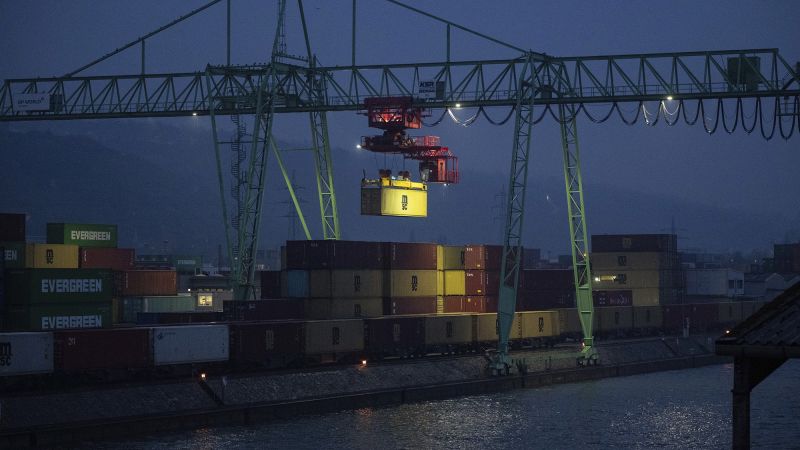
It’s a make-or-break moment for Germany’s economy. Trump’s tariffs won’t help
CNN
When German voters go to the polls Sunday, the country’s moribund economy — and promises to fix it — will be front of mind. But Donald Trump’s looming import tariffs will make that daunting task even harder for the new government.
When German voters go to the polls Sunday, the country’s moribund economy — and promises to fix it — will be front of mind. But Donald Trump’s looming import tariffs will make that daunting task even harder for the new government. Failure would be costly. If the parties most likely to form a new governing coalition do not manage to kick-start economic growth, “they know who’s going to win the next elections, and this would be the far-right AfD,” said Carsten Brzeski, a senior economist at pan-European bank ING, echoing others’ fears about the Alternative for Germany party. The German economy, the world’s third-largest, has barely grown since the pandemic. It shrank both in 2023 and last year, posting the first back-to-back annual contractions since the early 2000s. And this year, it is set to grow by a paltry 0.3%, according to International Monetary Fund forecasts. It wasn’t always like this. Between around 2005 and 2019, the export-oriented economy was thriving, propelled by cheap natural gas from Russia, an imports-hungry China and a relatively frictionless global trading environment.


Undeterred by a federal judge’s recent rebuke, the Pentagon has announced another set of restrictions on the press corps that regularly covers the US military.

If you’ve been paying attention to, like, the news, you may be tempted to see Wall Street’s Monday morning 180 from despair to euphoria as a sign that stock traders are all a bunch of rubes.

“Linda from Arizona,” a caller on Clay Travis’ conservative talk radio show, might deserve the credit or blame for ICE agents deploying to airports across the US today.

Artificial intelligence could widen the problem of income inequality, said BlackRock CEO Larry Fink in his annual letter to shareholders.

Stocks soared and oil prices fell after President Donald Trump on Monday said the United States would postpone further strikes on Iran’s energy infrastructure, pending the outcome of negotiations.

The national average price for a gallon of regular unleaded gasoline is on the verge of hitting $4 for the first time since 2022.

Oil prices rose Monday after the United States and Iran threatened fresh attacks on energy facilities in the Middle East, including power plants, signaling that the conflict may yet escalate.

The war in Iran is pushing up prices for already-strained farmers, with higher costs for fertilizer and energy on top of last year’s tariffs. And the increasing pressure on American agriculture could lead to even bigger price tags at the grocery store.

If you only watched Fox News over the weekend, you didn’t hear about President Donald Trump’s widely condemned reaction to Robert Mueller’s death.

Oil prices rose Sunday after President Donald Trump threatened to “obliterate” Iran’s power plants if the Strait of Hormuz is not reopened by Monday evening.

Defense Secretary Pete Hegseth has been taking steps to thwart news coverage of the Pentagon for more than a year. Now he has finally met some resistance.

Defense Secretary Pete Hegseth has been taking steps to thwart news coverage of the Pentagon for more than a year. Now he has finally met some resistance.

Gerald Rodriguez, the general manager of an NPR affiliate in rural Colorado, expected federal funding for public media to shrink. He didn’t expect it to disappear almost overnight.