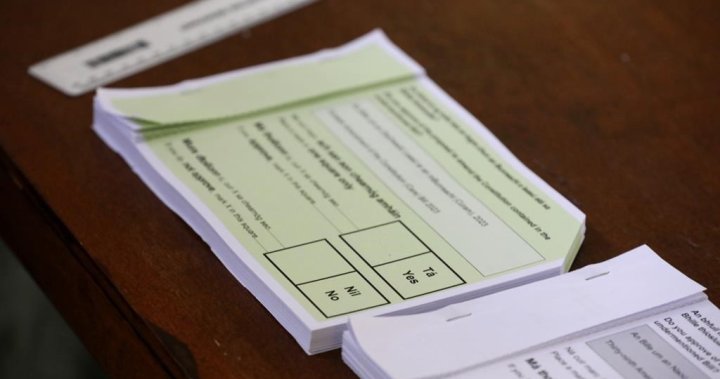
Ireland’s Constitution says a woman’s place is in the home. Voters could change that
Global News
Irish voters will decide Friday — International Women’s Day — whether to change the 87-year-old document to remove passages the government says are outdated and sexist.
According to Ireland’s Constitution, a woman’s place is in the home.
Irish voters will decide Friday — International Women’s Day — whether to change the 87-year-old document to remove passages the government says are outdated and sexist. The twin referendums are on deleting a reference to women’s domestic duties and broadening the definition of the family.
While many women and men support the amendments, others say the proposed changes are confusing and could have unintended consequences.
The first vote deals with a part of the constitution that pledges to protect the family as the primary unit of society. Voters are being asked to remove a reference to marriage as the basis “on which the family is founded” and replace it with a clause that says families can be founded “on marriage or on other durable relationships.” If passed, it will be the 39th amendment to Ireland’s Constitution.
The second change — a proposed 40th amendment — would remove a reference to women’s role in the home as a key support to the state, and delete a statement that “mothers shall not be obliged by economic necessity to engage in labor to the neglect of their duties in the home.” It would add a clause saying the state will strive to support “the provision of care by members of a family to one another.”
Ireland’s Constitution dates from 1937, though the country did not not formally become known as the Republic of Ireland until 1948. It has changed enormously since then, transforming from a conservative, overwhelmingly Roman Catholic country in which divorce and abortion were illegal, to an increasingly diverse and socially liberal society. The proportion of residents who are Catholic fell from 94.9% in 1961 to 69% in 2022, according to the Central Statistics Office.
The social transformation has been reflected in a series of constitutional changes. Irish voters legalized divorce in a 1995 referendum, backed same-sex marriage in a 2015 vote and repealed a ban on abortions in 2018.
Prime Minister Leo Varadkar announced a year ago, on International Women’s Day 2023, that the government would hold a referendum to enshrine gender equality and remove discriminatory language from the constitution. The new votes are about removing “very old-fashioned language” and recognizing the realities of modern family life, said Varadkar, Ireland’s first ethnic minority leader, who is in a same-sex relationship but not married.


Trump says U.S. is nearing its Middle East objectives as allies condemn Iran’s actions in the Strait of Hormuz and warn of global energy impacts.

NATO’s top commander, Gen. Alexus Grynkewich, confirmed earlier Friday that the alliance has pulled several hundred personnel out of Iraq and relocated them to Europe.

The Epstein files revealed consistent communication between the royal and Epstein, including after he was convicted of child sex trafficking offences in 2008.

Prime Minister Mark Carney endorsed a statement after it was released by allies Thursday, expressing willingness to contribute to efforts to reopen the Strait of Hormuz..

James 'Jimmy' Gracey was reported missing after he didn't return to the short-term rental where he was staying with friends during spring break.

The Mina Al-Ahmadi refinery in Kuwait, which can process some 730,000 barrels of oil per day, is one of the largest in the Middle East.

U.S. intelligence, military and law enforcement officials unanimously agreed that an intelligence assessment doubting a foreign role in the 'Havana syndrome' should be withdrawn.

The federal Conservatives accuse the government of being too secretive about the war and point out that Canada's allies are sharing such information openly at daily briefings.

Canada is amongst several nations who 'condemn in the strongest terms recent attacks by Iran on unarmed commercial vessels in the Gulf.'

Gas prices in Canada have been climbing sharply since the Iran war began, but how much higher they could go is unclear as consumers struggle with the higher cost of living.

The Oscar-winning actor has denied all allegations against him and maintains that the incidents raised in the lawsuits either did not happen or were consensual.

European leaders have deflected entreaties from U.S. President Donald Trump to send military assets to secure the Strait of Hormuz.

All six crew members of a KC-135 Air Force refueling aircraft were killed last week in a plane crash over friendly territory in western Iraq, supporting operations against Iran.