Iran, Saudi Arabia agree to reestablish ties after 7 years of tensions
Global News
The deal, struck in Beijing this week, represents a major diplomatic victory for the Chinese as Gulf Arab states perceive the U.S. slowly withdrawing from the wider Middle East.
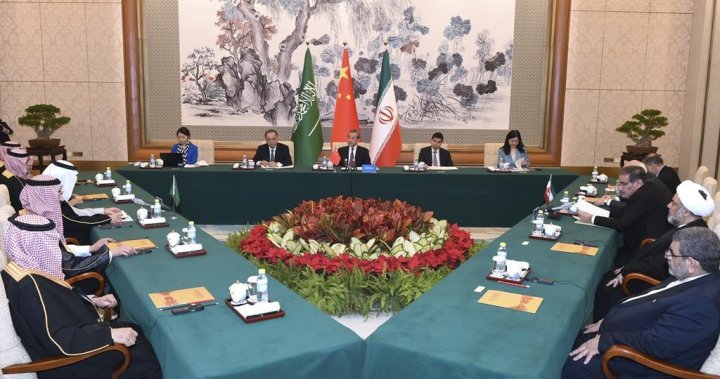
Iran and Saudi Arabia agreed Friday to reestablish diplomatic relations and reopen embassies after seven years of tensions. The major diplomatic breakthrough negotiated with China lowers the chance of armed conflict between the Mideast rivals — both directly and in proxy conflicts around the region.
The deal, struck in Beijing this week amid its ceremonial National People’s Congress, represents a major diplomatic victory for the Chinese as Gulf Arab states perceive the United States slowly withdrawing from the wider Middle East. It also comes as diplomats have been trying to end a long war in Yemen, a conflict in which both Iran and Saudi Arabia are deeply entrenched.
The two countries released a joint communique on the deal with China, which brokered the agreement as President Xi Jinping was awarded a third five-year term as leader earlier Friday.
Xi, whose administration in recent days has relaunched a campaign to challenge the U.S.-led Western liberal order with warnings of “conflict and confrontation,” was credited in a trilateral statement with facilitating the talks through a “noble initiative” and having personally agreed to sponsor the negotiations that lasted from Monday through Friday.
Videos showed Ali Shamkhani, the secretary of Iran’s Supreme National Security Council, meeting with Saudi national security adviser Musaad bin Mohammed al-Aiban and Wang Yi, China’s most senior diplomat.
The statement calls for reestablishing ties and reopening embassies to happen “within a maximum period of two months.” A meeting by their foreign ministers is also planned.
In the video, Wang could be heard offering “wholehearted congratulations” on the two countries’ “wisdom.”
“Both sides have displayed sincerity,” he said. “China fully supports this agreement.”


The institution cancelled all in-person exams on Monday, and the students' union called off events and shut down venues in response to the outbreak.

The Ministry of Energy and Mines announced a 'complete disconnection' of the country’s fuel-powered electrical system, plunging nearly 11 million people into darkness.

Abbas Omidi is one of 32 'senior officials' of Iran’s regime located in Canada.

About a fifth of global oil and liquefied natural gas normally passes through the Strait of Hormuz, a narrow passage of water between Iran and Oman.

Canada finished eighth in the gold-medal standings with just three. As for total medals, Canada placed sixth, with four silver and eight bronze.

Canada produced on average 5.3 million barrels per day of crude oil in 2025, according to the Canada Energy Regulator, making the upcoming production jump a 2.6 per cent increase.

Iran's foreign minister said the U.S. attacked Kharg and Abu Musa islands from locations in the United Arab Emirates, a claim the UAE rejected.

Citing "a more contested environment", British Prime Minister Keir Starmer and his Irish counterpart Micheal Martin said the exercises would begin in September.

Only one in four (23 per cent) Canadians approve while, 16 per cent are unsure either way. Forty-two per cent were found to strongly disapprove.

Countries around the world are grappling with skyrocketing costs for key commodities like oil and fertilizer as the war with Iran continues to upend global trade.

The U.S. Central Command said the crash followed an unspecified incident involving two aircraft in “friendly airspace,” and that the other plane landed safely.

Water treatment centres in the Persian Gulf region are under threat amid the Iran war, with desalination plants in areas like Bahrain taking damage from strikes.

John Gradek said that the price of jet fuel is up about 30 per cent and the cost of fuel represents about 30 per cent of an airline's operating costs.