Investors struggle to price French assets in response to political limbo
CNN
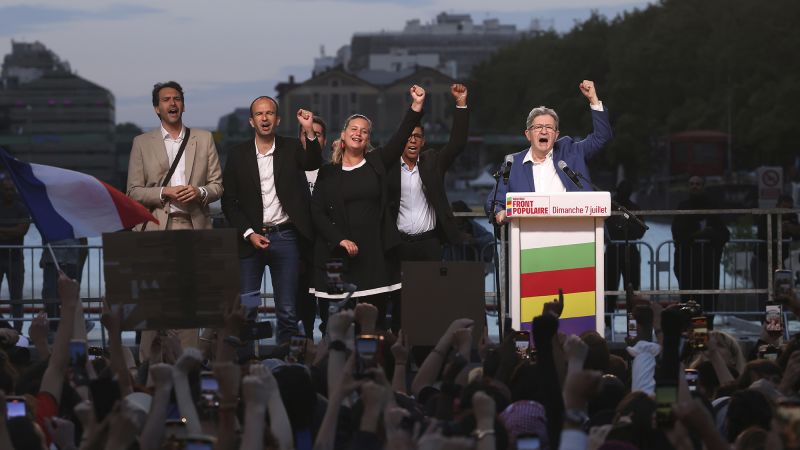
French stocks and government bonds struggled to find direction Monday following surprise results in France’s parliamentary elections, which saw left-wing parties outperform the far right, leaving the country’s parliament facing gridlock.
French stocks and government bonds struggled to find direction Monday following surprise results in France’s parliamentary elections, which saw left-wing parties outperform the far right, leaving the country’s parliament facing gridlock. The yield on benchmark 10-year bonds rose by a fraction of a percentage point to 3.21% by 6.37 a.m. ET. But the premium traders demand to hold French bonds instead of the ultra-safe German equivalents was lower on the day. However, it was still a lot higher than before French President Emmanuel Macron called the snap elections on June 9. Analysts at Rabobank said uncertainty over the composition of the next government was likely to keep that risk premium, or the spread, at “elevated levels” compared with before Macron announced the snap elections. France’s left-wing alliance came in first after the vote Sunday, while the far right trailed in third place in a shocking reversal of first-round results. But with the left falling short of the 289 seats needed for a majority and with a weakened president, the national assembly is expected to be more fractured than ever. France is now set for a prolonged period of instability as three opposing blocs with competing ideas and agendas try to form a coalition or find themselves stuck in a state of paralysis. “The so-called ‘Republican Front’ whereby parties co-operate to block the far right’s ascendance to power proved remarkably successful but leaves the parliament split,” the Rabobank analysts wrote in a note Monday. “We are now likely looking at a period of policy paralysis.”


Oil prices rose Monday after the United States and Iran threatened fresh attacks on energy facilities in the Middle East, including power plants, signaling that the conflict may yet escalate.

The war in Iran is pushing up prices for already-strained farmers, with higher costs for fertilizer and energy on top of last year’s tariffs. And the increasing pressure on American agriculture could lead to even bigger price tags at the grocery store.

If you only watched Fox News over the weekend, you didn’t hear about President Donald Trump’s widely condemned reaction to Robert Mueller’s death.

Oil prices rose Sunday after President Donald Trump threatened to “obliterate” Iran’s power plants if the Strait of Hormuz is not reopened by Monday evening.

Defense Secretary Pete Hegseth has been taking steps to thwart news coverage of the Pentagon for more than a year. Now he has finally met some resistance.

Defense Secretary Pete Hegseth has been taking steps to thwart news coverage of the Pentagon for more than a year. Now he has finally met some resistance.

Gerald Rodriguez, the general manager of an NPR affiliate in rural Colorado, expected federal funding for public media to shrink. He didn’t expect it to disappear almost overnight.

The much-touted new tax breaks for tips, overtime, seniors and car loan interest have a lot of income tax filers expecting a big bump in their refunds this year – or a big cut in their tax bill.

Looking out his shop window, across the street, just to the right, Paloma Clothing co-owner Mike Roach sees one of Portland, Oregon’s, most expensive gas stations.

Oil and liquefied natural gas tankers moving through the Strait of Hormuz carry around 20% of the world’s supply. But for countries on the Persian Gulf, the waterway is more than just an energy route – it’s a lifeline for more than 100 million people.

A California jury has largely sided with Twitter shareholders who accused billionaire Elon Musk of defrauding them by intentionally driving down the social media company’s stock ahead of his $44 billion acquisition in 2022.

The war with Iran is disrupting global oil flows, damaging energy infrastructure and raising fears of prolonged conflict. But gold, usually considered a safe haven during periods of economic uncertainty, has slumped.

US stocks and bonds fell, oil prices rose and gold had its worst week in four decades as the Iran war continues to ripple through financial markets.