Invasive Jorō spider is surprisingly tolerant of busy urban settings, according to new study
CNN
The invasive Jorō spider has baffled researchers by living near busy roads and urban places that other creatures tend to avoid. A new study might explain why.
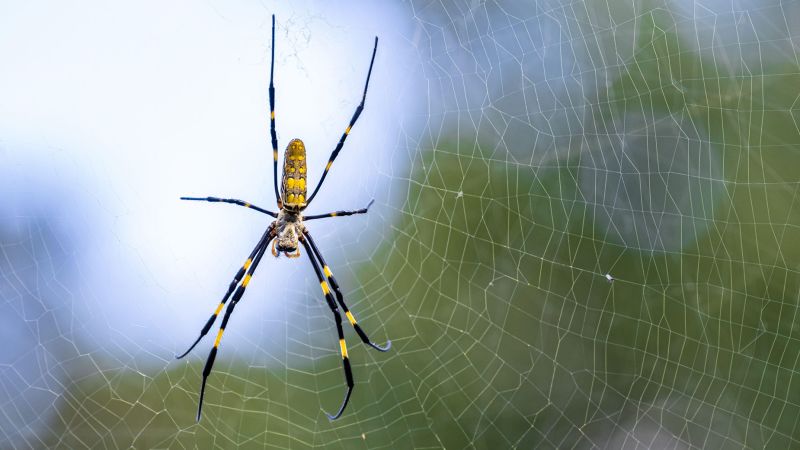
As the Jorō spider continues to spread across the southeastern United States, its spindly homes can be spotted almost anywhere — even on power lines and stoplights hovering over busy roads. Typical spiders — and most creatures — tend to find the noise and wind disturbance from nearby busy roads to be too stressful, but the Jorō spider doesn’t seem to mind much, according to a new study published in Arthropoda on February 13. This research could explain why the spiders are regularly spotted in urban areas that native spiders don’t inhabit and suggests the creatures are well-suited to thrive and spread in similar locations throughout the United States. “If you ever look at a spiderweb next to a road, they’re jiggling and shaking, and it’s a cacophony of stimuli. … Roadsides are a really harsh place for an animal to live. But Jorōs seem to be able to live next to them,” said lead study author Andy Davis, a research scientist at the University of Georgia’s Odum School of Ecology. “It’s kind of unfortunate for us here in the US — it so happened to be the place where the spider got deposited about 10 years ago, and it just so happens that the (spider) that got dumped here is one that can do really well with humans.” Jorō spiders, or Trichonephila clavata, were first spotted in the United States around 2013, according to a University of Georgia news release. The creatures — which grow up to 4 inches (10 centimeters) in length, about the size of the palm of a human hand — have since spread rapidly across the southeastern states. Classified as orb weavers, the spiders catch prey using their giant, three-dimensional webs. The Jorō will sit in the middle of the web and wait to feel a vibration, signifying that an insect has been caught in the sticky trap, allowing the spider to rush down and capture it.


President Donald Trump voted in Tuesday’s state House special election by mail even as he suggested on Monday that “mail-in voting means mail-in cheating.”

CNN’s 5 Things AM brings you the news you need to know every morning.

The Supreme Court on Tuesday will consider the legality of a policy championed by President Donald Trump during his first term that prevented scores of migrants arriving at the southern border from starting the process of applying for asylum.

A young, well-liked facilities manager at the Kennedy Center has gone from being described as “in charge of HVAC and toilets” to head of the renowned arts institution.

Democrats in Florida are hoping to capitalize on the party’s recent special election overperformances and come out on top Tuesday in a special state House election for a Palm Beach district that includes President Donald Trump’s Mar-a-Lago residence.

The Supreme Court on Monday appeared ready to limit mail-in ballots, a move that would reinforce the justices’ pattern of shrinking voter protections and that has, at bottom, favored Republican interests and the Trump administration.

An Air Canada plane traveling from Montreal collided with an emergency vehicle on the runway at New York City’s LaGuardia Airport in the late hours of Sunday night, killing two pilots and injuring dozens of people.

Top Senate Republicans on Capitol Hill believe their party is unified behind a plan to reopen the Department of Homeland Security. Now, they need to sell the plan to Democrats.

Markwayne Mullin will serve as Donald Trump’s next Department of Homeland Security secretary, elevating the US senator to helm the agency at the center of the president’s controversial immigration enforcement effort and an ongoing shutdown.

President Donald Trump’s sudden turnabout and, according to him, rapidly advancing peace talks made for an abrupt shift in the administration’s approach to the Iran war.

The Supreme Court’s conservative majority appeared dubious of state laws that allow the counting of mail ballots that arrive at election offices after Election Day as justices heard oral arguments in a challenge to Mississippi’s five-day grace period for mail ballots.

The chief district judge in New Jersey appointed Robert Frazer, a career prosecutor, to serve as US attorney for the state, ending for now a dispute over the legality of the office’s leadership that threatened to derail criminal investigations.

Tens of thousands of taxpayer dollars were spent on expenses for hair and makeup artists and a horse for the advertisement showcasing outgoing Department of Homeland Security Secretary Kristi Noem in front of Mount Rushmore, according to invoices seen by CNN.