Into the heart of clay | Indian Ceramics Triennale 2024 gets underway Premium
The Hindu
The second edition of the Indian Ceramics Triennale features 60 artists from 12 countries, and subjects that straddle the personal and the political
“We manifested this,” declares Vineet Kacker, artist and one of the six founding members of the Indian Ceramics Triennale, which returns for its second edition in the newly opened Arthshila gallery in Okhla, New Delhi. All practising ceramists, Kacker, along with Anjani Khanna, Madhvi Subrahmanian, Neha Kudchadkar, Reyaz Badaruddin, and Sharbani Das Gupta, describe the triennale as “first and foremost a passion project,” brought together to showcase ceramics — or rather, clay.
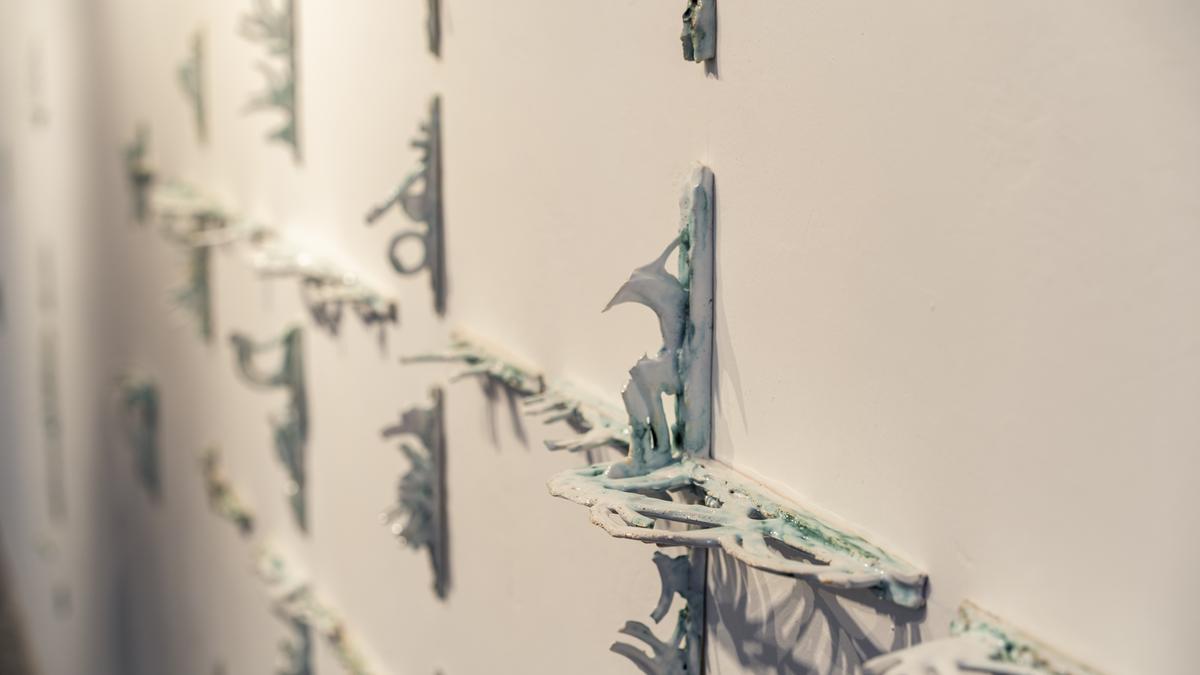
Aptly themed Common Ground, the triennale brings together over 34 powerful art projects by more than 60 artists from 12 countries. Each artist’s proposal, chosen through an open call, addresses diverse critical issues and perspectives while being bound by clay. The mission is straightforward: to challenge the conventional perception of ceramics and give it the platform it deserves.
“Ceramics have often been linked to functionality and decoration, and not commonly considered as an artistic medium,” shares Khanna. “Bringing about this shift is of utmost importance for us.” This shift is realised by incorporating a range of artists, from traditional and contemporary practitioners working with ceramics to those engaged in highly multidisciplinary practices involving performance, sound and even Virtual Reality (VR) — all firmly grounded in the realm of ceramics.
Tradition, often confined to functionality, is thoroughly explored through multiple presentations at the triennale. This includes a showcase by the national award-winning artist Om Prakash Galav from Alwar, Rajasthan, belonging to a family of potters, who makes the familiar unfamiliar through contemporary terracotta creations. He explores the abstract concept of Shunya (the state of nothingness) through pieces that diminish in size from large to the smallest, almost requiring a magnifying lens to appreciate.
Hailing from the Lodia district of Gujarat, master artist Kumbhar Ismail Hussain and his family will showcase ancient Kutch pottery and painting reinvented to mirror their everyday life. The vibrancy of indigenous life also finds expression in ceramic pots crafted by Australian aboriginal artists Hayley Coulthard and Rona Rubuntja. The pieces are painted with luscious landscapes of their native Hermannsburg, while miniature figures of humans and animals adorn the lids, adding a touch of whimsy.
The artist-curators of the triennale have harnessed the power of cross-cultural collaborations too, to unlock individual potential and creative energies. Potters Lota Ismailbhai Husen and Kumbhar Alimamad Dhavad in Kutch, and Santosh and Rakhi Warekar from the Warak Cluster in Jaipur, closely collaborated with curators Rajesh Kulkarni and Raju Sutar of Creative Dignity, an initiative to energise the craft ecosystem. Together, they have created a striking installation titled Lost and Found, composed of arranged lotas — or pots — as a means to revive and honour the ordinary vessels used for water and grain across India, as well as the clusters of people who craft them.
Similarly, in a unique collaboration among artists and makers across continents, Ugandan artist Lilian Nabulime and British artist Andrew Burton will work with the women of Mandi Village in South Delhi to build a structural installation out of clay and cow dung, drawing from the visual of huts covered in cow dung cakes, which is used as fuel in both rural and urban households.


An independent video, ‘Feel the Spark’ by Raleigh Rajan with vocals by Ciera Dumas that celebrates Tamil literary giants, garnered 1.4 million views in less than 36 hours.

In ‘Jack Ryan: Ghost War’, John Krasinski is back as the savvy CIA analyst, diving headfirst into a high-stakes mission that unravels a deadly conspiracy and pits him against a rogue black-ops unit

Shriram Bharatiya Kala Kendra’s Shankarlal festival showcased rare ragas, radiant artistry, and inclusive performances, from Pt Madhup Mudgal’s serene morning ragas to Ramana Balachandran’s Saraswati veena.

Explore "Threads that Bind: The Kantha Project," an exhibition in Delhi reimagining kantha as a medium of repair and renewal.

Sean Penn skips the Oscars to meet Ukraine's Zelenskyy, who praises him as a "true friend" amid the war.

The teaser of Tamil star Suriya’s much-awaited film with director Venky Atluri, titled Vishwanath and Sons, was unveiled by the makers on Monday

A 'Golden' moment for a K-pop track at the Oscars.

Parvathi Nayar’s new exhibition, The Primordial, in Mumbai, traces oceans, pepper and climate change
Opened on March 12, the exhibition marks the artist’s first solo show in Mumbai in nearly two decades. Known for her intricate graphite drawings and multidisciplinary practice spanning installation, photography, video, and climate change, her artistic journey has long engaged with the themes of ecology, climate change and the natural world. In this ongoing exhibition, these strands converge through a series of works centred on water, salt, and pepper — materials that carry natural and historic weight across centuries.

Explore the highlights and key winners of the 98th Academy Awards, featuring memorable moments and historic achievements from Oscars 2026.

Spring season celebrated at Ramakrishna Mission Institute, Kolkata, with ‘Evening of Basant’

The Spirit of the Land, a solo show by artist Shivakumar Sunagar, is a vista of Nature-inspired emotions

Tal Fry is all set for an exciting new performance season

Netflix is making a bold move by snagging InterPositive, the AI filmmaking company founded by Ben Affleck, in a deal that could hit $600 million