Inside Prakriti Foundation’s Festival of Sacred Music
The Hindu
When Marathi abhangs and Tamil musical compositions came together to signal hope and comfort in these divisive times
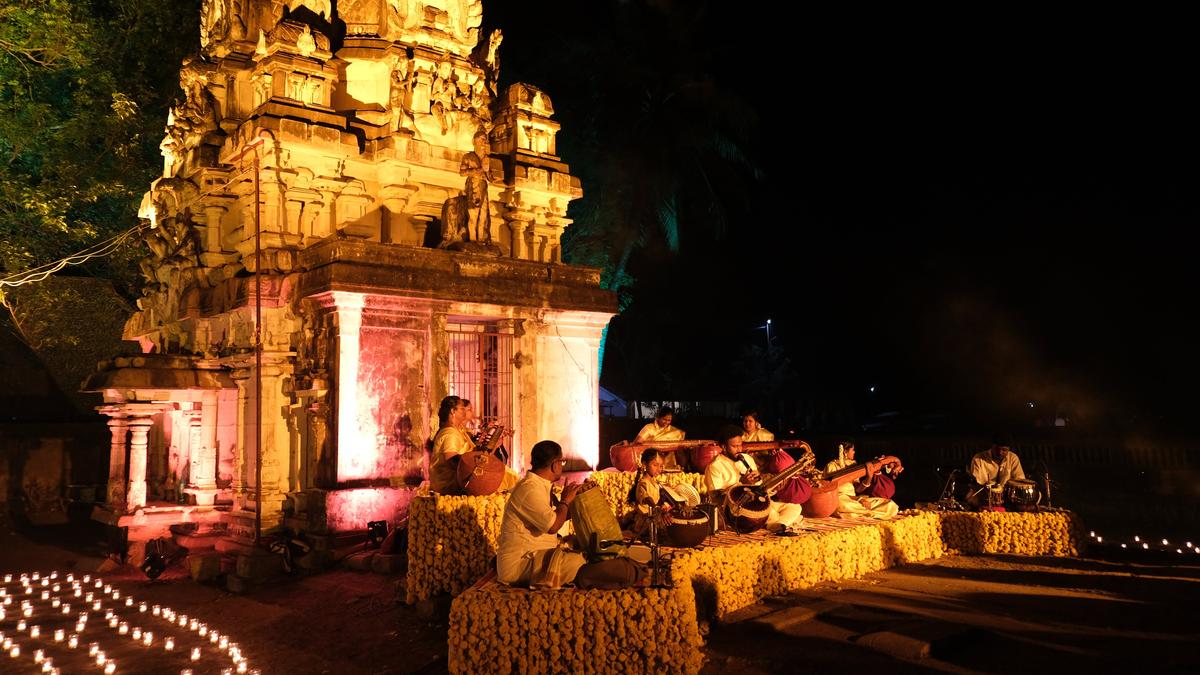
Prakriti Foundation’s Festival of Sacred Music (Thiruvaiyaru on the Cauvery), the 12th in a remarkable series initiated by cultural catalyst Ranvir Shah, took place this February in Thanjavur and Thirupugalur in Tamil Nadu. Festivals of sacred music are now popping up all over: there is an impressive annual one in Fez, Morocco; another on the island of Patmos in the Aegean Sea; and an International Festival of Music and Art in Rome.
India has a few too, including the Sacred Spirit Festival that takes place in March in Mehrangarh Fort, Jodhpur; Bengaluru’s Fireflies Festival of Sacred Music; and the Sacred River Festival in Maheshwar, Madhya Pradesh. Some of these have their own idiosyncratic definitions of what “sacred” means; some have unifying themes — ecological, social, meditative, mystical, and so on.
In this expanding and varied landscape, Prakriti’s Thiruvaiyaru festival is unfailingly excellent. The performances are brilliant and wide-ranging, the artists superb; the musical texts come mainly (but by no means only) from the classical Carnatic repertoire.
Throughout the 2025 festival, day and night overlapped in a gentle symbiosis — evening performances balanced by daytime adventures. A trip to Darasuram and Swamimalai ended with a veena recital at the Siddhar koyil (temple) in Thirupugalur, across from the temple where the Tevaram poet Appar merged forever into Lord Shiva.
On day three, a morning walk on West Main Street in Thanjavur led us past the Bangaru Kamakshi temple, to whose goddess Shyama Shastri devoted many of his musical compositions. That same evening in Thiruvaiyaru, Sikkil Gurucharan sang for Bangaru Kamakshi. I was moved beyond words.
For a moment, I thought I saw both poet Muttusvami Dikshitar and Shastri walking together, singing, just ahead of us on the street where they once lived at the same time. Imagine the creative effervescence of those days in Thanjavur at the royal court, the temples, and in the musical salons. Clearly, these astonishing geniuses are still very much alive.
On the first night of the performances, Shruthi Veena Vishwanath, whose work celebrates the intersection of classical and folk forms, sang a medley of intoxicating abhangs (devotional poems), accompanied by Shruteendra Katagade on tabla and Babui on dotara. Marathi abhangs — dramatic, highly personal, emotional, and sometimes antinomian — are by now intrinsic parts of the Carnatic concert canon, as is only right.


Discover the Minor Planet Centre, the key hub for tracking and verifying observations of small solar system bodies.

Discover the Minor Planet Centre, the key hub for tracking and verifying observations of small solar system bodies.

In this week's Science for All newsletter, XX explains

Test your knowledge with the quiz on Science films at the Oscars through history

Set between the Siwalik hills and the plains, Butwal offers travellers a mix of regional cuisine, pilgrimage trails to Lumbini and the comfort of Hyatt’s new hospitality landmark

Explore 2026's wallpaper trends in India, highlighting botanicals and handmade designs that enhance modern homes with nature-inspired aesthetics.

Mercedes-Benz CLA 250+ with EQ Technology review: design, performance, range and features explained. Discover how the new electric CLA combines advanced AI, long range, fast charging and futuristic styling for the next generation of luxury EVs.

AI tool for sparrow conservation

BTS’s comeback with ‘Arirang’ marks a major global music event. When does the album release, and where can you watch their concert live stream? We have all the details

The 2026 U.S. cholesterol guidelines urge starting screening and treatment at 30 to prevent cardiovascular disease effectively.

Olam Festival 2026 in Thiruvananthapuram returns March 27-29 with 120+ vendors, music, art, and cultural zones.

A few storytellers in Thiruvananthapuram share their journeys, challenges, and evolving methods on World Storytelling Day, inspiring young minds.

76-year-old Kurian Jacob from Kerala triumphs with seven medals, including five golds, at the Open Masters Games in Abu Dhabi.