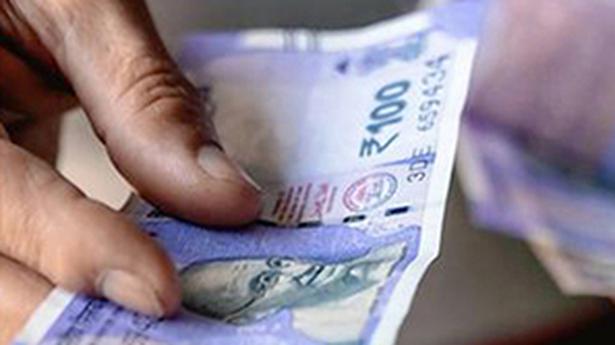
Indian rupee hits record low on CAD concerns
The Hindu
Country’s June trade deficit widened to a record high of $25.63 billion from $9.61 billion a year earlier
The Indian rupee hit a record low against the U.S. dollar on Tuesday as concerns of a wider current account deficit (CAD) came to the forefront after the country's trade deficit hit an all-time high in June.
Data late on Monday showed India's June trade deficit widened to a record high of $25.63 billion, following a rise in crude oil and coal imports, from $9.61 billion a year earlier.
Analysts and economists are expecting the country's current account deficit to widen to about 3.2% of the GDP in fiscal year 2023 compared with 1.2% in 2022.
The partially convertible rupee closed trading at 79.37/38 per dollar, after hitting a life low of 79.3750. It had had closed trading at 78.95 on Monday.
"We expect India's widening current account deficit to remain an ongoing drag for INR, with limited offsets from India's FDI and overseas investment inflows, exacerbated by ongoing FPI outflows," Sonal Varma, economist at Nomura, said.
"Therefore, we expect USD/INR to reach 82 by Q3 2022 and 81 by Q4 2022. One risk to our view is the RBI's USD selling intervention, which could slow the pace of INR depreciation."
The domestic share market turned negative towards the end of trade to close down 0.2%, adding to the pressure on the rupee.


Parliamentary panel criticizes Ministry of Planning and Niti Aayog for persistent underutilization and poor financial management practices.

LPG consumption in India dropped 17.7% in March due to war-related supply disruptions, impacting household cooking gas availability.

LPG eKYC is required only for unauthenticated customers, clarifies the Ministry of Petroleum and Natural Gas.

India's second LPG carrier, 'Nanda Devi', arrives at Gujarat's Vadinar port, carrying 46,500 metric tonnes of gas.

European publishers, tech firms and startups have urged EU antitrust regulators to wrap up a near two-year probe into Alphabet unit Google’s alleged favouring of its own services in online searches and impose a fine on the tech giant.

OpenAI is in advanced talks with private equity firms including TPG, Advent International, Bain Capital and Brookfield Asset Management to form a joint venture

Shares of Samsung Electronics rose as much as 5% on Tuesday after Nvidia CEO Jensen Huang said the South Korean company was producing Nvidia’s new artificial intelligence chips.

Stock markets rebound after early losses, with Sensex and Nifty rising amid global bullish trends despite notable laggards.

The rupee declines 14 paise to 92.42 against the dollar amid rising crude prices and foreign fund withdrawals.

Dell’s total workforce declined by about 10%, or 11,000 employees, in fiscal 2026, it said on Monday

Nvidia chief Jensen Huang on Monday said the leading artificial intelligence chip maker is heading for space with a goal of powering orbiting data centres.

Meta Platforms shares rose nearly 3% on Monday after a Reuters report that the social media giant plans to lay off 20% or more of its workforce to offset heavy spending

Wholesale price inflation hits 11-month high at 2.13%, driven by rising crude prices and increased costs across various sectors.