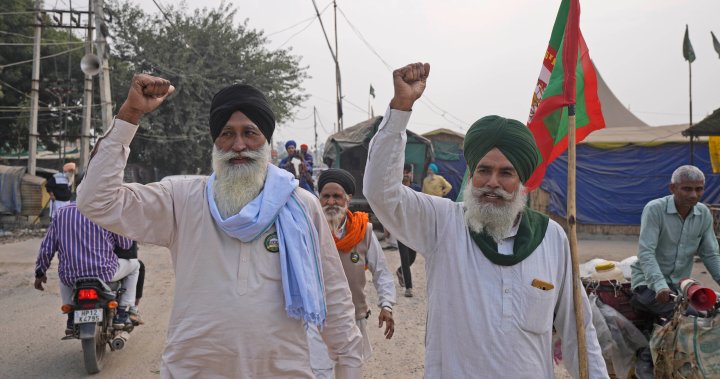
Indian PM Modi repeals contentious farm laws after yearlong farmers’ protests
Global News
Narendra Modi made the announcement to repeal the three farm laws during a televised speech that was broadcast live to the entire nation.
In a surprise announcement, India’s Prime Minister Narendra Modi said Friday his government will withdraw the controversial agriculture laws that prompted yearlong protests from tens of thousands of farmers and posed a significant political challenge to his administration.
The decision is a major climbdown by Modi’s Bharatiya Janata Party government, which enjoys a brute majority in Parliament but has been often accused by opposition leaders and constitutional experts of ramming through laws without enough consultation. The decision also came ahead of key elections in states like Uttar Pradesh and Punjab, and on the day of the Guru Purab festival, when Sikhs, who made up most of the protesters, celebrate their founder Guru Nanak’s birthday.
Modi made the announcement during a televised speech that was broadcast live, a medium he has chosen over the years to make public some of his government’s landmark, sometimes contentious, decisions. He urged the protesters to return home and said the constitutional process to repeal the laws will begin in December when Parliament sits for the winter session.
“While apologizing to the nation, I want to say with a sincere and pure heart that maybe something was lacking in our efforts that we could not explain the truth to some of our farmer brothers,” Modi said during the address. He then went on to say: “Let us make a fresh start.”
The laws were passed in September last year and Modi’s party had refused to extend the debate despite repeated requests from the opposition.
For a year, the government defended the laws, saying they were necessary reforms to modernize India’s agricultural sector and boost production through private investment. But the farmers protested, saying the legislation would devastate their earnings by ending guaranteed pricing and force them to sell their crops to corporations at cheaper prices.
The perceived threats to their income terrified farmers, who mostly work on a small scale: More than two-thirds of them own less than 1 hectare (2 1/2 acres) of land.
Clauses in the legislation also prevented farmers from resolving contract disputes in court, leaving them with no independent means of redress apart from government-appointed bureaucrats.


U.S. intelligence, military and law enforcement officials unanimously agreed that an intelligence assessment doubting a foreign role in the 'Havana syndrome' should be withdrawn.

The federal Conservatives accuse the government of being too secretive about the war and point out that Canada's allies are sharing such information openly at daily briefings.

Canada is amongst several nations who 'condemn in the strongest terms recent attacks by Iran on unarmed commercial vessels in the Gulf.'

Gas prices in Canada have been climbing sharply since the Iran war began, but how much higher they could go is unclear as consumers struggle with the higher cost of living.

The Oscar-winning actor has denied all allegations against him and maintains that the incidents raised in the lawsuits either did not happen or were consensual.

European leaders have deflected entreaties from U.S. President Donald Trump to send military assets to secure the Strait of Hormuz.

All six crew members of a KC-135 Air Force refueling aircraft were killed last week in a plane crash over friendly territory in western Iraq, supporting operations against Iran.

U.S. Director of National Intelligence Tulsi Gabbard testified that the regime remains intact and Tehran and its proxies remain capable of attacking U.S. and allies' interests.

James 'Jimmy' Gracey was reported missing after he didn't return to the short-term rental where he was staying with friends during spring break.

The U.K. Health Security Agency described the event as 'rapidly evolving' and warned of the potential for further cases.

U.S. benchmark crude fell US$1.24 to US$94.53 per barrel. Brent crude, the international standard, rose to US$104.17 per barrel. That's down from more than US$106 on Monday.

Volodymyr Zelenskyy urged Ukraine's allies not to forget about his country, and suggested the U.S. and others should make use of Ukraine's anti-drone technology during the war.

Trump’s visit to China is seen as an opportunity to build on a fragile trade truce, but it has become tangled in his effort to find an endgame to the war in Iran.