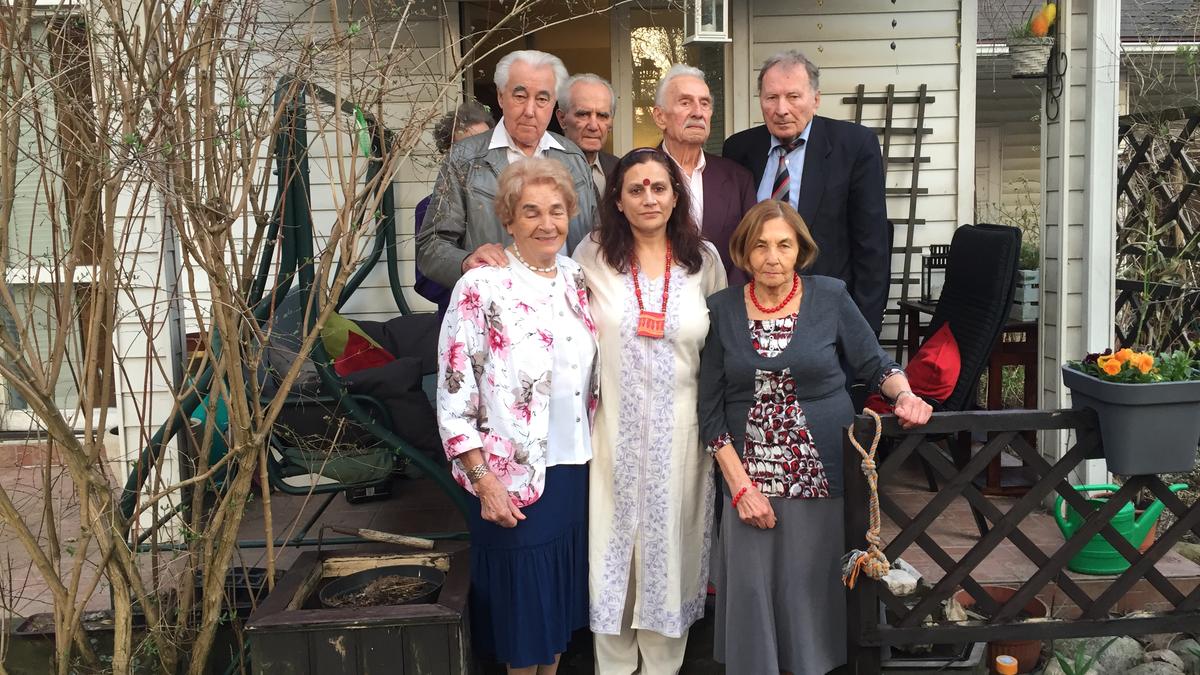
Indian homecoming for Polish grandchildren
The Hindu
Polish youth revisit the wartime sanctuary of their grandparents who were sheltered during World War II by the Maharaja of Nawanagar
It didn’t come as a surprise earlier this year in March when Kieran Kyle Culkin walked away with the Academy Award for Best Supporting Actor for his performance in A Real Pain. In the comedy-drama, Culkin sets off on a journey through Poland with his mismatched cousin (played by Jesse Adam Eisenberg) to honour their Jewish grandmother, a holocaust survivor.
Coincidentally, a few weeks before the Oscars, a group of young Polish men and women were retracing their grandparents’ journey in India. Their ancestors were among the Polish children orphaned during the course of World War II, who found refuge in this country.
Twenty Polish youth, some of them grandchildren of the Polish survivors, visited Balachadi (Jamnagar) and Valivade (Kolhapur) in February under the Jamsaheb Memorial Youth Exchange Programme. The visit was organised by the Ministry of Youth Affairs and Sports, Government of India, after PM Narendra Modi’s visit to Poland last year.
“Our grandfather was always talking about India. He called it his second home,” says Arkadiusz Michałowski (Arek), 28, a resident of Warsaw, whose (late) grandfather Wieslaw Stypula, was one of about 1,000 Polish children orphaned during World War II who were sheltered by the Maharaja of Nawanagar (presently Jamnagar), Jam Saheb Digvijaysinhji Ranjitsinhji Jadeja, in the erstwhile state of Gujarat. The year was 1942, when Poland was occupied by Nazi Germany and the Soviet Union, and the exiled Polish Government in London was anxious about the future of their younger generations. The Maharaja, whose musical skills were appreciated by the great Polish pianist and statesman Ignacy Jan Paderewski, created a home within his estate for the orphaned children.
“It was my grandfather’s dream to show us where he spent his childhood, introduce us to the people who remember the camp, and show us the memorial in Balachadi that he was instrumental in designing,” says Arek, who was visiting India with his 25-year-old sister Kasia Michalowska.
The memorial depicts a woman with a babe in her arms, caressing the head of a child reaching up to her. “The woman symbolises Mother India, an Indian child is in her arms and she is hugging a Polish child with her other arm. It is symbolic of how the Good Maharaja in India protected all the Polish children,” says Arek. “I cried when I read the poem carved on the memorial. It was written by my grandfather in the Balachadi camp when he was a teenager. It is part of him, his story, and my past,” say Arek, remembering his grandfather who passed away last year.
After World War II, the efforts of the International Red Cross helped these Polish children reunite with their surviving families across the world, including Poland, the U.K., Canada, and Australia. Books and documentaries have captured their experiences. Poles in India 1942-1948: Second World War Story is a collective work of these Polish survivors, based on archival documents and personal reminiscences.


The 2026 U.S. cholesterol guidelines urge starting screening and treatment at 30 to prevent cardiovascular disease effectively.

Olam Festival 2026 in Thiruvananthapuram returns March 27-29 with 120+ vendors, music, art, and cultural zones.

A few storytellers in Thiruvananthapuram share their journeys, challenges, and evolving methods on World Storytelling Day, inspiring young minds.

76-year-old Kurian Jacob from Kerala triumphs with seven medals, including five golds, at the Open Masters Games in Abu Dhabi.

Explore the nature of the human mind as an emergent property of brain activity and complex neural interactions.

CERN's Large Hadron Collider discovers the Xi-cc-plus particle, enhancing understanding of quantum mechanics and baryon behavior.

Vibha Batra’s latest book, Spotless (Hachette India) is a novel in verse for young adults

In its first edition, the Madras Art Salon spotlights the works of journalist and artist Narayan Lakshman at The Botanical Club, a social space in the British Deputy High Commission, Chennai

Cholesterol enhances melanoma cell invasion by making nuclei squishier, revealing a potential treatment target in cancer progression.

The designers reinterpret the Swedish artist’s symbolic forms and colour energy through contemporary resortwear silhouettes

Discover the inspiring legacy of Bibha Chowdhuri, a pioneering woman in physics and a trailblazer in STEM history.

Discover the inspiring legacy of Bibha Chowdhuri, a pioneering woman in physics and a trailblazer in STEM history.

Ashdeen’s Spring 2026 collection features saris inspired by the designer’s Parsi gara archive