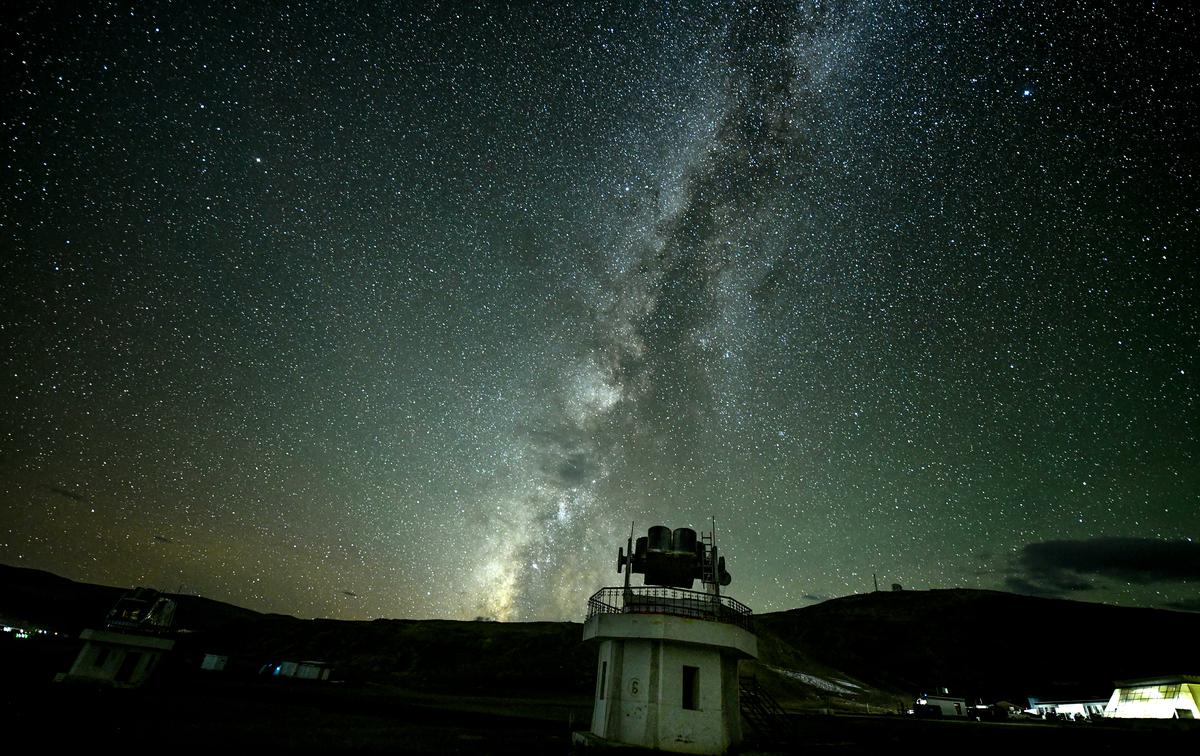
Indian Astronomical Observatory | Where the stars must not twinkle
The Hindu
Clean skies, high altitude and complete darkness are vital for India’s cutting-edge astronomical observatory in Ladakh’s Hanle village. Jacob Koshy reports on the challenges in having it declared an International Dark Sky Reserve, and the efforts to make residents stakeholders in the process
Srinivasa Ramanujan was ‘discovered’ twice in the 20th century. The first was when English mathematician G.H. Hardy ‘discovered’ the genius mathematician in 1914; and the second was when Indian astronomers in India, led by R. Rajamohan, discovered an asteroid that was later named 4130 Ramanujan. It was the first time in 104 years that asteroids were discovered from India. Their instrument, the 45-cm Schmidt telescope, was housed on the Javadi hills in Kavalur, Tamil Nadu.
This spot is today the Vainu Bappu Observatory and is run by the Indian Institute of Astrophysics (IIA), Bengaluru, and is among India's foremost observatories. It was chosen in the 1960s because it was an impressive 750 metres above sea level, located amid a forest and offered fairly unobstructed vistas of the night sky.
But this wasn’t ideal. Kavalur’s geography put it in the path of both monsoonal clouds, during June-September and the returning, or northeast, monsoon in November, forcing the observatory to often shut down for months. Rainclouds absorb starlight and radiation from cosmic objects, preventing them from being caught on the telescopes of cameras. So IIA scientists began their search in the early 1980s for a place least affected by the monsoon.
To be able to detect stars or traces of cosmic phenomena, such as supernovae or nebulae from light years away, astronomers must be able to catch the faintest slivers of their radiation that often lie outside the range of visible light. Such radiation is, however, easily absorbed by water vapour and so it helps to have a telescope high above ground where the atmosphere is drier. “A dry, high-altitude desert is in many ways the ideal location,” says Annapurni Subramaniam, Director of the IIA. “Such terrain is difficult and quite inaccessible. We commissioned several expeditions and teams to different parts of the Himalayas and finally Hanle, Ladakh was chosen.”
A largely smooth double-lane highway from Leh, the capital of Ladakh, to Hanle cuts through a valley scooped out of the mountains of the Ladakh range and the teal-coloured Indus. Army units and border check-posts punctuate the landscape that opens out into the Changthang Wildlife Sanctuary, where you can spot the occasional herd of the Tibetan wild ass and swarms of leaf warblers. As the road ascends, a smattering of hamlets, surrounded by pasture land, comes into view with herds of Changthangi sheep, the source of pashmina wool.
Situated at 14,000 ft above sea level and a little over 250 km southeast of Leh, Hanle is a village of about 320 houses and a population of about 1,500, according to Paljor Therchin, the sarpanch of Hanle.
Against the backdrop of a blue sky flecked with cottony clouds, two huge metallic capsules — one higher than the other — incongruously rise out of the hills. Next to them, satellite dishes, like ushers, point to the sky. From here, a tarred road spirals down about 900 ft to flat land where makeshift cabins and a small building serve as ancillaries to a giant, parabolic dish that is a complex of a thousand mirrors bathed white in sunlight, resting on criss-crossing steel frames of red and blue. Men, some perched, some dangling on the beams, weave out of the meshes of this honeycomb structure.


Set between the Siwalik hills and the plains, Butwal offers travellers a mix of regional cuisine, pilgrimage trails to Lumbini and the comfort of Hyatt’s new hospitality landmark

Explore 2026's wallpaper trends in India, highlighting botanicals and handmade designs that enhance modern homes with nature-inspired aesthetics.

Mercedes-Benz CLA 250+ with EQ Technology review: design, performance, range and features explained. Discover how the new electric CLA combines advanced AI, long range, fast charging and futuristic styling for the next generation of luxury EVs.

AI tool for sparrow conservation

BTS’s comeback with ‘Arirang’ marks a major global music event. When does the album release, and where can you watch their concert live stream? We have all the details

The 2026 U.S. cholesterol guidelines urge starting screening and treatment at 30 to prevent cardiovascular disease effectively.

Olam Festival 2026 in Thiruvananthapuram returns March 27-29 with 120+ vendors, music, art, and cultural zones.

A few storytellers in Thiruvananthapuram share their journeys, challenges, and evolving methods on World Storytelling Day, inspiring young minds.

76-year-old Kurian Jacob from Kerala triumphs with seven medals, including five golds, at the Open Masters Games in Abu Dhabi.

Explore the nature of the human mind as an emergent property of brain activity and complex neural interactions.

CERN's Large Hadron Collider discovers the Xi-cc-plus particle, enhancing understanding of quantum mechanics and baryon behavior.

Vibha Batra’s latest book, Spotless (Hachette India) is a novel in verse for young adults

In its first edition, the Madras Art Salon spotlights the works of journalist and artist Narayan Lakshman at The Botanical Club, a social space in the British Deputy High Commission, Chennai