India, Singapore launch linkage of real-time payment systems
The Hindu
The cross-border connectivity between the Unified Payments Interface (UPI) and PayNow of Singapore will “benefit students, professionals, NRIs, and their families the most”, PM Modi said
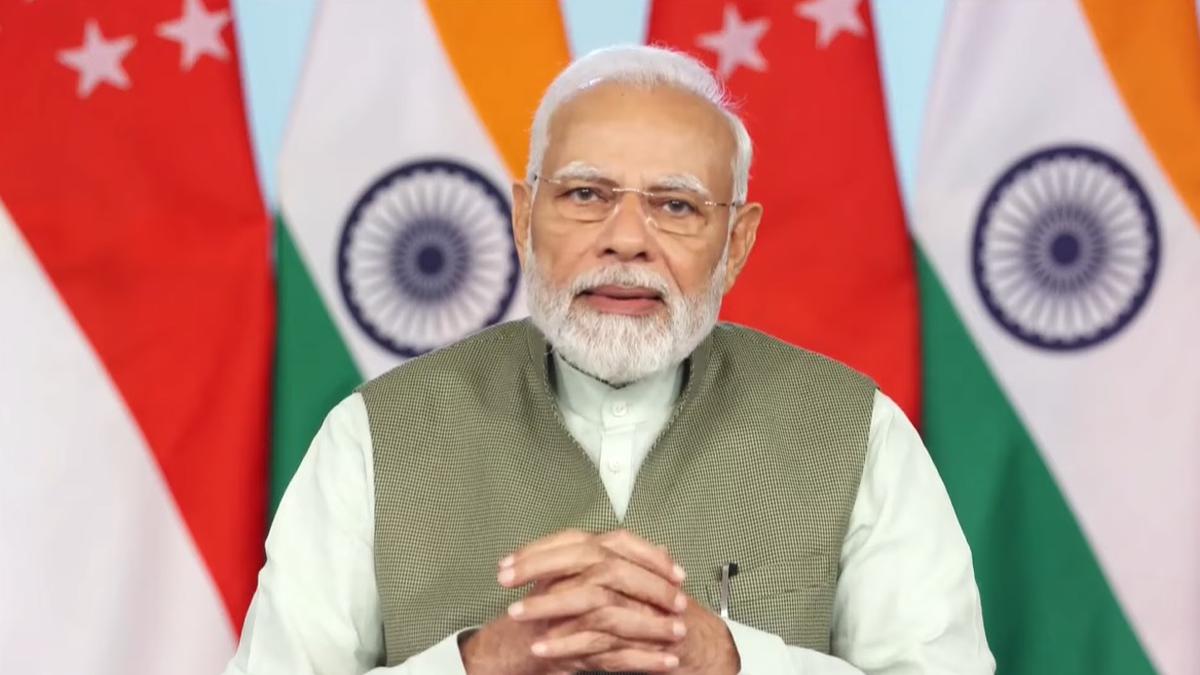
Prime Minister Narendra Modi, along with Singapore counterpart Lee Hsien Loong, on February 21 launched the cross-border connectivity of real-time digital payment systems via video conferencing.
Now, the easy linkage between India’s Unified Payments Interface (UPI) and Singapore’s PayNow will allow residents across the two regions to undertake faster and cost-efficient transfers. The instant and low-cost transfer is particularly useful for migrant workers and students studying in both countries, a statement issued by the Prime Minister’s office yesterday said.
Tuesday’s launch was virtually attended by Reserve Bank of India (RBI) Governor Shaktikanta Das and Monetary Authority of Singapore (MAS) managing director Ravi Menon.
“This linkage will provide a low-cost real-time payment option to people from both countries and increase remittance. This will benefit students, professionals, NRIs, and their families the most,” Mr. Modi said.
“A key emphasis of the Prime Minister has been on ensuring that the benefits of UPI are not limited to India only, but other countries too benefit from it,” the statement said. It added that India under the helm of PM Modi has emerged as one of the fastest-growing ecosystems for fintech innovation, and will help drive globalisation of India’s “best-in-class digital payment infrastructure”.
The UPI-based payment ecosystem has witnessed significant attention recently. In January, the National Payments Corporation of India (NPCI) enabled international (phone) numbers to be able to transact using UPI. Later, the Union Cabinet chaired by PM Modi approved incentivisation schemes for promoting low-value BHIM-UPI transactions in FY 2022-23.
In February this year, PhonePe, launched support for the “UPI international” payments, allowing Indian users travelling abroad to pay foreign merchants using UPI.


Epic Games said Tuesday it is laying off 1,000 employees to save money as it grapples with industry-wide and company-specific challenges.

Indian stock markets rise 2% as investor optimism returns amid easing crude prices and improved geopolitical clarity.

Gold and silver prices rebounded on March 25, but remain under pressure amid high volatility and global uncertainties.

Gaining the approval of local communities has become paramount to building data centres in the U.S., Microsoft President Brad Smith said

OpenAI on Tuesday announced key leadership appointments for its nonprofit arm and committed to investing at least $1 billion through the division

EU antitrust chief Teresa Ribera, who has voiced concerns about Big Tech extending its dominance into artificial intelligence, will meet the CEOs of Alphabet, Meta Platforms and OpenAI

OpenAI is close to securing about $10 billion in fresh funding from investors, boosting its valuation to $850 billion, including the money raised, a person familiar with the matter said, confirming an earlier report in Bloomberg News

Discover the key changes in the New Income Tax Rules 2026, simplifying compliance and enhancing deductions for taxpayers.

Palantir, which won a contract to supply AI systems to Britain’s Financial Conduct Authority, will not have access to regulatory intelligence, an FCA official said

Arm Holdings announced a new artificial intelligence data centre chip on Tuesday which it said will add billions of dollars of revenue

Amazon said on Monday its Amazon Web Services region in Bahrain has been “disrupted” amid the current conflict in the Middle East

Petroleum Ministry directs reforms to enhance natural gas infrastructure, streamline approvals, and ease transition from LPG to PNG.

The Sora decision means the end of a blockbuster $1 billion deal between Disney and the ChatGPT maker that was announced a little more than three months ago.