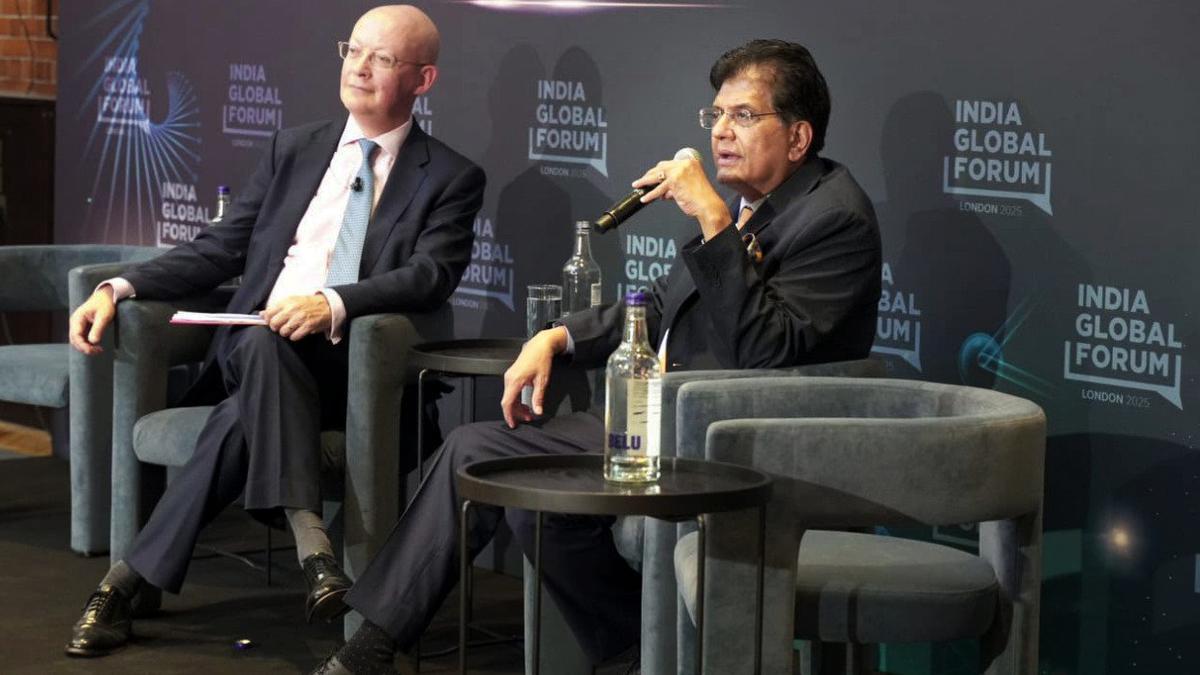
India seeking trade deals with rich, democratic countries: Goyal
The Hindu
Commerce Minister Piyush Goyal aims for trade deals with developed nations, distancing from past agreements with competitors.
Commerce and Industry Minister Piyush Goyal said the government was interested in doing trade deals with rich countries and democratic allies, as he distanced himself from previous governments’ efforts to explore deals with countries he considered competitors.
Mr. Goyal’s comments were made at the India Global Forum 2025 conference, during a conversation with Ian Blatchford at London’s Science Museum.
The government was focused on “entering into robust trade agreements with the developed world”, he said, contrasting it to the practice “15 years ago, when we were more focused on doing trade agreements with countries who are our competitors”.
Mr. Goyal referred to trade deals with ASEAN (Association of South East Asian Nations) countries, presumably meaning The Regional Comprehensive Economic Partnership (RCEP) negotiations. These talks had commenced in 2012 and India had begun exploring participation in this agreement a few years earlier under the Congress-led UPA government. He described this as “silly” because the countries in the region have now become the “B Team of China”.
Citing trade deals or negotiations with countries such as the U.K., Australia, Peru, the United Arab Emirates (UAE), and the European Free Trade Association countries, he said India’s products complemented and did not compete with these countries’ products.
“We don’t hurt their economies,” he said suggesting that a pair of jeans could be made most cost-effectively in India while medical devices (for instance) could be made most efficiently in economically developed countries. These arrangements would help India grow its innovation ecosystem, Mr. Goyal said, as he pushed for co-development.
“Let’s work together as friends and allies of the democratic world,” he added.


LPG crisis: Alternative solutions are being considered, with ammonia cylinders being increasingly used for industrial applications amid delays in commercial LPG deliveries.

India monitors U.S. military pause on Iran as oil prices dip; External Affairs Minister engages with GCC nations for support.

India monitors U.S.-Iran tensions as Trump pauses attacks, leading to a significant drop in oil prices.

Union Minister Ashwini Vaishnaw launches three initiatives to enhance India's creative economy through AI training, citizen platforms, and advanced tech access.

Two Indian-flagged LPG tankers approach the Strait of Hormuz, navigating safely amidst regional tensions to reach Indian ports.

Gold and silver prices plummet over 7% due to West Asia tensions, inflation fears, and a stronger dollar.

Asian shares fall as rising oil prices and escalating Iran conflict diminish hopes for U.S. interest rate cuts.

Japan's SoftBank Group said Saturday it plans to build a huge new gas-fired power plant in the US state of Ohio

Silver prices plunge 9% to ₹2.06 lakh per kg in futures trade amid weak global cues and rising macroeconomic pressures.

OpenAI plans to nearly double its workforce to 8,000 from 4,500 by the end of 2026, the Financial Times reported on Saturday, citing two people with knowledge

Global equity markets plummet as West Asia tensions rise and oil prices surge, triggering significant investor anxiety.

The rupee hits a record low of 93.94 against the dollar amid foreign fund outflows and a crashing equity market.

The Thane police have arrested two co-founders of cryptocurrency exchange platform CoinDCX in connection with an alleged fraud of Rs 71.6 lakh, officials said