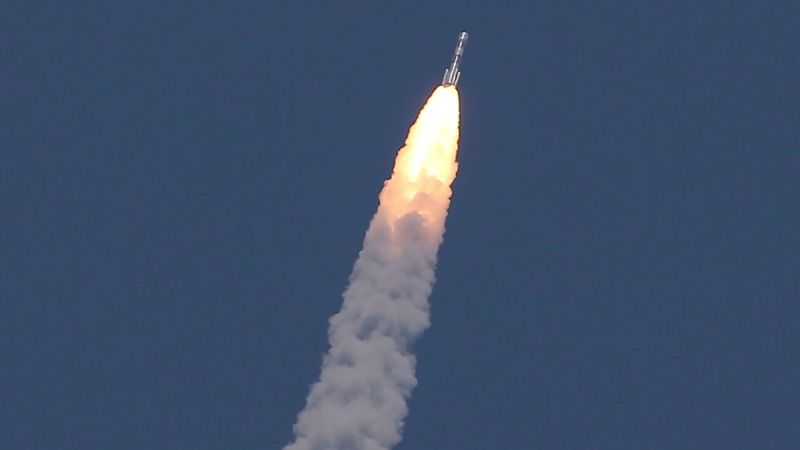
India’s first solar observatory successfully reaches intended orbit
CNN
The first Indian solar observatory has reached its intended orbit, the country’s space organisation said Saturday, as India seeks to cement its status as an emerging space superpower.
The first Indian solar observatory has successfully reached its intended orbit, the country’s Space Research Organisation announced Saturday, as India seeks to cement its status as an emerging space superpower. The Aditya-L1 spacecraft safely arrived at Lagrange Point L1, the position in space with unobstructed views of the sun located about 1.5 million kilometers (almost a million miles) from Earth, paving the way for scientists to enhance their study of the Sun-Earth System. Indian Prime Minister Narendra Modi applauded the “extraordinary feat” in a post on X on Saturday, adding that this “is a testament to the relentless dedication of our scientists in realizing among the most complex and intricate space missions.” The Aditya-L1 launched on September 2, less than two weeks after the ISRO made a historic landing of its Chandrayaan-3 spacecraft on the moon’s South Pole. The spacecraft is equipped with seven scientific instruments, four of which will be trained directly on the sun while the others will study solar wind particles and magnetic fields passing through at Lagrange Point L1. The main goals of the mission include studying the sun’s upper atmosphere and various solar phenomena, such as coronal mass ejections — or massive expulsions of plasma from the sun’s outermost layer.


Trump administration officials are making a desperate push to secure every available barrel of oil amid a worsening energy crisis — even if it means lifting sanctions on the very country that they’re fighting against.

A federal judge on Friday voided various parts of a restrictive press policy rolled out by Defense Secretary Pete Hegseth last year, ruling that they trampled on the constitutional rights of reporters who seek to cover the US military from within its sprawling headquarters.

President Donald Trump is reshaping a Colorado Republican primary by offering one of the candidates a role in his administration and returning his endorsement to the incumbent, whom he called a “RINO” just last month.

More than a month into the Department of Homeland Security shutdown, lawmakers on Capitol Hill are reckoning with their own travel privileges amid anxieties the funding crunch could exacerbate issues at already understaffed airports around the country.

TV host and comedian Bill Maher has been chosen to receive the prestigious Mark Twain Prize for American Humor, two sources close to the Kennedy Center told CNN.

Conventional wisdom has set in that President Donald Trump’s base is sticking with him on the Iran war, but he has alienated significant portions of his voters — and risks alienating more.

US officials are furiously trying to avert a potential monthslong closure of the Strait of Hormuz, privately acknowledging that reopening the key waterway is a problem without a clear solution and dependent at least in part on what lengths President Donald Trump is willing to go to force the Iranian regime’s hand, multiple administration and intelligence officials tell CNN.

The chief executive of Live Nation testified Thursday that it was “disgusting” that a top ticketing employee talked about “robbing fans blind” in internal messages.

Supreme Court revives First Amendment lawsuit from street preacher who called concertgoers ‘sissies’
The Supreme Court on Friday revived a First Amendment lawsuit from a street preacher who used a loudspeaker to call people “whores,” “Jezebels” and “sissies” as they tried to enter an amphitheater to attend concerts in a suburban Mississippi community.

As millions of Americans braced for a series of brutal storms this winter, the senior official in charge of the federal government’s disaster response had been on the job only a few weeks — and had previously claimed on podcasts that he once teleported to a Waffle House.

Air travelers across the US continue to face travel headaches as Transportation Security Administration workers go without full pay. Find the latest live updates here.

Veterans’ advocates are raising concerns that a new agreement between the departments of Veterans Affairs and Justice could take away veterans’ autonomy over their health care decisions and deter them from seeking care, particularly those facing homelessness.

Admirers of Cesar Chavez and public officials are scrambling to respond to claims about the man who has been honored with holidays, statues and school names in communities around the country.