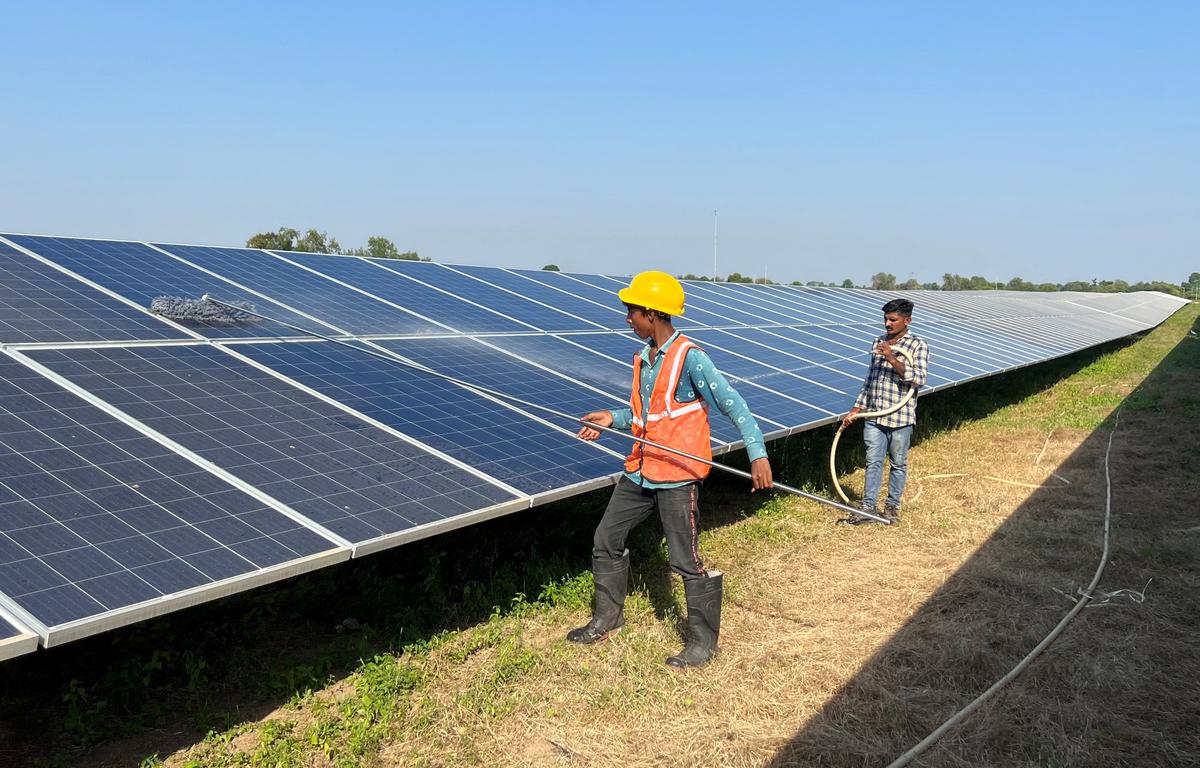
India's first fully solar village lights up the lives of poor residents
The Hindu
India aims to meet half of its energy demands from renewable sources, such as solar and wind, by 2030.
Kesa Bhai Prajapati beams with a smile as he moulds blocks of clay into jugs and vases on a potter's wheel.
These days, Prajapati, 68, from the village of Modhera in western India's Gujarat state, has doubled the amount of earthenware he makes compared to a few months ago since he no longer has to turn the wheel manually as he could not then afford high electricity bill that were up to 1,500 Indian rupees a month.
Now, however, his machine moves on solar power as earlier this month Prajapati's village of around 6,500 residents, consisting mainly of potters, tailors, farmers and shoemakers, was declared India's first village to run entirely on solar energy all the time.
"Electricity has helped us to save time and produce more products," Prajapati said.
India, the world's third-largest carbon dioxide emitter, aims to meet half of its energy demands from renewable sources, such as solar and wind, by 2030, a boost over its previous target of 40%, the government said it achieved in December 2021.
The project in Modhera, financed by the federal and provincial government at nearly $10 million, involved setting up over 1,300 rooftop panels on residential and government buildings that were connected to a power plant.
Also Read | Growing concern over unseasonal warm spell in Europe


Discover the Minor Planet Centre, the key hub for tracking and verifying observations of small solar system bodies.

Discover the Minor Planet Centre, the key hub for tracking and verifying observations of small solar system bodies.

In this week's Science for All newsletter, XX explains

Test your knowledge with the quiz on Science films at the Oscars through history

Set between the Siwalik hills and the plains, Butwal offers travellers a mix of regional cuisine, pilgrimage trails to Lumbini and the comfort of Hyatt’s new hospitality landmark

Explore 2026's wallpaper trends in India, highlighting botanicals and handmade designs that enhance modern homes with nature-inspired aesthetics.

Mercedes-Benz CLA 250+ with EQ Technology review: design, performance, range and features explained. Discover how the new electric CLA combines advanced AI, long range, fast charging and futuristic styling for the next generation of luxury EVs.

AI tool for sparrow conservation

BTS’s comeback with ‘Arirang’ marks a major global music event. When does the album release, and where can you watch their concert live stream? We have all the details

The 2026 U.S. cholesterol guidelines urge starting screening and treatment at 30 to prevent cardiovascular disease effectively.

Olam Festival 2026 in Thiruvananthapuram returns March 27-29 with 120+ vendors, music, art, and cultural zones.

A few storytellers in Thiruvananthapuram share their journeys, challenges, and evolving methods on World Storytelling Day, inspiring young minds.

76-year-old Kurian Jacob from Kerala triumphs with seven medals, including five golds, at the Open Masters Games in Abu Dhabi.