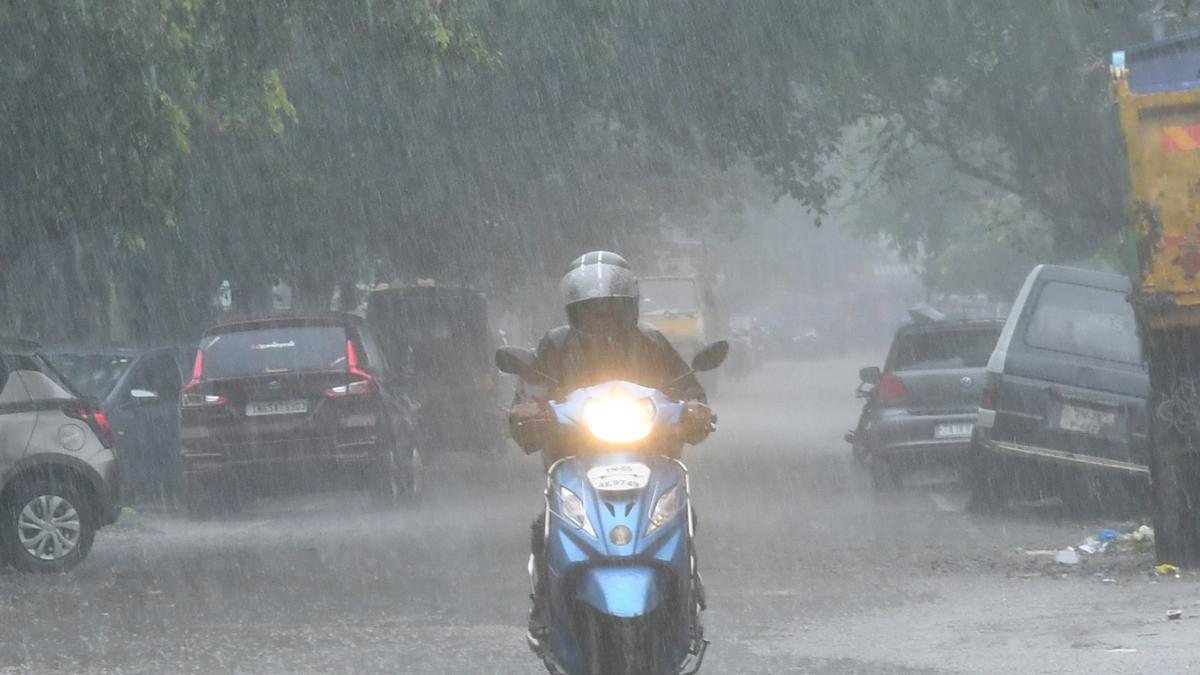
India boosts AI in weather forecasts as floods, droughts increase
The Hindu
India is testing artificial intelligence (AI) to build climate models to improve weather forecasting as torrential rains, floods and droughts proliferate across the vast country, a top weather official said.
India is testing artificial intelligence (AI) to build climate models to improve weather forecasting as torrential rains, floods and droughts proliferate across the vast country, a top weather official said.
Global warming has triggered more intense clashes of weather systems in India in recent years, increasing extreme weather events, which the independent Centre for Science and Environment estimates have killed nearly 3,000 people this year.
Weather agencies around the world are focussing on AI, which can bring down cost and improve speed, and which Britain's Met Office says could "revolutionise" weather forecasting, with a recent Google-funded model found to have outperformed conventional methods.
Accurate weather forecasting is particularly crucial in India, a country of 1.4 billion people, many impoverished, and the world's second-largest producer of rice, wheat and sugar.
The India Meteorological Department (IMD) provides forecasts based on mathematical models using supercomputers. Using AI with an expanded observation network could help generate higher-quality forecast data at lower cost.
The department expects the AI-based climate models and advisories it is developing to help improve forecasts, K.S. Hosalikar, head of climate research and services at IMD, told Reuters.
The weather office has used AI to generate public alerts regarding heatwaves and such diseases as malaria, Hosalikar said. It plans to increase weather observatories, providing data down to village level, potentially offering higher-resolution data for forecasts, he said.


Explore 2026's wallpaper trends in India, highlighting botanicals and handmade designs that enhance modern homes with nature-inspired aesthetics.

Mercedes-Benz CLA 250+ with EQ Technology review: design, performance, range and features explained. Discover how the new electric CLA combines advanced AI, long range, fast charging and futuristic styling for the next generation of luxury EVs.

AI tool for sparrow conservation

BTS’s comeback with ‘Arirang’ marks a major global music event. When does the album release, and where can you watch their concert live stream? We have all the details

The 2026 U.S. cholesterol guidelines urge starting screening and treatment at 30 to prevent cardiovascular disease effectively.

Olam Festival 2026 in Thiruvananthapuram returns March 27-29 with 120+ vendors, music, art, and cultural zones.

A few storytellers in Thiruvananthapuram share their journeys, challenges, and evolving methods on World Storytelling Day, inspiring young minds.

76-year-old Kurian Jacob from Kerala triumphs with seven medals, including five golds, at the Open Masters Games in Abu Dhabi.

Explore the nature of the human mind as an emergent property of brain activity and complex neural interactions.

CERN's Large Hadron Collider discovers the Xi-cc-plus particle, enhancing understanding of quantum mechanics and baryon behavior.

Vibha Batra’s latest book, Spotless (Hachette India) is a novel in verse for young adults

In its first edition, the Madras Art Salon spotlights the works of journalist and artist Narayan Lakshman at The Botanical Club, a social space in the British Deputy High Commission, Chennai

Cholesterol enhances melanoma cell invasion by making nuclei squishier, revealing a potential treatment target in cancer progression.