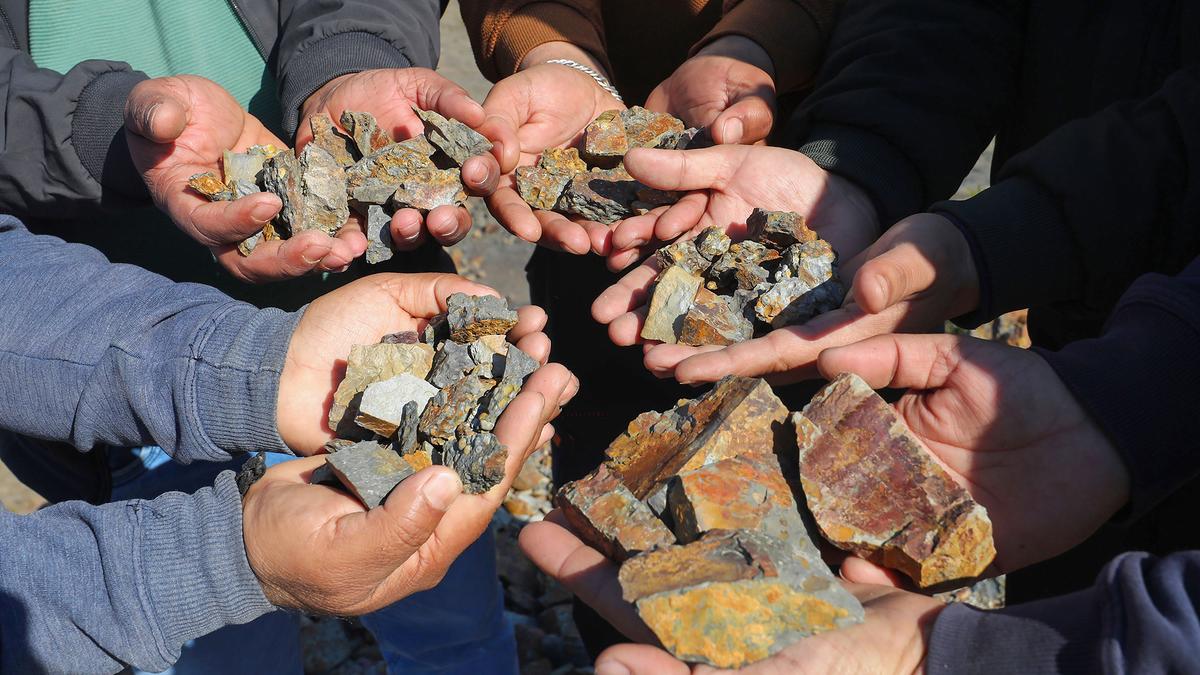
India and U.S. work out strategies to scale up collaboration on critical minerals under iCET
The Hindu
India and the U.S. are looking to “quickly” conclude a bilateral agreement on furthering cooperation on critical minerals
India and the U.S. are looking to “quickly” conclude a bilateral agreement on furthering cooperation on critical minerals between the U.S. Department of Commerce and the Indian Ministry of Commerce and Industry and the Ministry of Mines, and to drive a partnership in supply chains for graphite, gallium, and germanium.
One of the aims will be to promote “India’s vital role in the mineral security partnership, including through co-investing in a lithium resource project in South America and a rare earths deposit in Africa, to responsibly and sustainably diversify critical mineral supply chains”, said a fact sheet issued on June 17 on the India-U.S. Initiative for Critical and Emerging Technology (iCET) dialogue, chaired by the National Security Advisers of the countries.
In July 2023, India released a list of 30 minerals critical for the country and has been looking to acquire mines abroad in addition to expanding exploration within the country. To enable this, the Mines and Minerals (Development and Regulation) Act, 1957 was amended through the MMDR Amendment Act, 2023.
India has incorporated a joint venture company Khanij Bidesh India Ltd. (KABIL) with equity contribution from three Central Public Sector Enterprises — National Aluminium Company Ltd, Hindustan Copper Ltd and Mineral Exploration and Consultancy Ltd — with the objective of acquiring critical mineral assets abroad to ensure consistent supply of critical and strategic minerals to the Indian domestic market. KABIL is presently exploring opportunities for acquisition of critical minerals assets like lithium and cobalt in Australia, Argentina and Chile.
The Ministry of Mines has already joined the mineral security partnership led by the U.S. which aims to enhance cooperation in securing the supply chain of critical minerals for the member countries by facilitating investment in identified blocks of these minerals in resource-rich countries.
The fact sheet also spoke of the establishment of an India-U.S. advanced materials research and development forum to expand collaboration between American and Indian universities, national laboratories, and private sector researchers. Exploring opportunities for collaboration in the critical minerals sector like bilateral collaboration in technologies for neodymium-iron-boron metal, alloy and magnet making, and collaboration with Department of Energy entities, are also listed among the aims. Indian collaboration with U.S. organisations and companies for carrying out research studies for beneficiation of critical minerals, including lithium, titanium, gallium, and vanadium, is also part of the plan.
Effort is also on for a collaborative programme between the Geological Survey of India and the U.S. Geological Survey on exploration, characterisation and evaluation of rare earth elements and critical mineral deposits.


Discover the key changes in the New Income Tax Rules 2026, simplifying compliance and enhancing deductions for taxpayers.

Palantir, which won a contract to supply AI systems to Britain’s Financial Conduct Authority, will not have access to regulatory intelligence, an FCA official said

Arm Holdings announced a new artificial intelligence data centre chip on Tuesday which it said will add billions of dollars of revenue

Amazon said on Monday its Amazon Web Services region in Bahrain has been “disrupted” amid the current conflict in the Middle East

Petroleum Ministry directs reforms to enhance natural gas infrastructure, streamline approvals, and ease transition from LPG to PNG.

The Sora decision means the end of a blockbuster $1 billion deal between Disney and the ChatGPT maker that was announced a little more than three months ago.

Regulator mandates city gas distributors to provide piped gas to educational institutions within five days, supporting India's transition from LPG to PNG.

NHAI's Raajmarga InvIT listed on BSE, enhancing investor participation in highway infrastructure with strong demand and oversubscription.

HDFC Life Insurance faces ₹172 crore Income Tax order for alleged violations, plans to appeal the decision.

Air-conditioner makers in India are looking forward to FY27 with hope as the war in West Asia threatens to impact plastic component availability and consumer sentiment, adding to the challenges around raw material price and new energy label, a senior executive of a leading company has said.

Rupee falls 23 paise to an all-time low of 93.76 against the U.S. dollar amid foreign fund outflows and global uncertainties.

Stock markets surged nearly 2% as Trump paused strikes on Iran, boosting investor confidence amid easing geopolitical tensions.

Coal Minister urges State leaders to maintain stable coal prices amid rising global costs, assuring ample domestic supply.