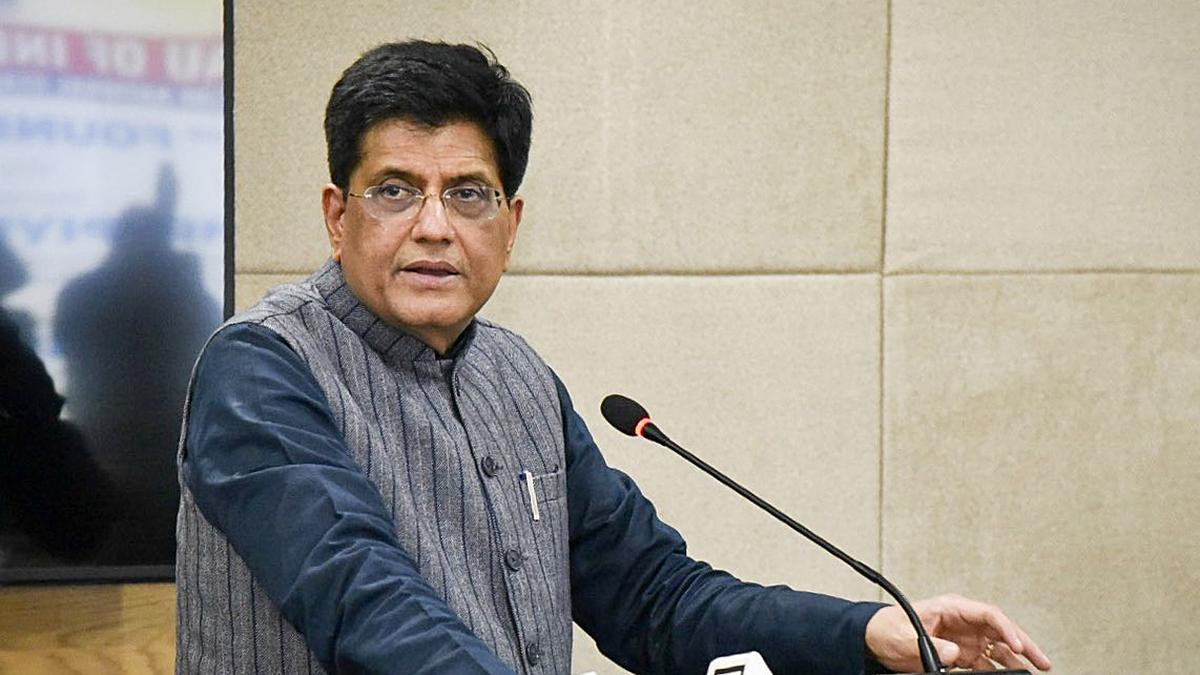
In India-U.K. trade deal, focus on what is acceptable to both countries: Piyush Goyal
The Hindu
Talking about the proposed trade deal with Canada, the Commerce Minister said that with Canada, India is looking at an early harvest agreement, which is called an early progress trade agreement
Commerce and Industry Minister Piyush Goyal has said that in the talks for the proposed free trade agreement between India and the U.K., the focus is on what is acceptable to both countries and not allow sensitive issues to scuttle the discussions.
He also said that student visas are never part of a free trade agreement (FTA).
Also Read | More student visas for India not part of the trade deal, U.K. Trade Secretary says
India has recently concluded the sixth round of talks with the U.K. and the next round will be held soon.
Negotiations with the U.K. started on January 13 last year with an aim to boost bilateral trade and investments. The bilateral trade between the two countries increased to $17.5 billion in 2021-22 compared to $13.2 billion in 2020-21. India's exports stood at $10.5 billion in 2021-22, while imports were &7 billion.
"With U.K., our approach is let's focus on what is acceptable to both the countries and let us not allow sensitive issues to scuttle our discussions," Mr. Goyal told reporters in Gandhinagar.
When asked about a statement of a U.K. official that granting more students visas for India is not part of this agreement, Mr. Goyal said: "Have you ever heard of student visas being part of FTA? How many students go there (UK) to study? It's never a part of an FTA”.


The Indian rupee plummets 82 paise to a record low of 93.71 against the dollar due to rising crude prices and geopolitical tensions.

Power Minister highlights energy security and renewable transition during Bharat Electricity Summit 2026 amid global tensions.

The rupee hits a record low of 93.08 against the dollar, pressured by rising oil prices and FII outflows.

OpenAI said on Thursday it will buy Python toolmaker Astral, as the ChatGPT maker seeks to strengthen its portfolio against rival Anthropic to gain more share in the artificial intelligence coding tools market.

Crude oil prices drop over 2% as Netanyahu reassures investors amid ongoing Iran conflict and rising energy market concerns.

PPAC designated as nodal agency to enhance data collection on domestic fuel and energy stocks for improved mandate enforcement.

Indian markets plunged over 3% amid soaring crude prices, rupee depreciation, and escalating West Asia geopolitical tensions in March 2026.

Government launches ₹497 crore RELIEF scheme providing credit insurance to exporters affected by the West Asia crisis, focusing on MSMEs.

Crude oil futures rise amid Middle East attacks, pushing Brent above $116 on fears of tightening global supply.

West Asia conflict delays India’s FTA talks with GCC and Israel, while UK and EU agreements proceed as planned in 2024.

Russian Urals oil vessels will reach India on March 21 amid stable fuel prices and diversified LPG imports.

Warner Bros. dominated the Academy Awards, but Paramount’s looming acquisition of the studio signals the biggest restructuring of the industry in decades and a battle over the future of Hollywood itself

HDFC Bank board calls Atanu Chakraborty’s resignation baffling, affirms robust corporate governance and strong market confidence.