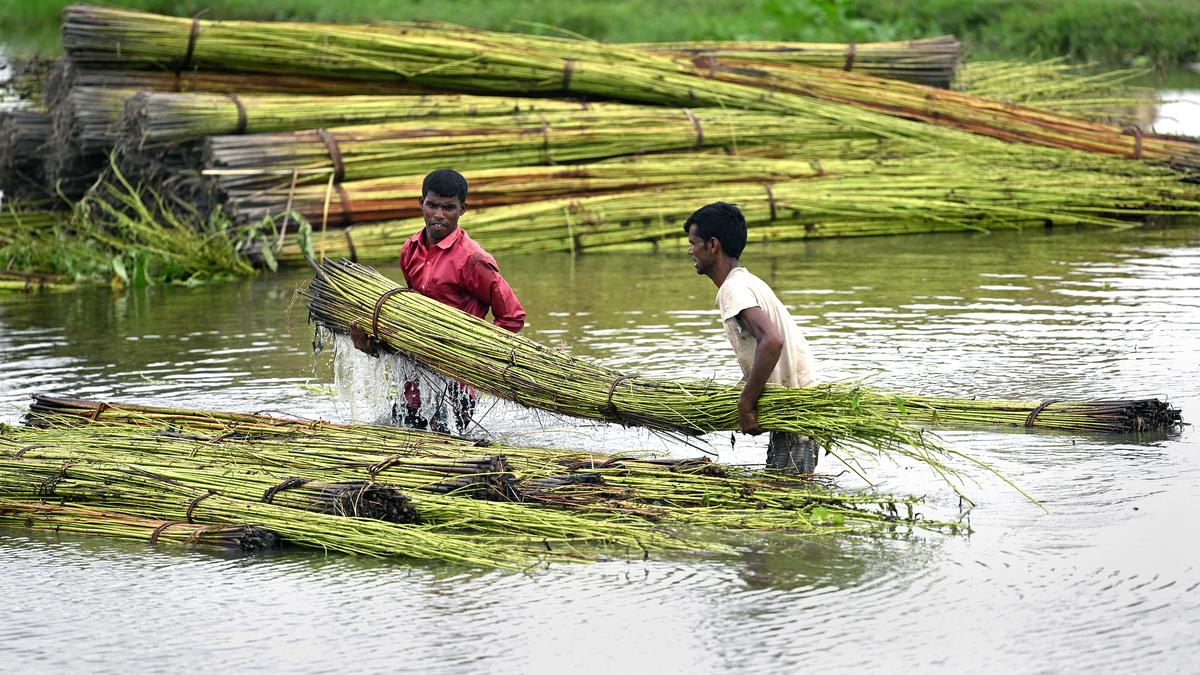
In Frames: Jute — the golden fibre
The Hindu
In Frames: Jute — the golden fibre, the process of cultivating and extracting the second most important cash crop in India
Jute, known as the golden fibre, is the second most important cash crop in India after cotton in terms of cultivation and usage. India is the largest producer of jute in the world. West Bengal, Assam, and Bihar are the major jute-growing States in the country, and raw jute farming and trade make up the livelihood of about 14 million people.
Jute is mainly cultivated by marginal and small farmers of Assam. The State is the second-largest producer of jute in India. The main jute-producing districts are Nagaon, Goalpara, Barpeta, and Darrang. Jute is a labour-intensive crop and provides huge employment opportunities and benefits to local farmers. The agro-based and export-oriented industry has played an important role in the economy of Assam.
The bast fibre crop can be harvested at any stage after a certain period of vegetative growth, usually between 100 and 150 days.
Harvesting of jute crop at the pre-bud or bud stage gives the best quality fibre, however, the yields are low. Older crop yields more quantity but the fibre becomes coarse and the stem does not ret properly. Hence, as a compromise between quality and quantity, the early pod formation stage has been found best for harvesting.
Harvesting is done by cutting the plants at or close to the ground level with sharp sickles. In flooded lands, the plants are uprooted. The harvested plants are left in the field for two or three days for the leaves to shed. Next, the plants are tied into bundles and the branching tops are left to rot in the field.
Retting is one of the important operations governing the quality of fibre. The bundles are kept in water and later placed side by side, usually in layers and tied together. They are covered with water hyacinth or any other weed that does not release tannin and iron. The float is then weighed down with seasoned logs or with concrete blocks or are kept submerged with bamboo-crating.
Retting is best done in slow-moving clean water. The optimum temperature is around 34 degrees Celsius.


The Thane police have arrested two co-founders of cryptocurrency exchange platform CoinDCX in connection with an alleged fraud of Rs 71.6 lakh, officials said

Meta Chief Executive Mark Zuckerberg is building a CEO agent to help him do his job, the Wall Street Journal reported

Insurance penetration and density are often misunderstood and do not reveal how many families are insured or whether they would be financially secure if the main earning member were to die. The real issue is not reach but adequacy, as households may have life insurance but not enough cover to replace lost income, leaving them financially vulnerable.

Five top firms lose ₹1 lakh crore in market value, with HDFC Bank experiencing the largest decline of ₹56,124.48 crore.

L&T confirms 95% of its West Asia project sites are safe, while addressing logistics challenges amid ongoing regional conflicts.

Mines Ministry to auction 19 critical mineral blocks on March 23, expanding strategic resources for clean energy and technology sectors.

Mines Ministry to auction 19 critical mineral blocks on March 23, expanding strategic resources for clean energy and technology sectors.

Five top firms lose ₹1 lakh crore in market value, with HDFC Bank experiencing the largest decline of ₹56,124.48 crore.

HDFC Bank terminates three senior officials over client onboarding issues at its DIFC branch amid ethical concerns following chairman's resignation.

Air India CEO warns of potential flight cuts and reduced travel demand due to rising fuel costs amid ongoing Gulf conflict.

Options are widely used by retail traders to speculate on the value of the stock for immediate gains and such behaviour in large scale can distort the market

India achieves 1 billion tonne coal production for the second consecutive year, ensuring stable energy supply and economic growth.

Generic drugmakers in India launch affordable Semaglutide versions, targeting a $1 billion diabetes and weight loss market.