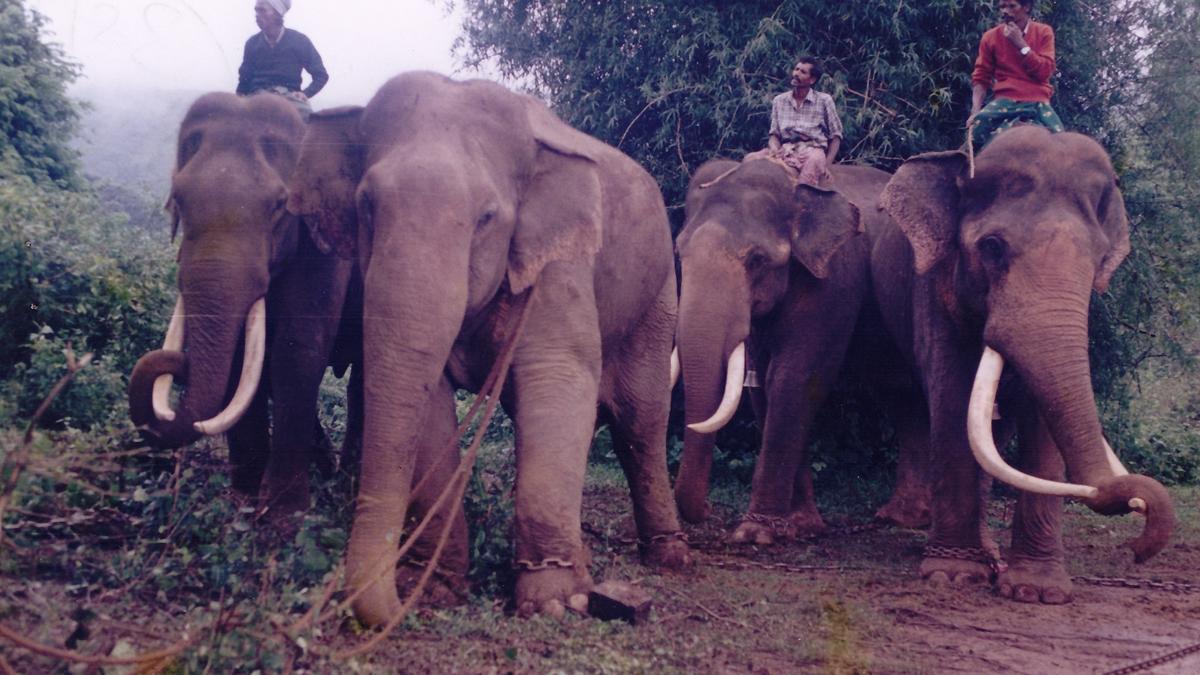
In 1998, foresters went all out to capture a tuskless male elephant in the Nilgiris Premium
The Hindu
The successful capture and rehabilitation of a rogue elephant named Moorthy in the Gudalur forests by a dedicated team.
It has been over 25 years since the capture of a makhna, a tuskless male elephant, in the Gudalur forests. It was supposedly a rogue elephant that killed 22 people, mostly in Kerala, and was to be shot dead there. Luckily, it entered the Tamil Nadu forests. Here, it was decided to capture and rehabilitate it. A 40-member team spent two months in the Mudumalai Wildlife Sanctuary, especially in the Gudalur forests, to capture the makhna, named Moorthy after ‘Elephant doctor’ V. Krishnamoorthy. K. Asokan, a veterinary assistant surgeon in the Animal Husbandry Department, recalls the days leading to the capture of makhna and its treatment and rehabilitation, considered one of the finest success stories in Mudumalai.
“In 1996, I was posted at the Theppakadu elephant camp on deputation. In those days, it was seen as a punishment posting because it was deep in the forests. Also, the veterinarian had to depend on the forest ranger to sanction everything, including medicines for treating injured wildlife. The roads were not that good and poaching was a concern. But the Mudumalai forests were also a heaven for researchers,” he says. “There were many challenges in wildlife management. Apart from the diseases, the severity of man-animal conflict was beginning to unravel in all its dimensions. Once we rescued an elephant calf from a 40-foot trench in O’Valley only for the mother to chase us all and the calf fell back into the trench and died. There was an elephant with 14-foot tusk that would just stand on the road, not allowing anyone to pass. The elephants also got injured after biting country-bombs,” he recalls.
For guidance, he consulted the field notes of Dr. Gopalan and Dr. Krishnamoorthi, who had served in the elephant camp, besides trusting his intuition, Dr. Asokan says.
“It was then that the makhna came into the picture. It was a brilliant elephant. They said it had killed 22 persons. So, it had to be captured. A team of 40 persons was formed. It was led by Indian Forest Service officers [Mudumalai Wildlife Warden] A. Udhayan and [Nilgiris District Forest Officer] Ulaganathan. We started camping in the forests. We were divided into teams and patrolling all the time. We came in contact with the makhna twice. Once it landed right in between six kumkis, but escaped. He was brilliant,” the veterinarian says.
“Thereafter, the makhna started camping in the Cherambadi area. It would stay the whole night in the town and leave in the morning. Once, we thought we had him right in front, and he came from behind. Finally, we tranquillised it on July 12 [1998]. We closed all its escape routes, and it had to return to the forests through a narrow path. It was about 10 feet away, and we fired the dart from behind the jeep door. It started escaping. About 20 minutes later, we found it sleeping on a slope. We used the kumkis and walked it 18 km to the Theppakadu elephant camp. Even during the walk, it tried to escape many times, but was overpowered,” Dr. Asokan recalls.
The makhna was riddled with bullets all over the body as it often came in conflict with humans. Farmers had fired at him to protect their crops. Possibly, it turned aggressive on seeing humans and kept chasing and injuring them. At the camp, a new enclosure had to be built. Since it was chained while being taken to the camp, the legs were sore and it went blind, too, for 10 days. The Forest Department spent ₹3 lakh on medicines alone. “We had to order medicines in kilos,” laughs Dr. Asokan. The elephant’s road to recovery became controversial, with the interest shown by Deanna Krantz, an American citizen and office-bearer of India Project for Animals and Nature. Union Minister Maneka Gandhi made a flying visit and expressed her satisfaction with the manner in which the animal was being looked after by Mudumalai sanctuary officials.
Soon the makhna became one of the most docile and dependable elephants at the camp and a darling of the tourists till its death last October due to its age. Meanwhile, Dr. Asokan has won the Anna Medal for Gallantry for saving wild elephants and protecting people, awards for environment protection and wildlife management for 2019, and one for environment education in 2021. He is waiting for his promotion ahead of retirement next year.


Palla urges NDA leaders to unite for grassroots outreach, enhancing public trust through balanced welfare and development initiatives.

Horses shone at Auroville's 2026 event, showcasing equestrian talent through dressage, derby, and show jumping competitions.

Telangana Governor Shiv Pratap Shukla attends Bihar Foundation Day celebrations in Hyderabad, honoring Bihar's historical and cultural contributions.

Samsung workers protest for the reinstatement of 27 suspended employees, citing unfulfilled promises from the Labour Minister.

The Vice-Chancellor of Rajiv Gandhi University of Health Sciences (RGUHS) B. C. Bhagavan said on Sunday that the university will soon open a research centre on Yoga and Naturopathy on 60-acre land in Bengaluru.

UT Matters: Construction of Uppar drain road overbridge in Puducherry to be completed in four months, amid traffic regulations.

Union Minister Dharmendra Pradhan highlights Bharat Innovates' aim to elevate Indian deep-tech startups to the global stage.

In an exclusive interview, DMK MLA Ezhilan discusses Tamil Nadu's 2026 elections, party structure, and local governance challenges.

Minister Satish Jarkiholi asserts confidence in retaining Davangere and Bagalkot seats in upcoming bypolls amid addressing internal discontent.

Sunil Ambekar of RSS emphasizes national unity, defending road prayer restrictions and promoting awareness of shared ancestry in India.

Opposition MPs and activists voice strong concerns against proposed amendments to the Transgender Persons Act at a Delhi hearing.

Four Assam police commandos injured in an extremist attack during a gunfight in Tinsukia district, officials report.

Campaigning intensifies in Ernakulam district as candidates engage voters ahead of the crucial Assembly polls.