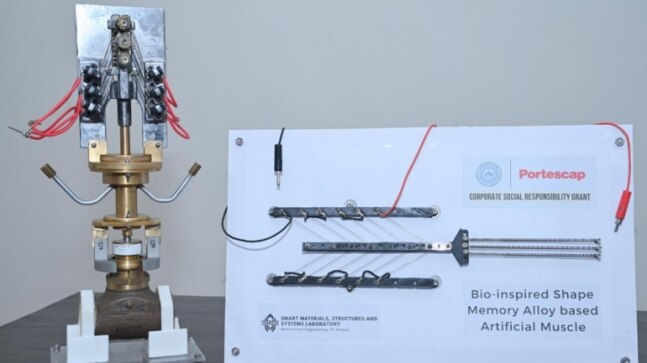
IIT Kanpur develops bio-inspired artificial muscle for next-gen space robots and medical prostheses
India Today
IIT Kanpur researchers have developed a bio-inspired artificial muscle for next-gen space robots and medical prostheses. It can be used to reinforce Indian space technology and also create adaptive robotic prostheses.
IIT Kanpur’s Smart Materials, Structures and Systems (SMSS) has developed a bio-inspired artificial muscle for next-generation space robots and medical prostheses.
Encouraged by the industry demand and growth in the field of miniature, light weight, non-magnetic gear-free actuators, shape memory alloy (SMA) based actuators have emerged with an excellent power-to-weight ratio as a suitable alternative to the conventional actuators.
(An actuator is a component of a machine that is responsible for moving and controlling a mechanism or system.)
However, existing SMA actuators have limited scope in terms of higher force or torque output due to the relatively simple architecture of the actuation mechanism.
To address this limitation, the SMSS Lab at IIT Kanpur, inspired by the Portescap CSR funding, have expanded the design space of the SMA actuator by leveraging the characteristics of bi-pennate muscle architecture with about 70% enhanced muscle force output per unit weight.
This will result in the creation of a new class of space robots which will reinforce the Indian space technology.
The research team is led by Prof. Bishakh Bhattacharya, Professor, Department of Mechanical Engineering at IIT Kanpur, and consists Kanhaiya Lal Chaurasiya, Senior Project Engineer, Mechanical Engineering, IIT Kanpur; Abhishek Kumar Singh, Senior Project Mechanic; A Sri Harsha, and Yashaswi Sinha, Project Engineer, Mechanical Engineering, IIT Kanpur.


ICAI CA Final January 2026 results have been declared today, March 1. Candidates who appeared for Group 1 and Group 2 exams can now check their scorecards, merit list and All India Rank holders on the official website, icai.nic.in. Direct result link is now active.

Pinterest CEO Bill Ready wants governments to ban social media for teenagers under 16, saying current platforms are harming young people's mental health and development.

Reddit is exploring biometric verification methods such as Face ID and Touch ID to ensure users are real humans, not bots, while pledging to maintain the platform's tradition of anonymity. CEO Steve Huffman said the company is planning to address the rising influence of AI-generated content and protect authentic user engagement.

Delhi is strengthening its push for UPSC success by recognising top achievers and improving support for aspirants. In a first-of-its-kind initiative, the government engaged directly with successful candidates to understand their preparation journey.

WhatsApp is reportedly working on a new privacy feature that will allow messages to automatically disappear shortly after being read. The upcoming feature, called "After reading," is expected to give users more control over their conversations, especially when sharing sensitive information.

RBSE Class 10 Result 2026 is expected to be declared soon, with students eagerly awaiting the official announcement date and time. The Rajasthan Board 10th result will be available online, making it important for students to stay updated on where and how to check their scores quickly.

In a push towards more inclusive school environments, the Central Board of Secondary Education has rolled out fresh directives on menstrual hygiene across its affiliated institutions. The move comes after a landmark ruling by the Supreme Court of India that places menstrual health within the framework of fundamental rights.

Tata Motors has introduced a more affordable dual-motor QWD variant of the Tata Harrier.ev, bringing all-wheel drive capability and strong performance to a wider audience at a lower entry price.

OpenAI is reportedly planning a major hiring push, aiming to nearly double its workforce to around 8,000 employees by the end of 2026 as competition in AI continues to intensify.

The Goa Board has announced the much-awaited Class 12 (HSSC) Result 2026 on its official website. Students can check the direct link, download steps, SMS option, login credentials, exam highlights, and re-evaluation details.

CBSE has launched an AI-based remote proctored exam in 2026 to assess 10,000 school counsellors in phases. The online evaluation will test their skills, ethics, and practical application in school settings.

OpenAI is now aiming to build a fully automated AI researcher that can plan, analyse, and solve complex problems on its own, calling it the company's "North Star" for the next few years.

Bihar Board Class 12 Result 2026 will be declared soon, bringing an end to the long wait for students. Once announced, students will be able to check their BSEB Inter scores not only on the official BSEB websites but also on the India Today Board Results 2026 platform, ensuring quick and convenient access to their scorecards.