IIT Bombay researchers show one way how animals find their way home
The Hindu
IIT Bombay researchers use robots to study homing behavior in animals, mimicking foraging and navigation with light-based cues.
Researchers at IIT Bombay are using robots to understand how animals find their way back home from unfamiliar places, a skill called homing.
Nitin Kumar, assistant professor at the Department of Physics at IIT Bombay, explained, “The primary goal of our research group is to understand the physics of active and living systems. We achieve this by performing experiments on centimetre-sized self-propelled programmable robots. In simple words, we model these robots to mimic the dynamics of living organisms, both at the individual and collective levels.”
Homing is crucial for many life-forms, from birds flying thousands of kilometres during migration to ants finding their way back to their colonies after foraging. Humans have even harnessed this ability to train homing pigeons to deliver messages over long distances.
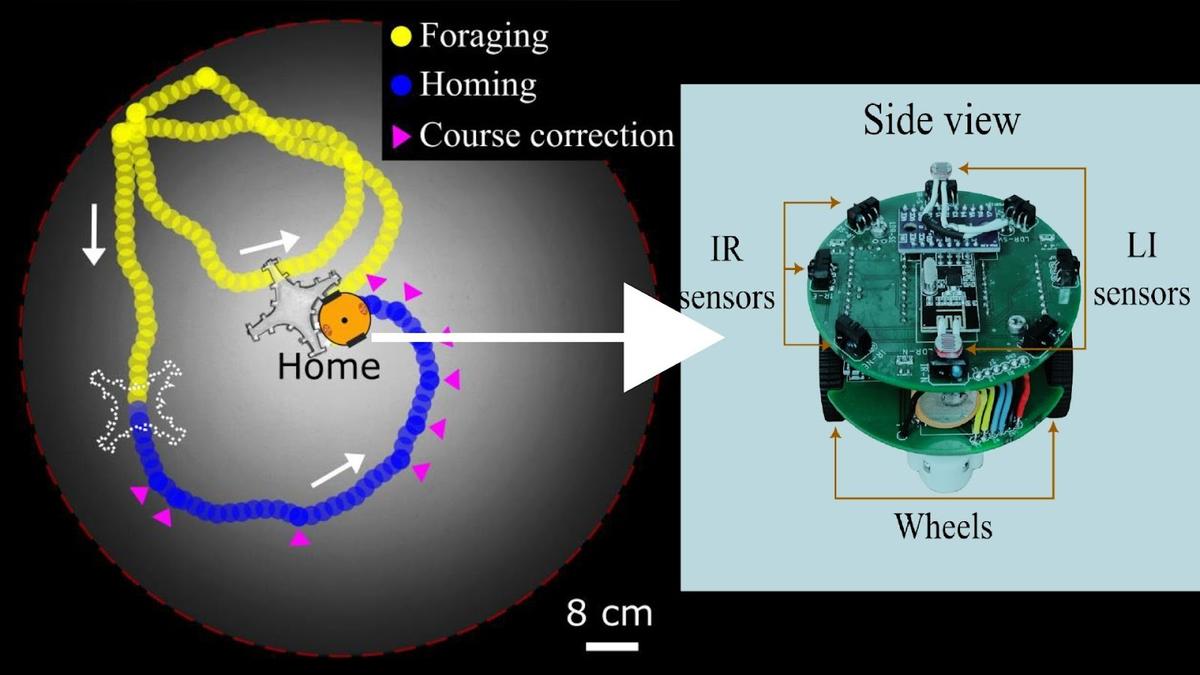
Dr. Kumar’s team has now developed a robot that mimics foraging and homing behaviour. This robot is designed to move on its own and use light as a guide to return home. In a new study, they have reported some principles of homing based on their studies with the robot.
The foraging robot is programmed to move semi-randomly, like how animals might wander when looking for food. This type of movement is called active brownian (AB) motion. The robot’s direction changes frequently due to rotational diffusion, a mechanism that introduces a certain level of randomness to its path. When the robot needs to return home, it shifts to a different mode that doesn’t include randomness inputs.
The researchers shone a beam of light on the robot; the light’s intensity changed gradually. The robot was programmed to follow this gradient light to find its way back, mimicking the way some animals use the Sun or other environmental light sources to find their way.
“The homing motion is similar to the AB model, except the robot undergoes frequent course corrections whenever it deviates significantly from its intended homing direction, as expected in actual living organisms” Dr. Kumar said.


CCB arrests three drug peddlers in Mangaluru, seizing ₹2.5 lakh worth of MDMA and other valuables.

TVK's 28 candidates in Puducherry include former BJP MLAs, a sitting Independent, and a retired police IG.

BRS submits notice on private member bill to Speaker

CPI-M accepts DMK's five-seat offer for Tamil Nadu Assembly elections, prioritizing INDIA bloc unity over seat demands.

Ricky Rai, son of former underworld operative Muthappa Rai, on Monday appeared before the Bengaluru Traffic Police for questioning in connection with a case involving a Lamborghini performing dangerous stunts at Anil Kumble Circle on March 21.

The Dispur election heats up as 'CongBJP' defections shape a high-stakes contest between veteran candidates from BJP and Congress.

Bengaluru's M. Chinnaswamy Stadium conducts readiness drill ahead of IPL 2026, ensuring upgrades and technical preparations are complete.

First-level randomisation of EVMs completed in Nagapattinam for upcoming elections, ensuring transparency and security.

A district-level committee in Krishnagiri has been formed to assess and verify seizure claims of goods and cash.

Minister Anam Ramanarayana Reddy pledges government support for local fishermen and farmers facing challenges in Andhra Pradesh.

MP M. Sribharat urges collective efforts to revive Visakhapatnam Steel Plant, highlighting key reforms for crucial recovery and growth.

141 candidates have filed nominations for Kozhikode's Assembly elections, with scrutiny on March 24 and campaigning intensifying.

BJP's Vijayendra accuses Congress of using money to influence Bagalkot bypolls, urging voters to reject their tactics.