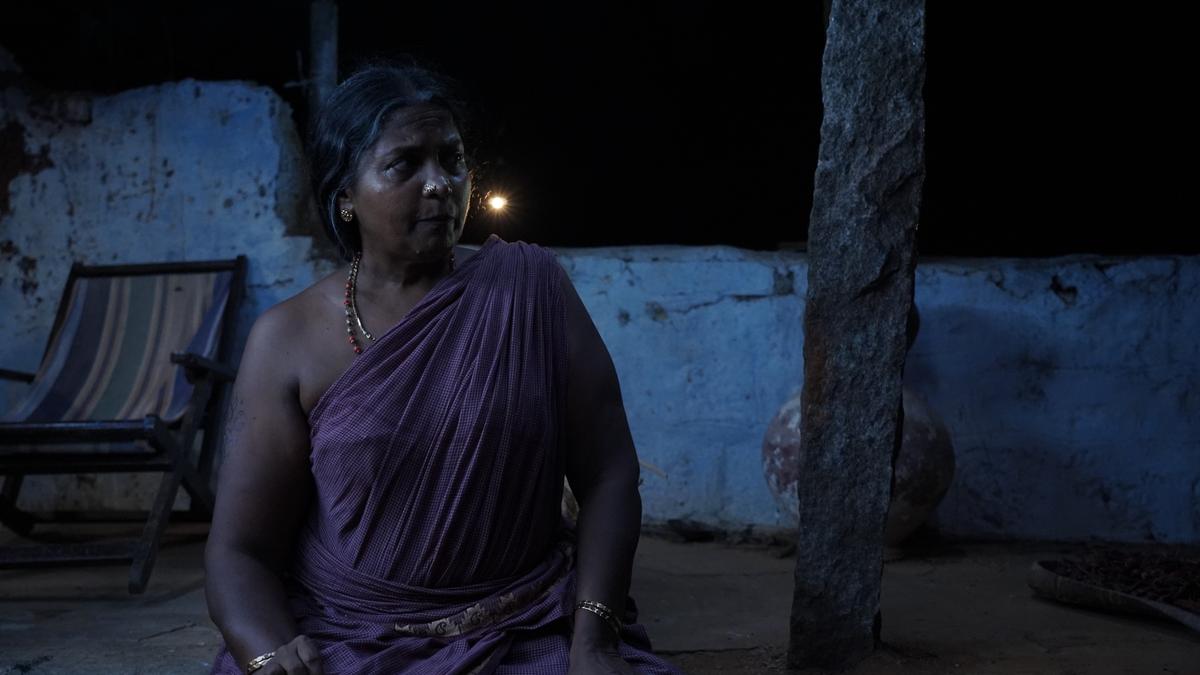
IFFK 2024: ‘Angammal’, a rustic tale relevant to the modern times
The Hindu
Angammal by Vipin Radhakrishnan explores mother-son conflict and societal norms
A piece of cloth is the bone of contention in Vipin Radhakrishnan’s Tamil film, Angammal. The protagonist Angammal does not wear a blouse with her sari. The feisty, free-spirited widow, who flaunts her tattoo, drives around the village on her moped, smokes beedi, is a monster of a mother-in-law to her elder son’s wife and has a soft spot for a widower in her village. When her younger son, a doctor, insists that she wear a blouse when his city-bred girlfriend and parents visit their home, Angammal refuses thus changing the dynamic in the family.
The evocative screenplay by Vipin sans moralising is complemented by powerful performances, stunning cinematography and a soothing soundscape. Screened to a rousing reception at the ongoing International Film Festival of Kerala (IFFK), Angammal is the cinematic adaptation of celebrated writer Perumal Murugan’s short story, Kodithuni. Vipin says, “I have been a fan of his works and came across his short story collection during the lockdown. I found the theme interesting. The writer also welcomed my idea and told us that it was based on a real incident in his neighbourhood.”
At the core of Angammal’ is the mother-son conflict. Her son, Pavalam (Sharan Shakthi) disapproves of not just her attire but also her stained teeth and the way she speaks. At the same time, the elder one, Sudalai (Bharani Thirumugam) is subdued, nursing the grief of having sacrificed his dreams for his younger brother. But he understands Angammal better.
Vipin explains that even though the short story did not delve into the characters, who did not have names, he added nuances and layers to each character. “This was done keeping in mind the possible theatrical release of the film. We wanted cinematic elements in the plot,” he adds.
That was why there has been no compromise on the technical aspect , he says. Shot in sync sound, the film has a seamless soundscape by composer Mohammed Maqbool Mansoor, sound designer Lenin Valappad and sound mixer PK Krishnanunni. “The producers, Firosh Rahim and Anjoy Samuel, also the cinematographer of the film, were on the same page as us.”
The filmmaker points out that besides exploring the mother-son relationship, the larger picture is about having the freedom to live the life one wants, without conforming to societal norms. “Since it is about a woman, you can possibly attach a feminist angle to the theme. But the narrative is more about not judging someone and accepting or loving that person for who he or she is,” he says.
Vipin, who debuted as a director with Ave Maria, which was premiered at the IFFK in 2018, observes that not being fluent in Tamil was never a challenge while making the film. “I didn’t look at it that way because the film can be placed only in the Tamil culture. It helped that I had a lot of people in the crew who were familiar with the milieu. Anjoy, the cinematographer, has worked predominantly in Tamil cinema. Sudahar Das, who co-wrote the dialogues and has played a character, and Gopi Karunanithi, our art director, are from Tamil Nadu.”


Explore the behind-the-scenes of political strategy with "Inside the War Room," a must-read for aspiring politicians and managers.

Villivakkam faces civic challenges despite infrastructure improvements, with residents demanding better healthcare, transport, and green spaces ahead of elections.

District Collector launches e-dip lottery for Settipalle land plots, benefiting 2,111 beneficiaries with planned infrastructure development.

Chengalpattu's horticulture farm launches herbal tea, Idhazh, made from sun-dried hibiscus and organic herbs.

Hyderabad is set to become a global film hub, says CM Revanth Reddy at TGFA 2025, highlighting its cinematic potential.

Sivananda Damodara Pai appointed head of RMC Chennai, known for advancing seasonal rainfall and temperature forecasting models.

Madurai Collector chairs meeting with Election Observers

CBI interrogates Anil Ambani in a ₹2,929-crore cheating case involving alleged loan fund irregularities from State Bank of India.

Tamil Nadu's 2026 election features intense competition among established parties and a new disruptor, promising unique voter choices.

Explore the contrasting management styles of England and India cricket teams, highlighting player support and development challenges faced by Liam Livingstone and Sanju Samson.

Modi and Jaishankar advocate for dialogue as India and France collaborate to de-escalate tensions amid escalating strikes on energy infrastructure.

The star-studded event was held in Mumbai and was attended by rithik Roshan, Alia Bhatt, Bobby Deol, Shahid Kapoor, Vijay Varma, Sonakshi Sinha, Jyotika, Ali Fazal, Sonali Bendre, Preity Zinta, Ravi Kishan and others

Shorts News:We are working on securing LPG, petroleum to meet our energy security needs: MEA