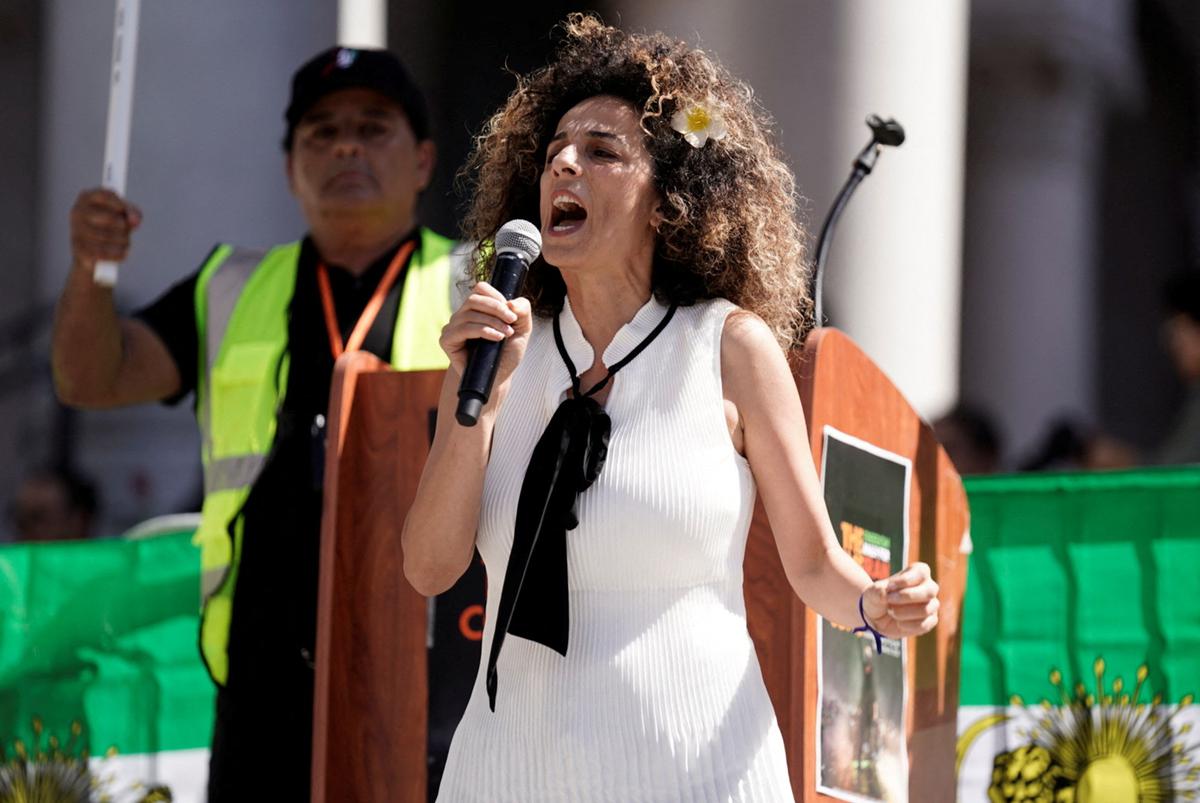
‘If you can bring down the compulsory hijab, you can bring down all of Iran’: activist Masih Alinejad
The Hindu
The Iranian-American journalist and activist says the ongoing anti-hijab protests in Iran are the first steps towards removing the Islamic republic’s Sharia-based system
From her home in exile in the U.S., journalist-activist Masih Alinejad, 46, has been at the forefront of the movement against Iran’s restrictive hijab laws, supporting and encouraging women who demand the right to dress as they please. As protests spread over the custodial death in September of 22-year-old Mahsa Amini, brutally assaulted and arrested by Iran’s ‘morality police’ for not covering her hair ‘properly’, Alinejad, famous for her angry, corkscrew curls, is helping to ignite international outrage with her hashtags #WhiteWednesdays, #MyCameraIsMyWeapon and #MyStealthyFreedom.
In July, the Iranian government, which has described the protests as “scattered riots” that have been “designed by enemies” of the country, passed a rule that made the sharing of photos and videos of hijab removal with Alinejad a punishable offence carrying up to 10 years in prison.
In an email interview, the author of The Wind in my Hair says the defiance of Iran’s Islamic regime has reached a point of no return. Edited excerpts:
The current protests in Iran are widespread and not dying down after nearly two months of the custodial killing of Mahsa Amini. The Islamic Republic has painted itself into a corner — it can brutally crack down on its youth and women and kill more people and create even more anger among the population. Or it can allow the hijab to be a choice. This would be an ideological defeat for the regime and it will be seen as the first step to removing the Sharia-law-based system.
Elnaz was forced to come back. Her brother was arrested and threatened with jail, torture and worse. But when she returned, she was received by thousands of well-wishers. And the next day, she refused to wear the hijab when she met the sports minister — she wore a baseball cap and a hoodie instead. Her family’s life is in danger. Three years ago at Stanford University, I predicted that the next revolution in Iran would be led by women. And what we are seeing now is women breaking the law, engaging in civil disobedience. And if you can bring down the compulsory hijab, you can bring down all of the Islamic Republic.
I became an activist at 18 when I ended up in jail for spraying slogans on walls and publishing a high school newsletter. But once I had my son, I gave that up. Eventually, I made it as a journalist, and although I was always critical [of the Iranian government], I thought I could help reform the system. We made incremental gains but even that became impossible by 2009.
I was expelled from the parliament for revealing how much Members of Parliament were receiving as extra payments. But that made me an even bigger name in Iranian journalism circles and I became a very popular political columnist. In 2009, during the controversial presidential election [where President Mahmoud Ahmedinejad was declared the winner], I was forced to leave the country. I thought I would return soon because I was sure the reformists were going to win. I was divorced at that time and had only partial custody of my son. I never thought I was leaving him behind for a long time. The election result was disputed, Opposition members were jailed and I watched from New York as the crackdown destroyed that early attempt at democracy. I was stuck in the U.S., my son was in Iran. I had to smuggle him out during the crackdown on Green Movement activists and we moved to the city of Oxford.


The government plans to amend the FCRA, introducing new regulations for NGO asset management and accountability for key functionaries.

The draft policy for “Responsible Digital Use Among Students”, released on Monday by the Department of Health and Family Welfare, has recommended that parents set structured routines with clear screen-time rules and prioritise privacy, safety, and open conversation with children on digital well-being.

Police Observer Sushant Kumar Saxena conducts surprise inspection at Shencottai police station, reviewing warrants and security arrangements ahead of elections.

Andhra Pradesh government to launch key projects in April, focusing on industrial growth and infrastructure development, says Nara Lokesh.

Lok Sabha refers the Corporate Laws (Amendment) Bill to a JPC amid opposition concerns over CSR provisions dilution.

SHG members in Kanniyakumari use snakes and ladders to raise election awareness and boost voter turnout.

Government accelerates consultations for early implementation of the Women’s Reservation Act to ensure women’s representation in 2029 elections.

CM A. Revanth Reddy distributes ₹1 crore insurance cheques to families of deceased Electricity department employees, enhancing financial security for workers.

The Bengaluru Traffic Police (BTP) registered 634 cases of drunk driving during a week-long special enforcement drive conducted across the city between March 16 and March 22.

GHMC intensifies action against property tax defaulters, seizing properties and offering a One Time Settlement scheme for payments.

CCB arrests three drug peddlers in Mangaluru, seizing ₹2.5 lakh worth of MDMA and other valuables.

TVK's 28 candidates in Puducherry include former BJP MLAs, a sitting Independent, and a retired police IG.

BRS submits notice on private member bill to Speaker