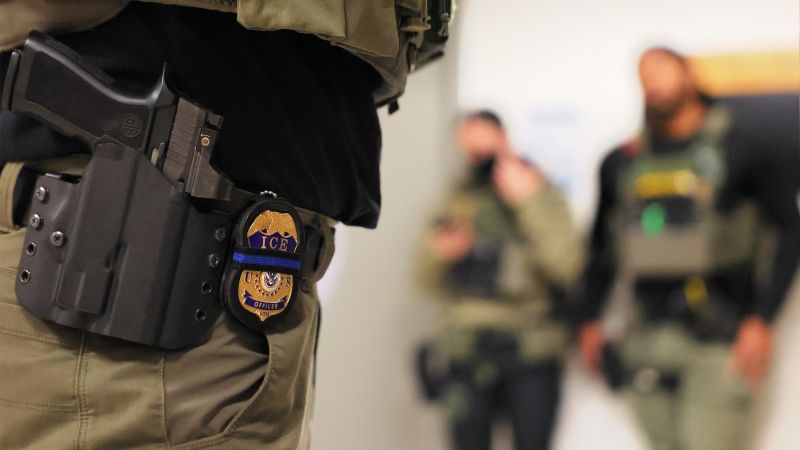
ICE is quite unpopular – even more so than when ‘abolish ICE’ was a thing
CNN
When we look back at the passage of President Donald Trump’s big agenda bill in a few years, it’s quite possible that it won’t be the extension of the tax cuts or the cuts to Medicaid that will stick out, but rather its historic expansion of Immigration and Customs Enforcement (ICE).
When we look back at the passage of President Donald Trump’s big agenda bill in a few years, it’s quite possible that it won’t be the extension of the tax cuts or the cuts to Medicaid that will stick out, but rather its historic expansion of Immigration and Customs Enforcement. The bill delivered ICE a huge windfall ($75 billion through 2029) that should make it by far the highest-funded federal law enforcement agency in the US government. PolitiFact calculated that ICE could be funded at an average annual rate of $27.7 billion, compared to the FBI’s $10 billion budget. This has led to plenty of concern among Trump’s critics about what that expansion will entail. He’s already signaled he’s willing to go to very controversial places in using law enforcement for his federal immigration crackdown and the military to back up his deportation efforts. He’ll also have more control over ICE than he would with the FBI, given post-Watergate reforms that made the FBI and the broader Justice Department more independent of the president. ICE has fewer such guardrails surrounding it. And even setting aside further potential politicization of federal law enforcement, there are the problems that can emerge when trying to quickly hire thousands of people for difficult jobs. A rapid 2000s-era expansion of the US Border Patrol led to standards being relaxed and a spike in misconduct. Whether any of that comes to pass remains to be seen. But what has become abundantly clear in recent days is that this expansion is ill-timed, politically speaking. Americans are increasingly quite negative toward ICE and skeptical of its actions.


Facing deadly Iranian drone attacks across the Middle East, the US military has been rushing defensive systems into the region while adjusting to a threat that has come to dominates modern battlefields and carries echoes of a weapon that haunted service members during the 20 years of the war on terror.

In his early days in Congress, Markwayne Mullin tried pairing his suit jacket and tie with a pair of jeans on the House floor. Then-House Speaker John Boehner reprimanded the young Republican for breaking the dress code.

As President Donald Trump rachets up the pressure on Cuba’s communist-run government and threatens a US “takeover” of the island, he frequently repeats a central promise: that decades after they left, Cuban exiles will soon be able to return to their homeland.

The first two weeks of the Iran crisis have demonstrated military dominance by the US and Israel, with asymmetrical responses from Iran. How this plays out over the coming weeks will determine the outcome.

Utah mother Kouri Richins was found guilty of murder and all other charges in the 2022 death of her husband, Eric Richins, who died of a lethal dose of fentanyl.

The Virginia man accused of planting two pipe bombs in Washington, DC, the night before the 2021 US Capitol riot asked a federal judge on Monday to dismiss his case, arguing that President Donald Trump’s expansive pardon of January 6 rioters applies to him.

President Donald Trump has repeatedly taken aim at Democratic rival and possible 2028 presidential candidate Gavin Newsom. But lately, he’s become fixated on saying the California governor cannot be president due to his “learning disability.”

Cuba’s electrical grid suffered a total collapse on Monday, the country’s power operator said, marking the latest nationwide blackout in recent years, and the first since the US effectively shut off the flow of oil to the island of roughly 10 million people.

Top Border Patrol official Gregory Bovino, who led controversial immigration sweeps in Democratic-led cities, has told people he plans to retire at the end of the month, according to two sources familiar with the discussions.

President Donald Trump’s handpicked Kennedy Center board of trustees voted Monday to close the storied performing arts institution for two years for renovations.

Florida GOP congressman Rep. Neal Dunn was thrust into the spotlight after Trump said he had a heart problem and underwent surgery

White House chief of staff Susie Wiles has been diagnosed with early stage breast cancer, President Donald Trump announced Monday.

An Afghan man who served alongside US special forces and fled his native country after its takeover by the Taliban died over the weekend shortly after being detained by immigration authorities, according to his family and an advocacy group.