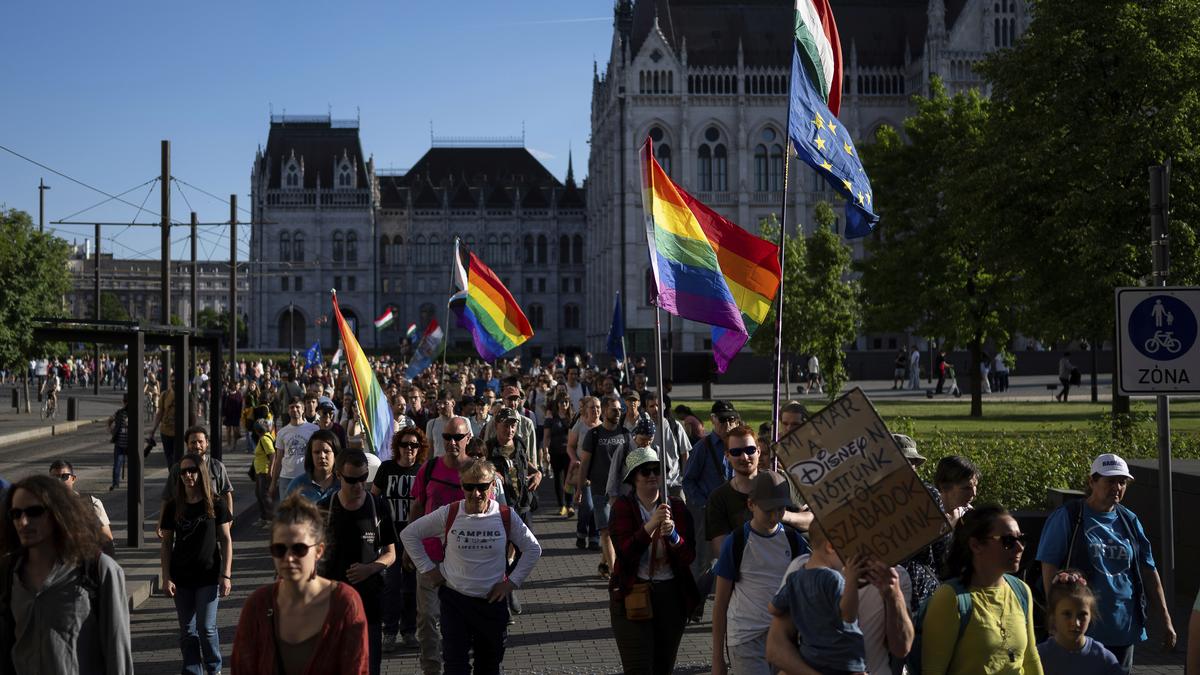
Hungarians declare resistance to Orbán's Government with large protest
The Hindu
Protesters in Hungary rally against Prime Minister Orbán's government, warning of authoritarian tactics and threats to democracy.
Around 15,000 protesters filled a square in Hungary's capital on Tuesday (June 10, 2025) in what organisers called the beginning of a resistance movement against the government of populist Prime Minister Viktor Orbán.
Nearly two dozen public figures including writers, actors, musicians and journalists joined the demonstration in Budapest. Most of the speakers criticised what they see as the government's increasingly anti-democratic conduct. Some alleged corruption benefiting those with ties to Mr. Orbán's Fidesz party.
“This country doesn't belong to those who lie, who rob from the people, who have sold their humanity for power,” said one speaker, Csaba Bogos. “This country belongs to those who dare to think, who can read between the lines, who trust in themselves and each other, and believe that there is a common, peaceful future that we must build together.”
It was the latest anti-government protest since Mr. Orbán's party pushed through a law in March, and a constitutional amendment the following month, that effectively banned public LGBTQ+ events. That law also allowed for authorities to use facial recognition technology to identify and fine participants in prohibited assemblies. It drew allegations that Mr. Orbán was leading the country toward a full autocracy similar to Russia under President Vladimir Putin.
As national elections approach in 2026 and Mr. Orbán's party trails in most polls to a new Opposition challenger, the Hungarian leader's detractors say he has turned to more authoritarian tactics to silence critics.
Speakers at Tuesday's (June 10, 2025) demonstration warned that a recent draft bill that would allow the government to blacklist critical media organisations and NGOs would mean the end of independent journalism and civic engagement.
That bill would allow the government to monitor, restrict, penalise and potentially ban organisations it deems a threat to Hungary's national sovereignty. Its passage was recently delayed until parliament's autumn session.


Iran strikes near Israeli nuclear research center as Trump threatens attacks on Iranian power plants
Iran's missile strikes near Israel's nuclear site escalate tensions as Trump threatens retaliation against Iranian power plants.

Saudi Arabia intercepts one of three ballistic missiles targeting Riyadh amid ongoing regional tensions and threats from Iran.

Iran's death toll exceeds 1,500 amid escalating war, with heavy airstrikes and shifting U.S. and Israel strategies reported.

Iran's military threatens to target U.S. energy and desalination infrastructure in response to American threats over the Strait of Hormuz.

Iran-Israel war: Follow the latest updates from The Hindu on the West Asia war, on March 22, 2026

Robert Mueller, former FBI chief and special counsel, dies at 81, known for investigating Russian election interference.

Bangladesh seeks $2 billion in loans to address energy security amid rising global fuel prices and ongoing crisis measures.

The U.S. military strikes an Iranian base threatening the Strait of Hormuz, prompting international condemnation and escalating tensions.

UAE assures India that the safety of its citizens is a top priority amid ongoing regional conflicts and tensions.

Explore Trump's Cuba policies and their impact on the island's energy crisis amid U.S. sanctions and Russian support.

Israel threatens increased attacks on Iran as Britain condemns Tehran's attempted strike on Diego Garcia air base.

The Id-ul-Fitr festival in 2026 is unfolding across the world in contrasting circumstances, shaped by both celebrations and conflicts.

U.S. and Israel strike Iran's Natanz nuclear facility, with no reported radioactive leakage, says Iran's atomic energy organization.