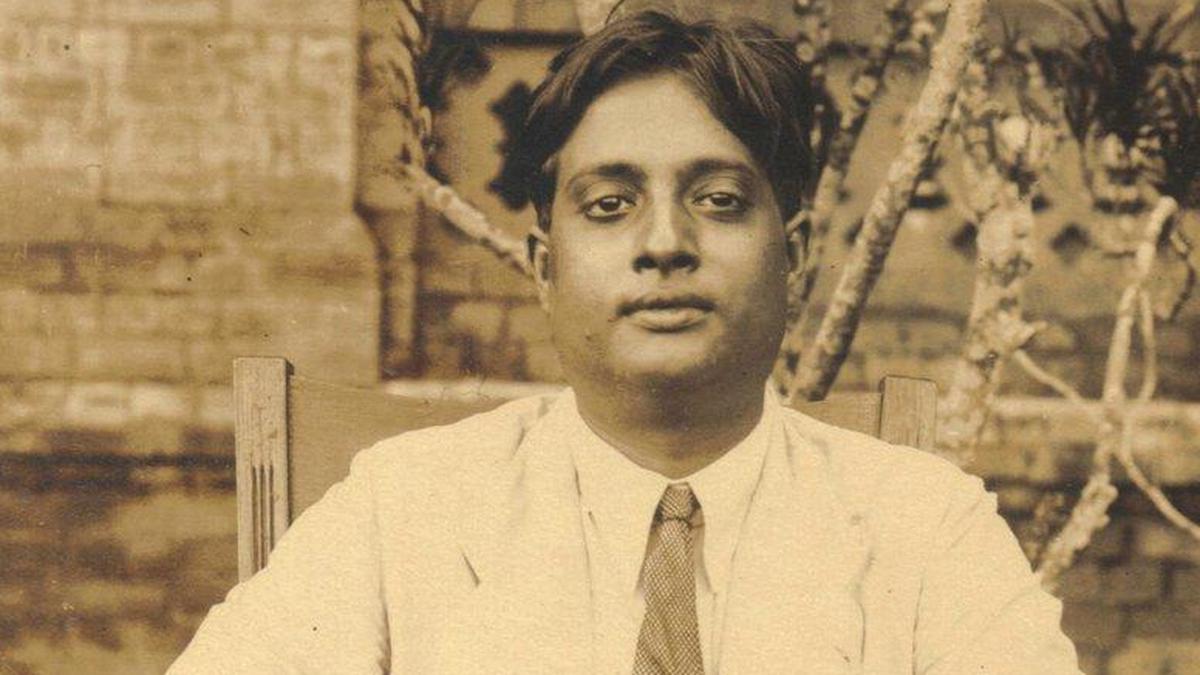
Hundred years ago, Satyendra Nath Bose changed physics forever Premium
The Hindu
Satyendra Nath Bose revolutionized physics with his discovery of a quantum statistics to describe photons, paving the way for modern quantum theory.
Satyendra Nath Bose appeared on the physics scene like a comet.
The year was 1924. Physics was in the middle of the biggest upheaval in its history. The old foundations had crumbled in the face of new data. The picture of a new ‘quantum theory’ was emerging. But it was a fractured, disjointed picture with major pieces missing.
The search was on among physicists to find the pieces and complete the jigsaw. In the best universities of Europe, new ideas were being proposed, debated, and discarded every week. Then a lecturer of physics from Dhaka University — located then in the backwater of backwaters — appeared out of nowhere with a major missing piece of the puzzle.
The lecturer, Satyendra Nath Bose, had discovered the correct set of equations to use to work out the behaviour of collections of photons (particles of light). As physics work goes, Bose’s was as fundamental as it got. The physicist and writer Abraham Pais listed it as one of the six foundational papers of quantum theory. Few would disagree.
Even so, a paper from an unknown Indian scientist was initially rejected by a journal. Bose then mailed the paper to his favourite physicist, Albert Einstein, hoping to secure the giant’s support. Einstein loved the paper, translated it to German, and sent it to a journal himself.
This year marks 100 years of Bose’s discovery.
Bose was born in Calcutta (now Kolkata) in 1894. His mathematical prowess had been noted by his teachers early on. After completing his schooling, he joined Presidency College to study physics. This is where he met and befriended another brilliant young man, Meghnad Saha. The two would remain lifelong friends.


76-year-old Kurian Jacob from Kerala triumphs with seven medals, including five golds, at the Open Masters Games in Abu Dhabi.

Explore the nature of the human mind as an emergent property of brain activity and complex neural interactions.

CERN's Large Hadron Collider discovers the Xi-cc-plus particle, enhancing understanding of quantum mechanics and baryon behavior.

Vibha Batra’s latest book, Spotless (Hachette India) is a novel in verse for young adults

In its first edition, the Madras Art Salon spotlights the works of journalist and artist Narayan Lakshman at The Botanical Club, a social space in the British Deputy High Commission, Chennai

Cholesterol enhances melanoma cell invasion by making nuclei squishier, revealing a potential treatment target in cancer progression.

The designers reinterpret the Swedish artist’s symbolic forms and colour energy through contemporary resortwear silhouettes

Discover the inspiring legacy of Bibha Chowdhuri, a pioneering woman in physics and a trailblazer in STEM history.

Discover the inspiring legacy of Bibha Chowdhuri, a pioneering woman in physics and a trailblazer in STEM history.

Ashdeen’s Spring 2026 collection features saris inspired by the designer’s Parsi gara archive

Red ochre burials, ritual markings and myths across cultures show that red repeatedly marks liminal thresholds such as puberty, sacrifice and death; anthropologists argue that the colour functions as a technology of collective ritual and value, binding communities through shared symbolic acts

India approves 23 institutions for quantum labs under the National Quantum Mission, aiming to advance quantum technology and research.

India approves 23 institutions for quantum labs under the National Quantum Mission, aiming to advance quantum technology and research.