Human relatives used tools to butcher and likely eat each other 1.45 million years ago: study
CTV
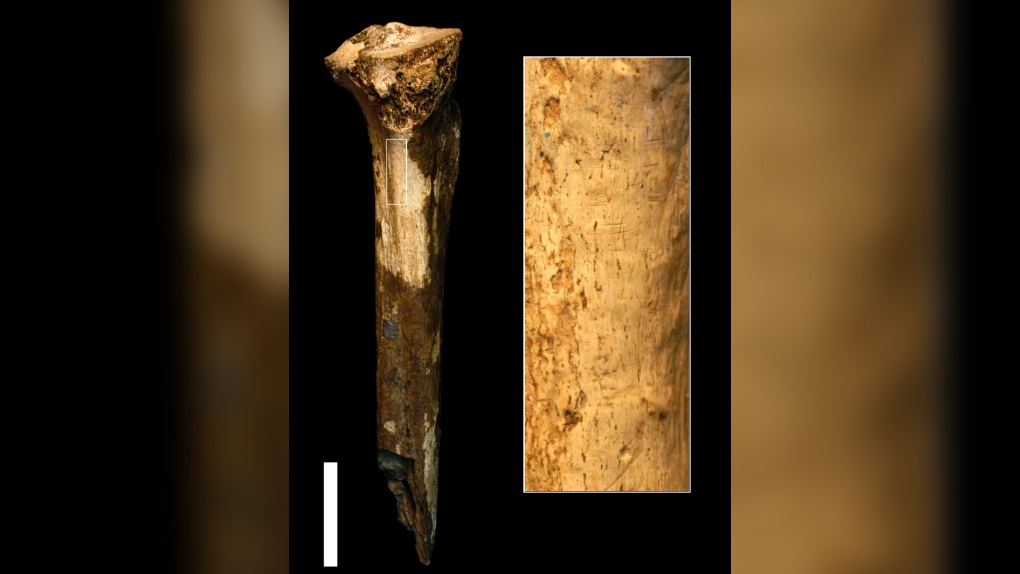
Marks on a fossilized shin bone are the oldest clear evidence of human relatives using stone tools to butcher and likely eat each other, according to a new study.
Nine cut marks on a fossilized shin bone are the oldest clear evidence of human relatives using stone tools to butcher and likely eat each other, according to a new study.
"Based on the location of the cut marks, the butcher(s) were most likely defleshing the leg – cutting meat off of it, ” lead author and paleoanthropologist Briana Pobiner told CTVNews.ca. "The best explanation for that is that the leg was butchered in order to eat the meat from it. This is the earliest solid evidence of hominins defleshing other hominins."
The word hominin refers to humans, our evolutionary ancestors and closely-related species. As a research scientist at the Smithsonian's National Museum of Natural History in Washington, D.C., Pobiner's work focuses on the evolution of the human diet, including meat eating and cannibalism in hominins.
Pobiner was combing through fossils at a museum in Nairobi, Kenya, looking for clues about the prehistoric predators that ate humans' ancient relatives. When she first picked up part of a 1.45-million-year-old hominin tibia, or shin bone, she used a magnifying lens to examine it for bite marks, but instead found cuts that looked like evidence of butchery.
Pobiner made moulds of the bone and sent them to co-author Michael Pante at Colorado State University. Without knowing Pobiner's theory, Pante used 3D scans to compare them against a database of 898 different tooth, butchery and trample marks that were created in earlier experiments. Nine of the 11 marks were identified as clearly coming from stone tools. The other two were likely from one of three extinct species of sabre-tooth cat that prowled the area in the early Pleistocene age.
While the cut marks themselves don't prove that human ancestors ate each other, Pobiner believes this is the most likely scenario. The cuts, she notes, are located where the calf muscle attaches to the bone, and they are also all orientated the same way, as if a stone age butcher held the bone with one hand while the other hand used a sharp tool to remove the flesh.
"We interpret this butchery as nutritional, rather than related to ritual or ceremony,” Pobiner said. “I have studied hundreds of fossil animal bones from this time and place in northern Kenya (Koobi Fora) with similar cut marks to the ones on this hominin fossil, and those are all interpreted as the result of butchering animals to eat them."


Tyson Atleo, a hereditary leader of the Ahousaht First Nation, says the creation of three new forestry areas to be managed by his community and two others on the west coast of Vancouver Island marks the realization of a long-standing promise.

As artificial intelligence continues to reshape industries worldwide, Canadian universities are emerging as key players – not only in developing technology but in teaching students how to use it responsibly.

Switching up your exercise routine does more than fight boredom. Engaging in varied forms of movement may significantly boost your longevity, according to research.

A seven-bedroom, five-bathroom home in Ottawa’s Rothwell Heights neighbourhood is currently the most expensive home on the market in the capital.

David Suzuki, the geneticist-turned-environmentalist, who is days away from his 90th birthday, reflected on his legacy as he prepared to release his latest book, “Lessons from a Lifetime,” which compiles photos and stories from his life, as well as testimonials written by those he inspired.

Microsoft subsidiary Bethesda said Tuesday hit space exploration game “Starfield” will appear on rival Sony’s PlayStation 5, effectively ending the practice of keeping some releases exclusive to Xbox consoles.

A woman visiting her family in Canada from the United States became ill and was admitted to the hospital, and without travel insurance, the family was shocked to get a bill for more than $110,000.

Renowned Canadian angler Jeff Gustafson back in Kenora Ont. after Bassmaster Classic absence.

A special weather statement remains in effect for Toronto Tuesday morning with winds gusting up to 80 km/h in some areas after an overnight snowfall.

Fraudsters are using seniors as tools in online scams without their knowledge.

Using medical or recreational marijuana to ease symptoms of numerous mental health conditions doesn’t work, according to two new analyses of existing gold-standard research.

A haunting whale song discovered on decades-old audio equipment could open up a new understanding of how the huge animals communicate, according to researchers who say it’s the oldest such recording known.

Despite the delays for the NASA’s Artemis II mission around the moon and back, a space medicine researcher says the crew, which includes Canadian astronaut Jeremy Hansen, are physically ready for when the time comes to launch.