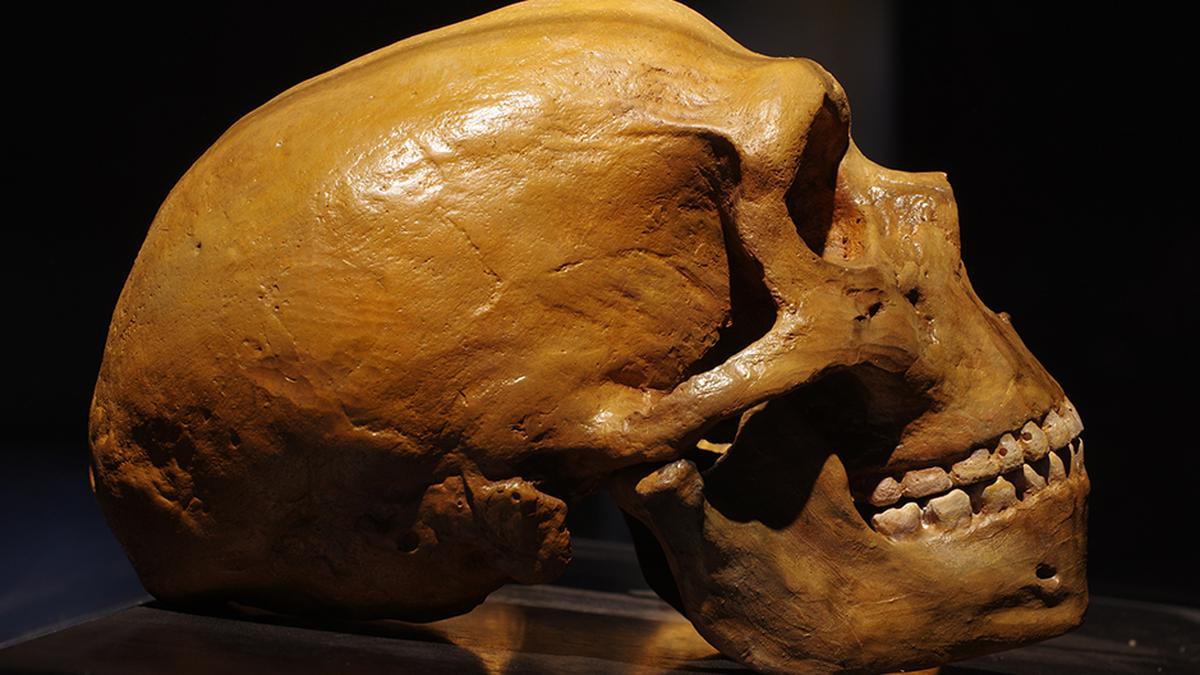
Human and Neanderthal brains have a surprising ‘youthful’ quality in common, new research finds
The Hindu
The way the different parts of the human brain evolved separates us from our primate relatives.
Many believe our particularly large brain is what makes us human – but is there more to it? The brain’s shape, as well as the shapes of its component parts (lobes) may also be important.
Results of a study we published today in Nature Ecology & Evolution show that the way the different parts of the human brain evolved separates us from our primate relatives. In a sense, our brains never grow up. We share this “Peter Pan syndrome” with only one other primate – the Neanderthals.
Our findings provide insight into what makes us human, but also further narrow any distinction between ourselves and our extinct, heavy-browed cousins.
Mammalian brains have four distinct regions or lobes, each with particular functions. The frontal lobe is associated with reasoning and abstract thought, the temporal lobe with preserving memory, the occipital lobe with vision, and the parietal lobe helps to integrate sensory inputs.
We investigated whether the brain’s lobes evolved independently of each other, or whether evolutionary change in any one lobe appears to be necessarily tied to changes in others – that is, evidence the evolution of the lobes is “integrated”.
Question Corner: How do modern human and Neanderthal brains differ?
In particular, we wanted to know how human brains might differ from other primates in this respect.


Student representatives from the 14 districts assumed the roles of the Prime Minister, Speaker, Ministers, and other parliamentary members

Shorts News:Election Commission revises UP SIR timeline amid staff workload concerns

Hyundai Motor India launches 'Prime Taxi' range, offering reliable and cost-effective vehicles for fleet operators and taxi drivers.

Four abandoned leopard cubs rescued in Bengaluru by PfA Wildlife Hospital, with plans for monitored reunification with their mother.

Explore Khaleda Zia's pivotal role in shaping India-Bangladesh relations through decades of political interactions and diplomatic engagements.

Udupi MLA Yashpal Suvarna reports phone hacking incident, with scammers soliciting money from his contacts via WhatsApp.

A Belgian Malinois puppy named 'Rudra' joins Vellore's Detective Dog Squad for narcotics detection training.

Tirumala celebrates Vaikuntha Ekadasi with the opening of Vaikuntha Dwaram, offering spiritual fulfillment and devotion to pilgrims.

Kashmir bans VPN usage in four districts for security reasons, citing concerns over potential unlawful activities and public safety.

T.N. Deputy CM Udhayanidhi Stalin inaugurates a ₹9.67-crore international hockey ground in Coimbatore, enhancing local sports infrastructure.

Telangana announces IAS officer transfers, with G. Srijana appointed as GHMC Additional Commissioner following administrative reorganization.

Delhi faces severe air pollution as CM announces road construction to reduce dust emissions and improve air quality.

Tiruchi faces ongoing infrastructure challenges despite recent developments, with many key projects still awaiting execution and community concerns unresolved.