How will bribery charges impact Adani? Premium
The Hindu
Adani Group faces bribery allegations, impacting market value, credit ratings, and funding access, with potential consequences for renewable energy goals.
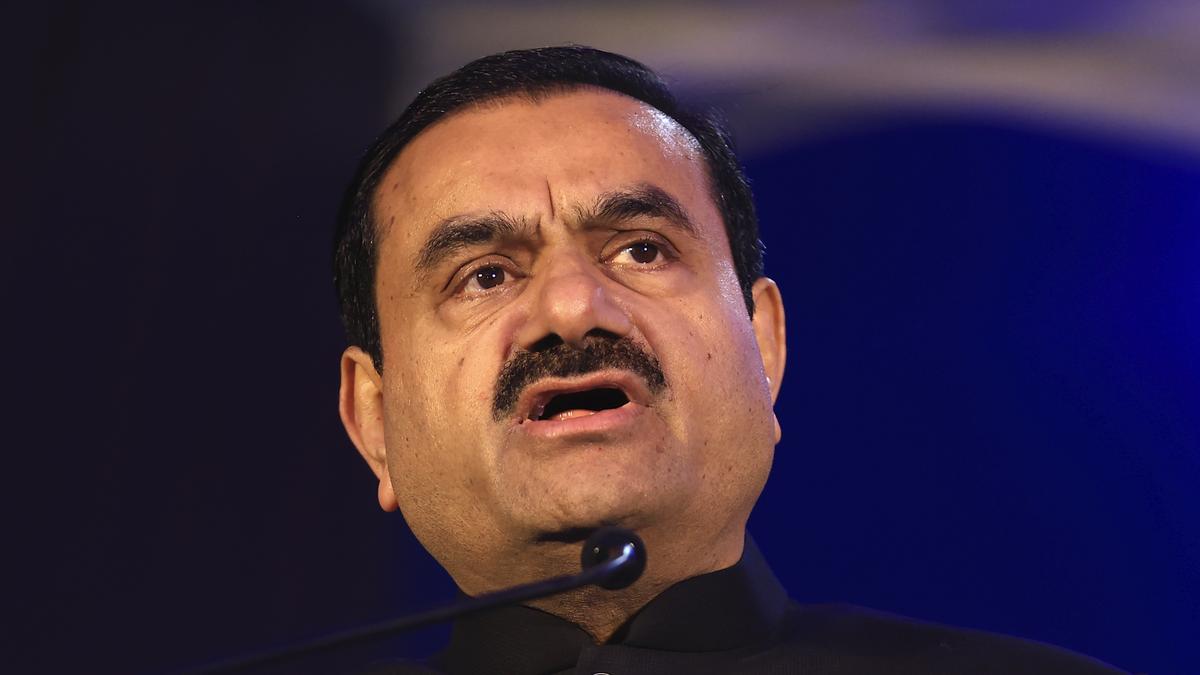
The story so far: Last week, the U.S. Department of Justice charged two officials of a renewable energy company listed in the U.S. in connection with a bribery scheme allegedly perpetrated by Gautam Adani, chairman of the Adani Group, and his associates including his nephew Sagar Adani. Several officials of an Adani Group company have been accused of bribing government officials in various Indian States to receive business favours.
Shares of various Adani Group companies dropped sharply; they have recovered most of their losses in the last week after Adani Green Energy Ltd. (AGEL) filed its first response to stock exchanges, denying the bribery charges pressed by the American market regulator. The Adani Group has claimed that the allegations of bribery cost the group’s listed companies a loss of $55 billion in market value. The conglomerate had notably lost more than $150 billion in market value last year after fraud allegations made by U.S. short-seller Hindenburg Research.
The latest bribery allegations are likely to make it harder for the Adani Group to raise funds from overseas investors, which means the company may have to rely more on domestic investors for its financing needs. Local lenders, including Indian banks that currently lend to the Adani Group, too may review their exposure to the group. The State Bank of India, which is the largest lender to the Adani Group among Indian banks, is exposed with loans worth ₹33,800 crore. While this represents less than 1% of the bank’s total loan book, a Reuters report on Thursday contended that SBI has said it will be cautious about disbursals to the Adani Group. The bank will however, continue funding for projects nearing completion.
Fitch Ratings, Moody’s and S&P Global took negative rating actions on Adani firms this week. As The Hindu reported, citing governance risks for its rating action, Moody’s said there could be a broader credit impact from AGEL’s crisis on group firms “given Gautam Adani’s prominent role as chairman of each of the rated entities or their parent companies as well as the controlling shareholder.” Fitch Ratings also took negative rating actions on the Adani Group’s infrastructure entities. S&P Global Ratings lowered its outlook on three Adani Group entities to negative, pointing at risks to funding access following the U.S. indictment. AGEL had to shelve a $600 million bond issue as a result.
The U.S. DOJ alleges that the AGEL promoter and senior officials paid bribes worth $265 million to officials in Andhra Pradesh, Chhattisgarh, Odisha, Tamil Nadu, and Jammu and Kashmir for the sale of renewable energy produced by AGEL. It is alleged that these bribes were paid so that State power distribution companies (DISCOMS) would purchase eight gigawatts worth of energy from AGEL’s renewable energy project. AGEL had won the right to sell renewable energy to interested buyers through the Solar Energy Corporation of India (SECI), a public sector unit owned by the Centre.
It is alleged that DISCOMS were unwilling to purchase power from AGEL due to the high price quoted. Hence, bribes were paid by Adani Group officials to prod State government officials to purchase power at prices favourable to the Adani Group. Azure Power Energy Ltd., a New Delhi-headquartered energy company listed in the U.S. and whose officials have been indicted for bribery by the DOJ, is also alleged to have colluded with AGEL officials to bribe State officials.
Allegations against AGEL officials could lead to higher costs of capital for the Group and also affect its profitability. However, the allegations may have no impact if lenders were already implicitly aware of potential corrupt practices and factored this in while making their lending decisions. The charges against AGEL have also raised doubts about the Centre’s policy goal of boosting the nation’s renewable energy capacity to 500 gigawatts by 2030.


Indian markets plunged over 3% amid soaring crude prices, rupee depreciation, and escalating West Asia geopolitical tensions in March 2026.

Government launches ₹497 crore RELIEF scheme providing credit insurance to exporters affected by the West Asia crisis, focusing on MSMEs.

Crude oil futures rise amid Middle East attacks, pushing Brent above $116 on fears of tightening global supply.

West Asia conflict delays India’s FTA talks with GCC and Israel, while UK and EU agreements proceed as planned in 2024.

Russian Urals oil vessels will reach India on March 21 amid stable fuel prices and diversified LPG imports.

Warner Bros. dominated the Academy Awards, but Paramount’s looming acquisition of the studio signals the biggest restructuring of the industry in decades and a battle over the future of Hollywood itself

HDFC Bank board calls Atanu Chakraborty’s resignation baffling, affirms robust corporate governance and strong market confidence.

RNFI and Jio Payments Bank launch cardless UPI QR cash withdrawals for instant access across urban, semi-urban, and rural India.

RBI approves HDFC Bank's chairman transition plan, affirming the bank's strong financials and competent management.

Markets fall 2% as Israel attacks Iran’s South Pars gas field, pushing Brent crude above $112 and rupee below ₹93.

HDFC Bank shares drop over 4% following chairman’s ethical resignation, raising insider trading and management concerns.

Erran Berger, the Vice President of Product Engineering at LinkedIn, thinks the former type of division of labour is rapidly disappearing

India mandates oil and gas firms to share import and export data to mitigate consumer shortages amid rising global prices.