How this Bengaluru-based sculptor gives shape to her feelings using clay Premium
The Hindu
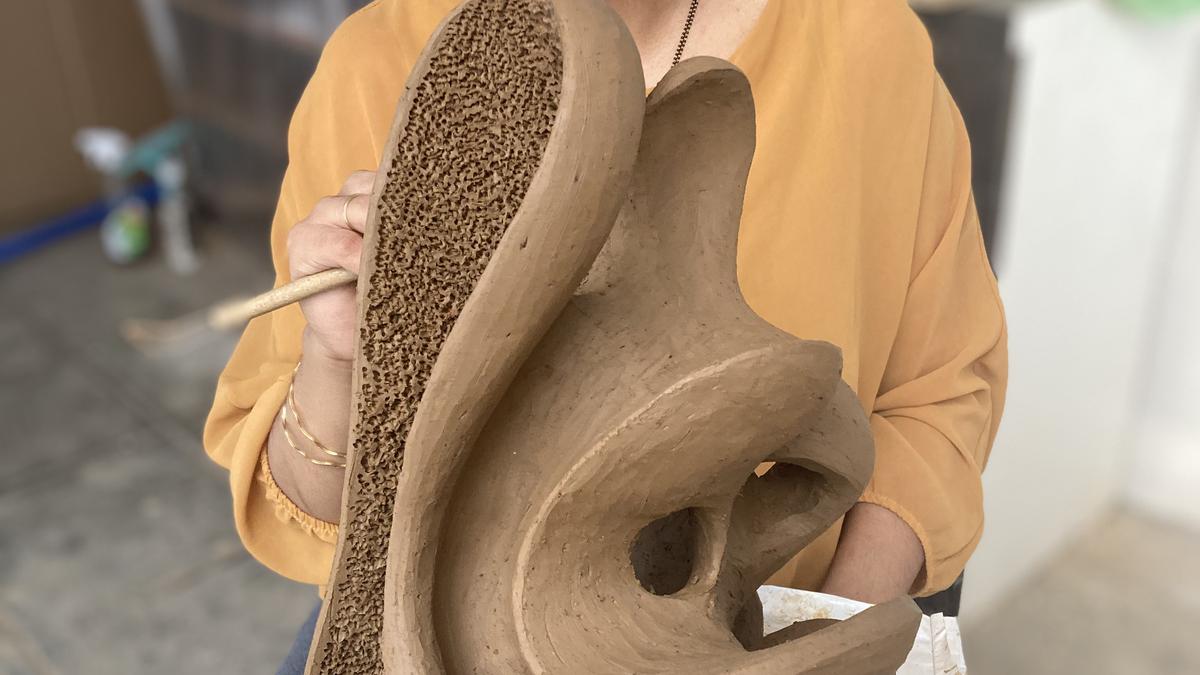
Aarti Gupta Bhadauria, who recently held a solo exhibition of her terracotta sculptures at the Karnataka Chitrakala Parishath, says she has always wanted to be different. It is why she chooses to mould her sculptures out of clay, using only a wire cutter.
“I put all my feelings into my work,” says Bengaluru-based sculptor Aarti Gupta Bhadauria, who recently held a solo exhibition of her terracotta sculptures at the Karnataka Chitrakala Parishath. This recently concluded show, titled Waves of Feelings, was curated by Isha Phillips and Sarbani Chatterjee.
From ‘Waves of Attraction’, a complex, fluid network of crests and troughs to ‘Reflection of Thoughts’, which resembles a womb, and ‘Wave of Blossom’, a gently blooming rose, every sculpture that is part of this exhibition comes from a deep well of emotion. “I am an emotional person, and I feel waves of it in my heart,” says Aarti. “This is my soul,” says the artist, who grew up in Gwalior and holds a bachelor’s degree in Fine Arts with a specialization in sculpture.
Aarti says she has always wanted to be different. It is why she chooses to mould her sculptures out of clay, using only a wire cutter. Talking about what draws her to clay, she says, “If you make something out of fibre or metal, you need a mould. I don’t like being restricted by that.”
Instead, she creates aerial, handmade sculptures made without armature, an aesthetic honed over nearly 20 years, since she began back in 2004. “I chose this material because it is an ancient one and no one promotes it, “she says, pointing out that clay is often restricted to pottery or folk art. “It takes me six months to make every piece,” says Aarti, who moved to Bengaluru in 2009, after her marriage.
Holding out her mobile phone, she flips to her Instagram account to show what she is currently working on; another wave-based sculpture titled ‘Wave of Impermanence’. “I am not sure what it will become,” says Aarti, who has exhibited both in India and the U.S., winning both national and international awards for her artwork. “I will know only when I finish,” says Aarti, claiming that she prefers to let the clay guide her. “I go with the flow,” she adds.


A 'Golden' moment for a K-pop track at the Oscars.

Parvathi Nayar’s new exhibition, The Primordial, in Mumbai, traces oceans, pepper and climate change
Opened on March 12, the exhibition marks the artist’s first solo show in Mumbai in nearly two decades. Known for her intricate graphite drawings and multidisciplinary practice spanning installation, photography, video, and climate change, her artistic journey has long engaged with the themes of ecology, climate change and the natural world. In this ongoing exhibition, these strands converge through a series of works centred on water, salt, and pepper — materials that carry natural and historic weight across centuries.

Explore the highlights and key winners of the 98th Academy Awards, featuring memorable moments and historic achievements from Oscars 2026.

Spring season celebrated at Ramakrishna Mission Institute, Kolkata, with ‘Evening of Basant’

The Spirit of the Land, a solo show by artist Shivakumar Sunagar, is a vista of Nature-inspired emotions

Tal Fry is all set for an exciting new performance season

Netflix is making a bold move by snagging InterPositive, the AI filmmaking company founded by Ben Affleck, in a deal that could hit $600 million

Watch the eerie trailer for 'Hokum,' where Adam Scott faces a witch haunting in a mysterious Irish inn.

Oscars 2026 security heightened amid FBI warnings of a potential Iranian drone threat ahead of the Hollywood ceremony.

Directed by Rahul Pandey, the series also stars Naila Grewal, Nidhi Bisht, Anant Joshi, Anjum Batra and Kusha Kapila

A tribute to the versatile actor and comedian V.K. Ramasamy in his birth centenary year.

‘One Piece’ Season 2 review: As the Straw Hats enter the Grand Line, Netflix’s live-action adaptation finds its sea legs with bigger islands, stranger villains and the same stretch-happy sense of boundless adventure

Geeta Gandbhir, the Indian-origin American filmmaker is waves at this year’s Oscars with not one, but two nominations. Her documentaries, ‘The Perfect Neighbor’ and ‘The Devil is Busy’ are in the race for the Academy Award