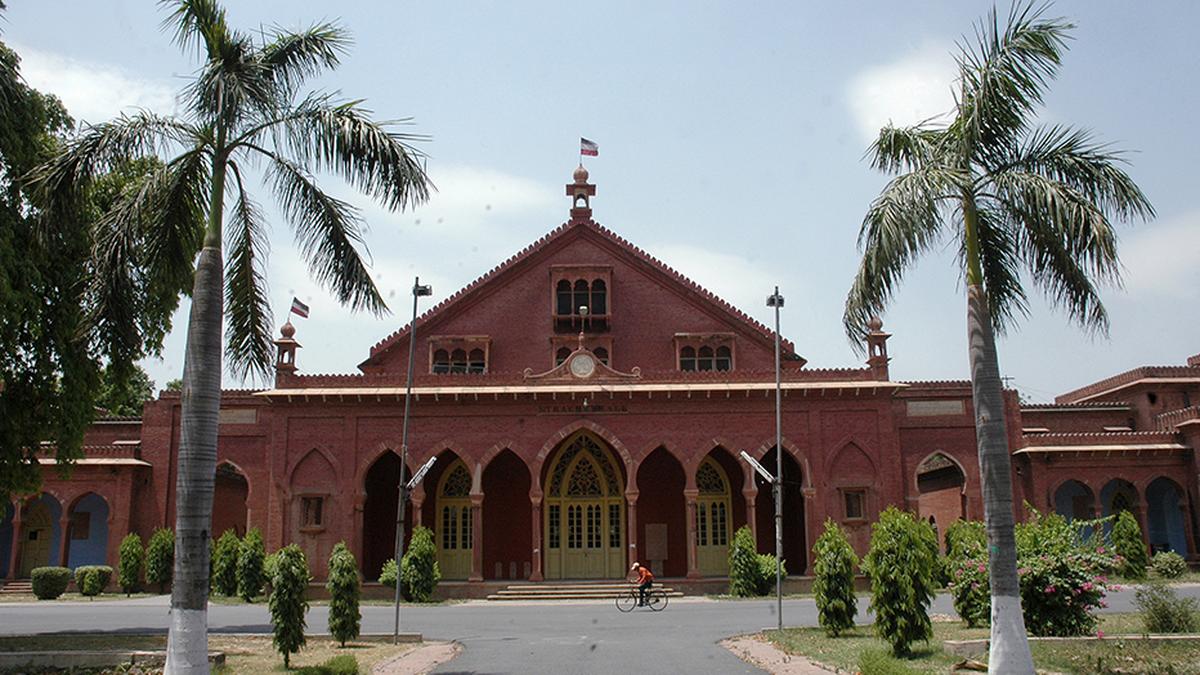
How the Supreme Court cleared the decks for AMU to claim its minority status | Explained
The Hindu
Supreme Court overturns Azeez Basha ruling, affirming AMU's minority status, setting precedent for minority educational institutions in India.
The story so far: In a narrow 4-3 majority verdict, the Supreme Court on November 8, 2024, overturned its 1967 ruling in S. Azeez Basha v. Union of India, which had previously served as the basis for denying Aligarh Muslim University (AMU) its minority institution status. The majority verdict was penned by former Chief Justice of India (CJI) D.Y. Chandrachud and endorsed by Justices Sanjiv Khanna, JB Pardiwala, and Manoj Misra. Justices Surya Kant, Dipankar Datta and S.C. Sharma dissented in separate opinions.
Article 30(1) of the Constitution guarantees religious and linguistic minorities the fundamental right to establish and manage educational institutions of their choice. Article 30(2) further mandates that the state must ensure “equality of treatment” in granting aid to all educational institutions, regardless of their minority status. Notably, such institutions enjoy greater autonomy than most others. Under Article 15(5), they are exempt from providing reservations for Scheduled Castes and Scheduled Tribes, and may reserve up to 50% of seats for students from their own community. In the landmark T.M.A. Pai Foundation (2002) case, the Supreme Court clarified that a ‘minority’ status should be determined based on the demographic composition of the concerned State, rather than the national population.
In 1875, Muslim reformer and educationist Sir Syed Ahmed Khan established the Muhammadan Anglo-Oriental (MAO) College in Aligarh to offer modern British education rooted in Islamic values to Muslims. In 1920, the Aligarh Muslim University Act (AMU Act) was passed, incorporating MAO College and the Muslim University Association into AMU. Under Section 23 of the Act, only Muslims were permitted to be members of the university’s governing body, known as the Court. In 1951, this mandate for Muslim-only representation on the Court was abolished. A subsequent amendment in 1965 redistributed the Court’s powers among other administrative bodies, with provisions allowing the President of India to nominate members to it.
However, in 1967, the Supreme Court, in Azeez Basha, upheld the amendments to the Act, reasoning that AMU was neither established nor administered by the Muslim minority since it had been established through central legislation. This decision sparked widespread protests, ultimately leading to an amendment of the AMU Act in 1981, which officially recognised the university’s minority status.
In 2005, the university introduced a policy reserving 50% of seats in its postgraduate medical courses for Muslim students. This was subsequently challenged before the Allahabad High Court which struck it down on the ground that the university did not qualify as a minority institution as per the Azeez Basha ruling. In 2006, a two-judge Bench of the Supreme Court stayed the reservation policy and referred the case to a larger Bench. In 2019, a three-judge Bench headed by former CJI Ranjan Gogoi referred the Azeez Basha decision for reconsideration by a seven-judge Bench. The matter stayed in limbo till October last year when Justice Chandrachud constituted a seven-judge bench to hear it.
Justice Chandrachud, in an expansive interpretation of Article 30, affirmed that educational institutions established prior to the adoption of the Constitution are equally entitled to the protections granted under Article 30(1). He clarified that statutory enactments conferring legal recognition or status upon such institutions do not compromise their minority character, provided their foundational purpose was “predominantly” aimed at benefiting the minority community.
The majority verdict further emphasised that an institution does not forfeit its minority character simply because its administration is no longer vested with the community. The judges reasoned that founders or the minority community might appoint individuals from outside the community to helm the administrative affairs, particularly if the institution seeks to focus on secular education. “This may be the case for professional colleges which offer specialised courses such as law, medicine, or architecture, where the founders may not possess the knowledge, experience, or insight necessary to manage or administer the institution personally,” they added.


Yakshagana Kalaranga of Udupi handed over its 91st house built in the series of its free houses, to a beneficiary student of its Vidyaposhak Scheme at Japti in Kundapur taluk of Udupi district on Saturday.

Sunil Ambekar of RSS emphasizes national unity, defending road prayer restrictions and promoting awareness of shared ancestry in India.

Kunnathur constituency braces for a factional clash in the 2026 Kerala Assembly polls amid shifting political dynamics.

R. Sarath Kumar expresses concerns over unfulfilled BJP promises and lack of roles for supporters ahead of the 2026 Tamil Nadu elections.

Delhi's hospital merger aims to enhance MBBS and PG seats, boost medical education, and improve healthcare services, says CM Rekha Gupta.

K.C. Tyagi leaves JD(U) to join Rashtriya Lok Dal, aiming to revive his political career in Uttar Pradesh.

Manipur CM Y Khemchand Singh calls meeting with Kuki Zo Council a positive step towards restoring peace and trust.

Papanasam dam's water level is 66.50 feet, with inflow and discharge rates reported.

Suspended Police Inspector P.G. Sandesh faces rape and extortion charges after a college principal alleges sexual assault from 2020 to 2023.

Tamil Nadu CM M.K. Stalin promises improvements to the 'Vidiyal Payanam' initiative, enhancing free bus travel for women and marginalized groups.

Kerala State Electricity Board seeks approval for a medium-term power deal with Damodar Valley Corporation amid procurement challenges.

Environmentalists in Madurai urge government action for the conservation of the endangered Grey Slender Loris in Melur taluk.

CPI leader K. Narayana criticizes Modi's silence on war, urging India to promote peace amid a deepening global crisis.