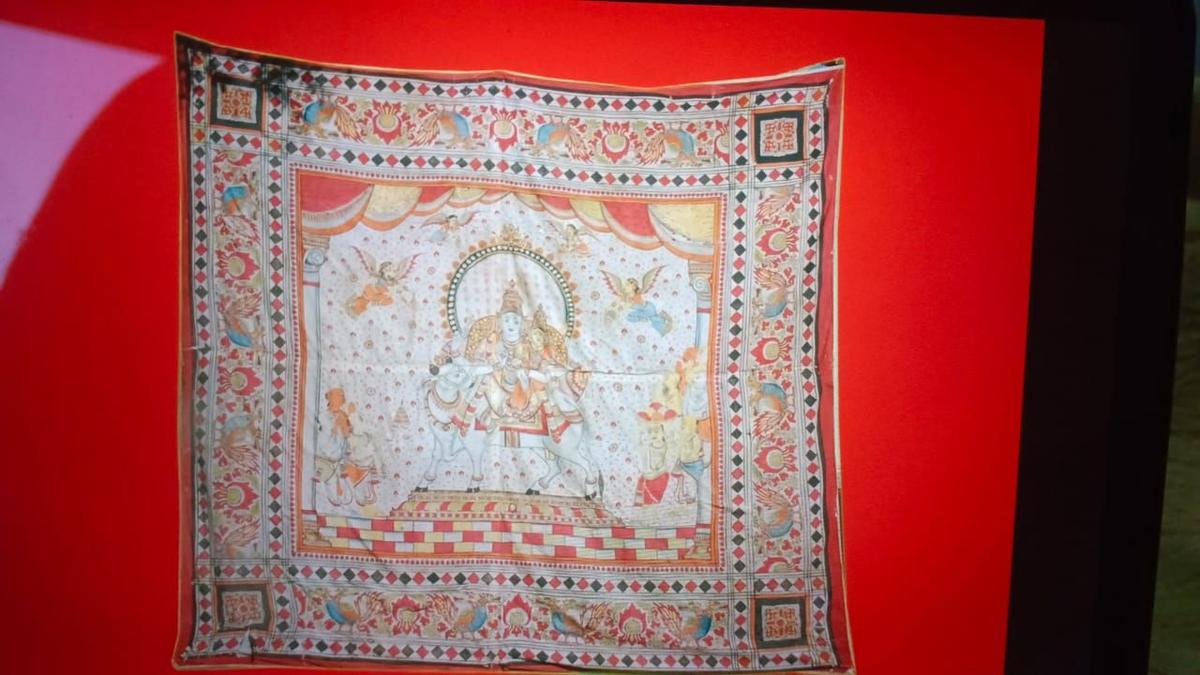
How the Kalamkari craft travelled from Srikalahasti to Thanjavur
The Hindu
Preserving the endangered art of Kalamkari through generations, Rajmohan and Narayanan keep tradition alive with quiet persistence.
When people think of Kalamkari, the first words that come to their minds are Srikalahasti or Machilipattanam and not Karuppur or Thanjavur, though the art form has its roots in the latter towns too. “Kalamkari first found royal patronage in Tamil Nadu in 1540, when Sevappa Nayak, the first Nayaka ruler of Thanjavur , brought a contingent of artists from Karuppur to adorn Thanjavur’s palaces and temples ,” says Kalamkari artist Rajmohan, son of National Award-winning Kalamkari artist R. Emperumal. These artists were descendants of migrants from Andhra Pradesh, where Kalamkari originated.
Also known as Chitrapadaam (‘chitra’ meaning picture and ‘padaam’, tracing), the art form was once used to depict stories from the Ramayana and the Mahabharata. It was later used to create tapestries for palaces, temple hangings, panels for door frames, canopies, umbrella covers, door hangings and tubular hangings and even decorating temple chariots. It eventually evolved into wearable art like sarees and duppattas, and utility items such as bags and bookmarks.
As Rajmohan shows us the works of his ancestors, including a tapestry that is more than 400-years-old, he says, “I recreate old pieces with a touch of modernity, yet try to keep alive the methodology adopted by my ancestors. For instance, he uses freshly-obtained paints or dyes the same day. The paints do not have a shelf life, as they are derived from nature. I do not use paints or dyes containing preservatives as they do notmatch the depth and richness that naturally-derived ones impart.” The handmade pens or kalams that he uses are crafted from bamboo and tamarind twigs. While bamboo twigs are used as it is, the tamarind ones are burnt and covered in soil overnight before use.
Rajmohan’s family has been practising kalamkari for more than 800 years now. A BFA graduate, who also studied filmmaking from MGR Film Institute, Rajmohan learnt the kalamkari art from his father. “There were no formal classes, I learnt by observing him. My son also learns the same way”, he says. “The art form has been slowly fading into obscurity. When royalty was abolished in India, the patronage disappeared, and with it, the livelihood of many artists. They were given land and money, but not the means to learn another trade, and hence languished”, he shares.
Not far away from Rajmohan’s residence, Lakshmi Narayanan keeps the art alive in a different way. “This is an endangered art,” says Lakshmi Narayanan, who runs a unit with Kalamkari workers in his two-storeyed home. Narayanan, whose family has been practising the art form that obtained a GI (geographical indication) tag for more than 400 years, explains how the motifs and colours set the Karuppur style of Kalamkari apart from the Srikalahasti style. Narayanan, who began working as a Kalamkari artist at the age of 15, feels that the market remains uncertain even today as handmade items are slowly regaining appreciation from customers. “We wait for over 20 days for profits to come our way. And if there is a small error, then we lose up to ₹ 17,000 or even ₹20,000 — that is how much a fully-worked kalamkari saree can cost” he shares.
“People who buy it need to understand the volume of work that goes into making a saree or even a dupatta. First, the design is traced using charcoal. It is then treated with a mixture of cow’s milk, starched and dried. Then, we fill in the black colour, wash and dry it; the process is repeated for each colour ,” he explains. “Black is derived from rusted iron, yellow from turmeric, and red from cinnamon,” he shares. A single saree can take 15 to 20 days, depending on the intricacy of the design. “Sales mostly happen through word-of-mouth,” he says. “Sometimes, boutiques approach us, but sporadically. We are the only family in this village that makes and sells Kalamkari products commercially,” he says and adds that both his sons (still studying) will eventually take up the craft.
Now, with quiet persistence, both Rajmohan and Narayanan ensure that this endangered art is not forgotten. They’re not just preserving a technique but a tradition that is passed on through generations.


Explore 2026's wallpaper trends in India, highlighting botanicals and handmade designs that enhance modern homes with nature-inspired aesthetics.

Mercedes-Benz CLA 250+ with EQ Technology review: design, performance, range and features explained. Discover how the new electric CLA combines advanced AI, long range, fast charging and futuristic styling for the next generation of luxury EVs.

AI tool for sparrow conservation

BTS’s comeback with ‘Arirang’ marks a major global music event. When does the album release, and where can you watch their concert live stream? We have all the details

The 2026 U.S. cholesterol guidelines urge starting screening and treatment at 30 to prevent cardiovascular disease effectively.

Olam Festival 2026 in Thiruvananthapuram returns March 27-29 with 120+ vendors, music, art, and cultural zones.

A few storytellers in Thiruvananthapuram share their journeys, challenges, and evolving methods on World Storytelling Day, inspiring young minds.

76-year-old Kurian Jacob from Kerala triumphs with seven medals, including five golds, at the Open Masters Games in Abu Dhabi.

Explore the nature of the human mind as an emergent property of brain activity and complex neural interactions.

CERN's Large Hadron Collider discovers the Xi-cc-plus particle, enhancing understanding of quantum mechanics and baryon behavior.

Vibha Batra’s latest book, Spotless (Hachette India) is a novel in verse for young adults

In its first edition, the Madras Art Salon spotlights the works of journalist and artist Narayan Lakshman at The Botanical Club, a social space in the British Deputy High Commission, Chennai

Cholesterol enhances melanoma cell invasion by making nuclei squishier, revealing a potential treatment target in cancer progression.