How researchers are mapping genetics in N.B. to detect inherited diseases sooner
CBC
Researchers at Vitalité Health Network imagine a health-care system where patients are screened early for a disorder or disease they inherited from their parents, and mothers know exactly what health problems they could pass down to their children before ever getting pregnant.
But first, medical teams need to know which genetic variants are common in specific regions of New Brunswick. Luckily, we are built of microscopic indicators that researchers in Moncton are studying so they can figure that out.
"We have thousands of genes," Jean Mamelona, who runs the provincial program of medical genetics, said. "We are going, specifically, to analyze the genes to see if there is a defect or … a default on the gene."
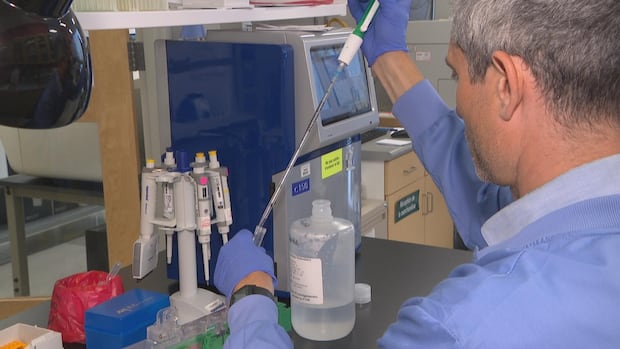
Mamelona and his research team at the Dr. Georges-L.-Dumont Hospital are touring the province to map people's genes to build the first database of its kind for each of the seven health zones in the province.
Genes provide a wealth of information about the body. But this research is focused on finding defects, otherwise known as variances or mutations. These can cause genetic disorders.
The hope is that medical teams will use that information to screen people earlier for conditions such as sickle cell anemia, cystic fibrosis and Huntington's, among others.
It could also be invaluable to inform more precise neonatal screening, Mamelona said.
"We can plan precision medicine for the area," he said.
The project, which began in 2018 and is partly funded by Research N.B., is expected to be complete once 60 people in each of the seven health zones have been tested by the end of 2027.
Teams have been testing 60 participants in each health zone who can provide medical information and a swab of DNA to be tested.
So far, the team has tested people near Moncton, on the Acadian Peninsula, and in Restigouche and Madawaska.
Results from some areas, such as the Acadian Peninsula and northwest regions, have not yet been released to the public.
The results from Zone 1, in the southeast, show that Acadians who were tested have similar genetic variants that are likely being passed down from generation to generation.
"We have seen that there are some variants that are really more frequent, compared to Caucasian populations elsewhere around the globe," Mamelona said.


Snuneymuxw First Nation is calling for a temporary closure and environmental investigation of a hazardous waste services company following a January oil spill on Duke Point near Nanaimo, B.C.

In February, five people were killed in separate avalanches across B.C. and Alberta. That same month, more than a dozen people were killed in California and Utah, including a particularly deadly avalanche that claimed the lives of nine. In Europe, from Andorra to Slovakia, the season has recorded 125 deaths from avalanches so far.

Getting a proper vehicle to transport people for urgent medical care is an ongoing challenge in fly-in First Nations in northwestern Ontario.

A new supergroup of musicians from Six Nations of the Grand River and Mississaugas of the Credit First Nation have collaborated on a Robbie Robertson-inspired song they will perform at the Junos Honouring Ceremony later this month in Hamilton.

People as young as 45 should be invited to provincial and territorial programs to screen for colorectal cancer, the Canadian Cancer Society urged on Wednesday.

The Métis Nation-Saskatchewan (MN-S) has opened an office and retail space in Ottawa to create a stronger presence in the capital since removing itself from the Métis National Council in 2024.

Toronto resident Winhan Wong's lung cancer journey began in 2016, with a nagging cough that just wouldn't go away.

Last month, Assembly of First Nations National Chief Cindy Woodhouse Nepinak pointed out on social media that history was made this year because there are a record 164 female chiefs serving across the country.

Most of humanity has a great propensity to think in the short-term, but generally, long-term considerations — air pollution, deforestation and emissions, for example — just aren't our thing.

As the COVID-19 pandemic began to unfold in early April 2020, Kolter Bouchard was just weeks into fatherhood when he noticed a lump on his neck.

Advocates and health care providers say they remain concerned about First Nations kids seeking services under Jordan's Principle even after the Canadian government’s recent promise of $1.55 billion in funding.

Contrary to science fiction, black holes are not portals to other dimensions or cosmic vacuum cleaners that swallow up everything around them.

An attempt to preserve files documenting some of the worst harms caused by Indian Residential Schools could soon head to Parliament.