How Rang De Basanti created a challenging storyboard for future filmmakers
The Hindu
The making of a contemporary classic Rang De Basanti set a trend in filmmaking with its unconventional narrative style
In one of Rang De Basanti’s (RDB) many moments of frank criticisms, Aamir Khan’s character, Daljeet, comes up with a dehati (rustic) logic to sum up the complexities of today’s India. He says: “With one leg in the past and one in the future... it’s no wonder we’re peeing on the present.” Incidentally, the film’s narrative style, with the past and the present running parallelly, did create a convincing and challenging storyboard for future filmmakers.
Rang De Basanti was a truly daring film — its success, connect, influence and referencing (cinematic and academic) is a testament to that fact. For those interested in studying people’s movements of the early 21st century India, like Anna Hazare’s ‘andolan against corruption’ (2011) , it would be worth researching the role of new millennium celluloid social critiques like Rang De Basanti and Lage Raho Munna Bhai (2006).
The film’s idea of peaceful candle light protests to voice the common man’s angst against a corrupt system, found itself replicated by those campaigning for justice in the Jessica Lal murder case, a fact acknowledged by the makers of No One Killed Jessica (2011), a film based on the trial.
Rang De Basanti begins with British filmmaker Sue McKinley’s (Alice Patten) desire to make a documentary film on the five young freedom fighters — Bhagat Singh, Chandrasekhar Azad, Rajguru, Ramprasad Bismil and Ashfaqullah Khan — who never lived to see an independent India.
The trigger happens to be her grandfather James McKinley’s accounts in his personal diary as a jailer in pre-independent India. Sue’s decoding of her grandfather’s ‘silent’ interactions with those revolutionaries on death row, inspire and urge her to a point of creative obsession to voice those silences through a popular, visual medium like cinema.
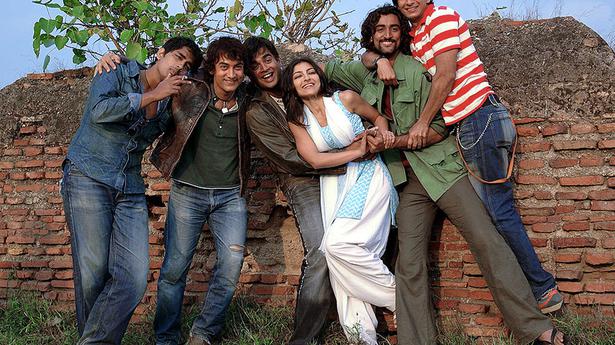
On reaching India, Sue however, has to first contend with the frustration of not finding good actors, who can understand and emote the essence of those young revolutionary heroes, until her host, friend and a Delhi University student, Sonia (Soha Ali Khan) introduces her to an eclectic and talented, yet seemingly aimless college gang of DJ (Aamir Khan), Sukhi (Sharman Joshi), Aslam (Kunal Kapoor) and Karan Singhania (Siddharth) apart from Sonia’s fiancé Ajay Rathod (Madhavan), and a Hindutva foot soldier Laxman Pandey (Atul Kulkarni). They are not only representatives of the modern Indian youth in its varied aspirations, but also in a clever twist of social context setting, represent the religious, social and economic diversity of India. So, you have a rich boy, a working-class boy, a middle-class boy, and a man employed with the defence services — between them hailing from Hindu, Muslim and Sikh communities.
Interestingly, when Sue recruits DJ and his pals to play the roles of the young freedom fighters, she’s surprised by their lack of interest in these Indian heroes she’s been idolising all along. Their disregard for history and an attitude of uprootedness, is, however, abruptly transformed when Ajay dies in a plane crash because of the faulty parts in the old MIG fighter plane he was flying. To deflect the media’s probing questions on corruption in defence sector purchases, the defence minister defames Ajay’s sacrifice on TV. DJ and his gang, meanwhile, to honour Ajay’s memory and reputation, plan a peaceful candlelight vigil at India Gate. Police crackdown follows, in which Ajay’s mother is critically wounded and goes into a coma. That’s when DJ and his friends, inspired by their recent date with revolutionary history, feel impelled to kill the defence minister.


The government plans to amend the FCRA, introducing new regulations for NGO asset management and accountability for key functionaries.

The draft policy for “Responsible Digital Use Among Students”, released on Monday by the Department of Health and Family Welfare, has recommended that parents set structured routines with clear screen-time rules and prioritise privacy, safety, and open conversation with children on digital well-being.

Police Observer Sushant Kumar Saxena conducts surprise inspection at Shencottai police station, reviewing warrants and security arrangements ahead of elections.

Andhra Pradesh government to launch key projects in April, focusing on industrial growth and infrastructure development, says Nara Lokesh.

Lok Sabha refers the Corporate Laws (Amendment) Bill to a JPC amid opposition concerns over CSR provisions dilution.

SHG members in Kanniyakumari use snakes and ladders to raise election awareness and boost voter turnout.

Government accelerates consultations for early implementation of the Women’s Reservation Act to ensure women’s representation in 2029 elections.

CM A. Revanth Reddy distributes ₹1 crore insurance cheques to families of deceased Electricity department employees, enhancing financial security for workers.

The Bengaluru Traffic Police (BTP) registered 634 cases of drunk driving during a week-long special enforcement drive conducted across the city between March 16 and March 22.

GHMC intensifies action against property tax defaulters, seizing properties and offering a One Time Settlement scheme for payments.

CCB arrests three drug peddlers in Mangaluru, seizing ₹2.5 lakh worth of MDMA and other valuables.

TVK's 28 candidates in Puducherry include former BJP MLAs, a sitting Independent, and a retired police IG.

BRS submits notice on private member bill to Speaker